Hotel PMS and IPTV Integration: What Actually Needs to Connect
August 17, 2026
By COTT.TV Hospitality Technology Research Desk·Published August 17, 2026·6 min read


Quick Summary
By the COTT.TV Hospitality Technology Research Desk | Updated 17 August 2026
By the COTT.TV Hospitality Technology Research Desk | Updated 17 August 2026
A property-management integration should make the room television behave like part of the stay: greet the right guest, activate at check-in, remove personal state at checkout and send approved charges or requests to the correct room. It should not become an uncontrolled copy of the PMS database.
The best integrations are deliberately small. They identify the property, reservation, assigned room, stay status and the limited guest attributes needed for the agreed experience. Everything else should remain in the PMS unless a documented use case requires it.
Start with outcomes, not an API shopping list
Before discussing endpoints, write the operational outcomes:
- 1show a welcome message after the room is assigned;
- 2select the guest language where available;
- 3enable services during the stay;
- 4post an approved paid item to the room account;
- 5clear OTT credentials, pairing and guest data at checkout;
- 6reassign safely after a room move;
- 7keep working when the PMS connection is temporarily unavailable.
Each outcome maps to a small set of data and events. This prevents the common mistake of requesting broad PMS access because it might be useful later.
The minimum useful data model
| Data | Typical purpose | Keep in TV platform? |
|---|---|---|
| Property ID | Separates hotels and credentials | Yes |
| Room ID and display number | Binds physical endpoint to PMS room | Yes |
| Reservation/stay ID | Handles updates and idempotency | During operational need |
| Check-in/checkout status | Activates and resets experience | Current state plus audit |
| Guest display name | Optional welcome | Minimise and delete at checkout |
| Preferred language | Localises interface | During stay or as anonymous setting |
| Balance, passport, payment card | Usually not required | No |
The room number shown to staff is not always a stable technical identifier. Hotels rename rooms, use connecting-room labels or maintain separate accommodation IDs. Store both the PMS identifier and the display number.
Event-driven beats constant polling
Modern PMS platforms expose webhooks or event APIs. Cloudbeds webhooks, for example, can notify an integration about reservation creation, status changes and accommodation changes. The integration then fetches only the detail required for the event.
Polling still has a role as reconciliation. A periodic job can detect a webhook that was missed or delayed. The strongest design uses events for speed and reconciliation for correctness.
Every event handler should be idempotent. If checkout arrives twice, the second message must not create a second charge, error or inconsistent reset. Store the provider's event or reservation reference and the result.
How major PMS integration patterns differ
Cloudbeds
Cloudbeds provides a PMS API and event subscriptions tied to permission scopes. Property-specific subscriptions matter in multi-property accounts. The hotel should approve only scopes needed by the integration.
Mews
The Mews Open API provides a general-purpose Connector API alongside purpose-specific APIs. Certification, partner identity and change management should be planned rather than treated as a final-week task.
Oracle OPERA Cloud
Oracle Hospitality Integration Platform uses OAuth, an application key and property context. Oracle's OHIP property API documentation lists the authorisation token, x-app-key and x-hotelid as core headers. OPERA product, version, enabled interfaces and commercial access must be confirmed per project; "supports Opera" is not a complete scope.
Legacy and on-premise PMS
Older systems may expose file drops, proprietary interfaces or certified middleware rather than modern webhooks. They can still be integrated, but the proposal should name the interface, ownership, test environment, vendor fee and failure model. Do not price a generic "PMS integration" line without knowing the actual product and version.
The checkout reset is the critical control
The hotel TV platform should treat checkout as a security event. The reset may include:
- 1remove guest name and stay information;
- 2clear installed OTT application credentials where supported;
- 3terminate casting and mobile-companion sessions;
- 4cancel room-specific service tokens;
- 5restore language and accessibility defaults;
- 6return to a clean hotel landing page;
- 7record success or flag the room for staff intervention.
A reset command can fail because the television is offline. The backend should retain a pending reset and apply it when the device reconnects. "We sent the command" is not equivalent to "the room is clean."
Design for PMS downtime
The television should continue live TV, hotel information and basic services when the PMS is unavailable. Queue non-urgent actions, mark uncertain state clearly and reconcile after recovery. Do not make the entire guest interface dependent on a synchronous PMS response at every launch.
Define a manual room reset for reception or NOC. In an incident, staff need one safe action, not database access.
Security and privacy checklist
- 1one credential set per hotel or appropriately scoped chain account;
- 2least-privilege PMS scopes;
- 3secrets in a managed store, never in the TV application;
- 4encrypted transport and verified webhook signatures where supported;
- 5event and administrative audit logs;
- 6guest display data removed at checkout;
- 7property separation tested with two real tenants;
- 8defined retention and incident-notification rules;
- 9no card, passport or sensitive profile data without a necessary use case.
Acceptance tests before go-live
Test check-in with and without a room assignment, room move, name correction, back-to-back stay, early checkout, cancelled check-in, PMS outage, duplicate event, offline television and delayed reconnect. Use the hotel's real numbering pattern and at least one room on every relevant floor or network segment.
The integration is complete when operations can explain the failure path, not merely when a welcome name appears once.
COTT.TV and PMS integration
COTT.TV supports property-scoped PMS integrations and handles each deployment against the actual PMS product, version and interfaces. The system can link stay state to the guest television, room services and checkout cleaning workflow while keeping the room experience operational if the PMS is briefly unavailable.
See the COTT.TV platform demonstration or review downloads and deployment help. For enterprise or chain projects, the integration scope is documented as part of technical validation.
Sources and further reading
- 1Cloudbeds PMS API introduction
- 2Cloudbeds webhooks documentation
- 3Mews Open API documentation
- 4Oracle Hospitality: calling OHIP property APIs
- 5Oracle Hospitality API specifications
PMS access, certification, fees and available events vary by provider, product, region and hotel contract. Confirm them before issuing a binding integration scope.
Related Posts
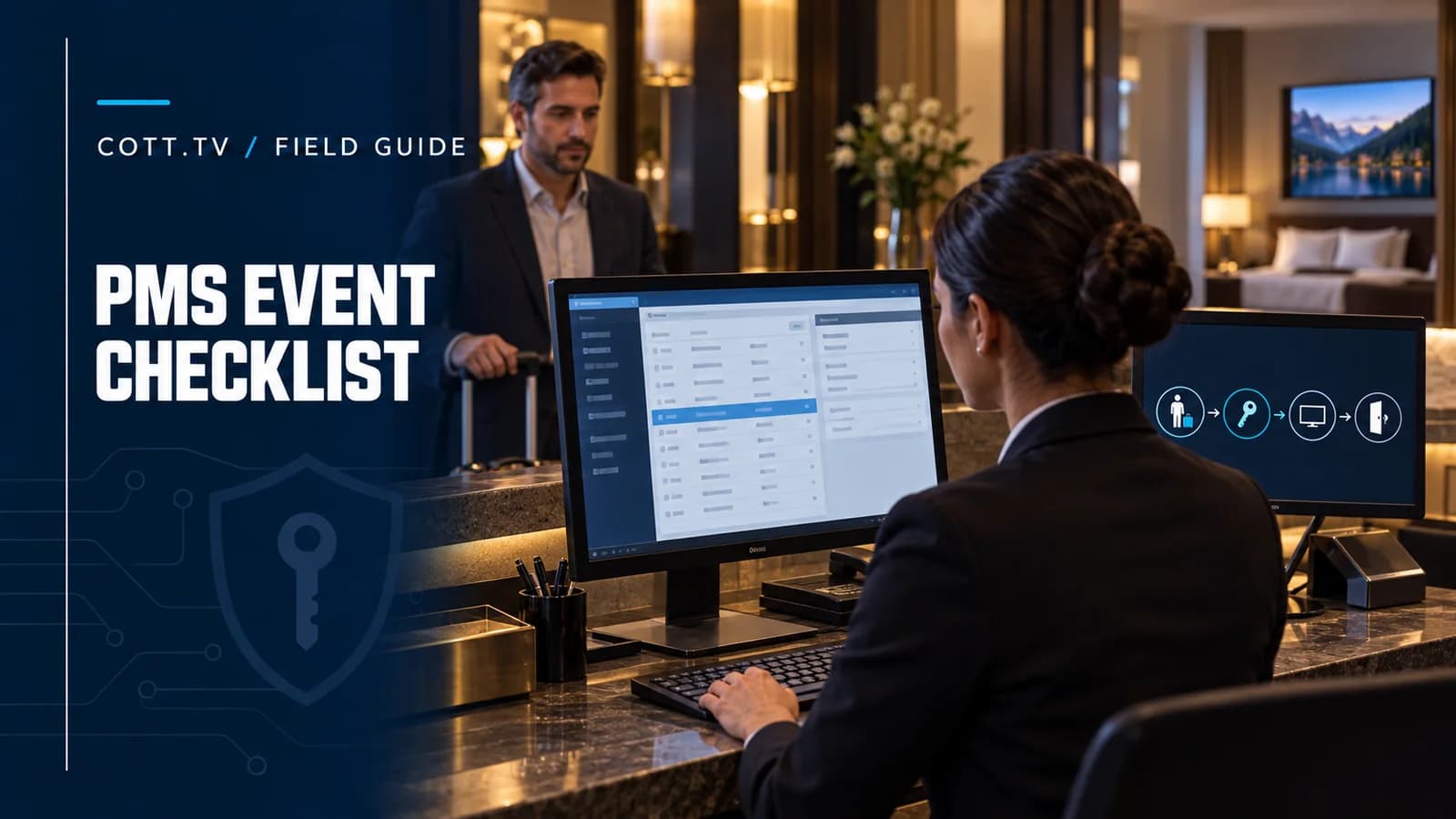
Hotel PMS Events for TV Systems: Check-In, Room Move and Checkout Done Properly
2026-10-02
An event-driven integration pattern with idempotency, reconciliation, privacy controls and failure recovery for hotel room technology.
Housekeeping and Maintenance Requests: Designing a Closed-Loop Workflow
2026-09-01
A practical workflow for turning guest and staff requests into accepted, timed and verified tasks instead of messages that disappear between departments.
PMS Checkout Data Hygiene: What Must Be Wiped From the Room
2026-08-30
A room-by-room data reset model for guest names, OTT credentials, casting sessions, messages, orders and stay tokens after checkout or room move.