Hotel PMS Events for TV Systems
October 2, 2026
Research period: September 2026
By COTT.TV Hospitality Technology Research Desk·Published October 2, 2026·6 min read

Quick Summary
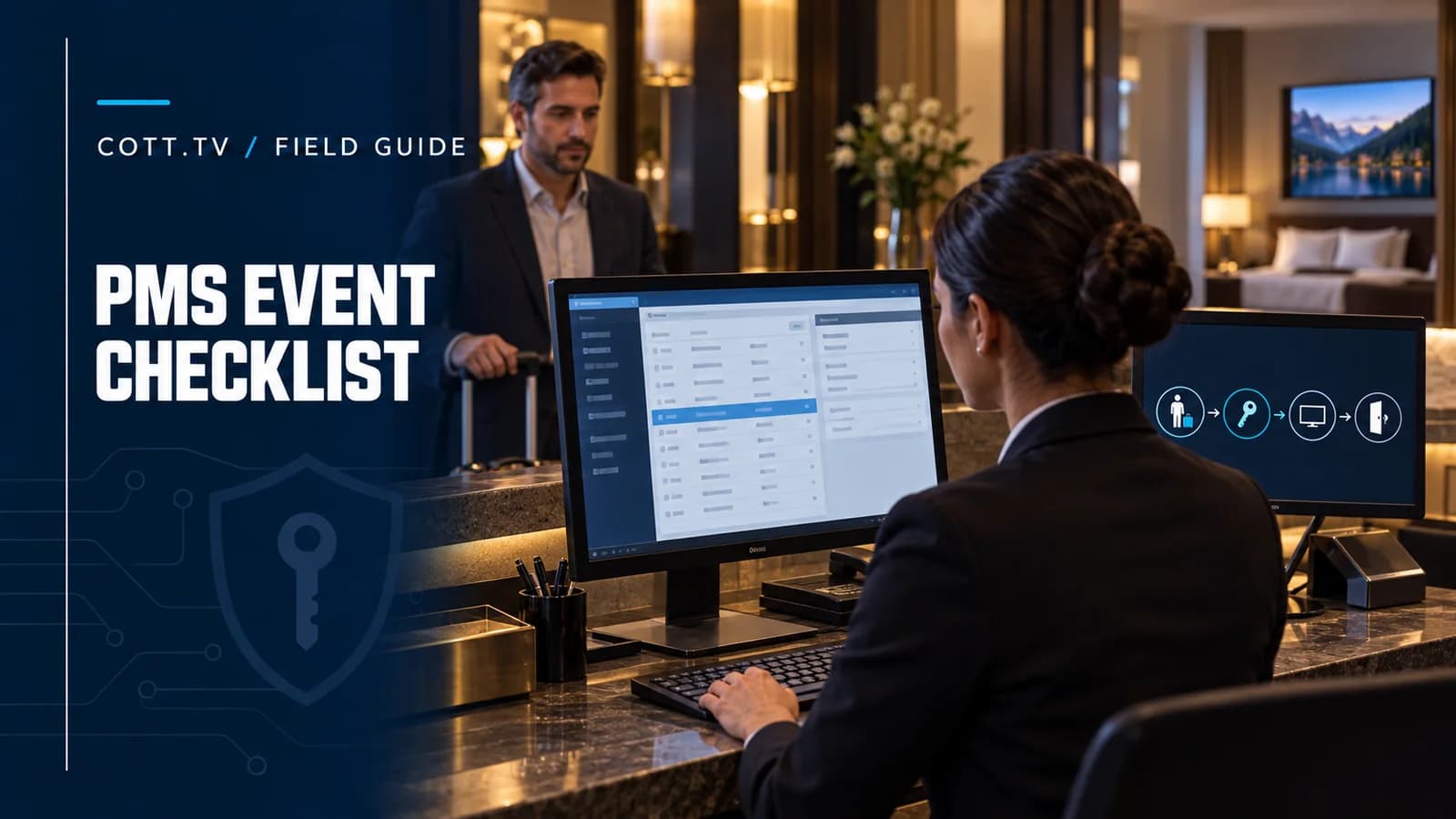
Consume the minimum events and fields, make every event idempotent, store a property-scoped mapping, acknowledge only durable work, reconcile regularly with the PMS, provide a safe manual reset and prove that checkout clears all guest state even after outages.
By the COTT.TV Hospitality Technology Research Desk | Researched September 2026
A PMS integration is often sold as personalisation: the television welcomes the guest by name and changes language automatically. The operationally important event is checkout. If that event is missed, a previous guest's name, messages, casting relationship or OTT session may remain in the room.
A production interface must therefore be designed as a recoverable state machine, not a one-way feed of attractive guest data.
Define the room state
The television platform should have an explicit room state, for example:
- 1vacant and clean digital state;
- 2assigned or expected arrival;
- 3checked in;
- 4room move pending;
- 5checked out and cleanup pending;
- 6integration exception requiring review.
Do not infer the complete state from whether a guest name exists. A name can be absent for privacy reasons while the stay is active, and it can remain accidentally after departure.
Use the smallest event set
Typical events are:
Check-in or room assignment: create the stay-room relationship and apply approved language or welcome context.
Reservation update or stay extension: change the expected checkout without rebuilding the room unnecessarily.
Room move: clean the old room and establish the new room as one coordinated operation.
Checkout: revoke stay-specific access and launch the complete cleanup workflow.
Reinstatement or correction: recover from a checkout posted in error or a corrected room assignment.
The integration may also need a periodic room-status query for reconciliation. Avoid subscribing to every available PMS event simply because the API exposes it.
Idempotency is mandatory
Event systems retry. Networks disconnect. Staff correct reservations. The same checkout may arrive more than once.
Create an idempotency key from the PMS environment, property, event identifier and version or timestamp. Processing the event a second time must produce the same safe result rather than another charge, duplicate message or inconsistent room record.
Store the event durably before acknowledging it. If an application confirms receipt and crashes before cleanup, the PMS may consider the delivery complete while the guest state remains active.
Room moves are two-sided
A room move contains two obligations:
1. remove the guest state and entitlements from the old room; 2. establish the current stay in the new room.
Treating the move as only a second check-in leaves data behind. Treating it as only a checkout interrupts the guest in the new room.
Use one workflow with a correlation identifier and visible status for both rooms. If the new room cannot be prepared, the old-room cleanup should still be escalated and completed deliberately.
What checkout should clear
Depending on the deployed features:
- 1guest name and personalised language;
- 2welcome messages and reservation details;
- 3room-specific QR or web session;
- 4casting receiver associations;
- 5native OTT credentials managed by the system;
- 6VOD rentals or entitlements according to policy;
- 7service-request drafts and private messages;
- 8temporary access tokens;
- 9cached personal content.
Keep operational audit evidence separate from guest-facing state. The hotel may need to know that cleanup succeeded at 11:04 without retaining what the guest watched.
Minimise the PMS data contract
For many TV use cases, the platform needs only:
- 1property and room identifier;
- 2stay or reservation reference in pseudonymous form;
- 3check-in and checkout state;
- 4preferred language if available and justified;
- 5display name only when the hotel chooses personalised greeting;
- 6event identifier and timestamp.
Payment details, passport data, full address and reservation notes do not belong in a television integration. The European Commission's GDPR guidance requires data minimisation and storage limitation; a narrow contract also reduces security and support complexity.
Oracle OHIP as an example
Oracle Hospitality Integration Platform uses registered applications, OAuth credentials and approved property environments. Business Events can be configured by category, event and selected data elements. Oracle's current documentation notes that integrations receive the data elements selected in event filters, which makes configuration part of the integration contract.
Production planning should include:
- 1OPERA Cloud and OHIP eligibility;
- 2UAT and production application credentials;
- 3enterprise and hotel identifiers;
- 4event template and selected filters;
- 5hotel approval for the partner application;
- 6streaming or polling route;
- 7reconnect, replay and retention behaviour;
- 8subscription and pay-per-call implications.
Other PMS products expose different mechanisms, but the same operating controls still apply.
Reconciliation closes the reliability gap
No event channel should be the only source of truth forever. Run a scheduled reconciliation that compares active PMS stays with active room sessions.
The job should find:
- 1checked-out rooms with guest state still active;
- 2checked-in rooms lacking an active room session;
- 3room moves completed on only one side;
- 4unknown room identifiers;
- 5events that failed repeatedly;
- 6integration inactivity suggesting a lost subscription.
Use a conservative repair policy. Automatic removal of stale guest state is usually safer than automatic creation based on ambiguous data.
Failure design
| Failure | Required behaviour |
|---|---|
| PMS temporarily offline | Keep the room usable and queue/reconcile later |
| Duplicate event | Process idempotently |
| Event arrives out of order | Compare version/state before applying |
| Unknown room | Quarantine and alert; do not guess |
| Checkout cleanup partly fails | Mark room unsafe digitally and retry |
| Credentials expire | Alert before or immediately at failure; retain no secrets in logs |
| Integration revoked | Remove subscriptions as required and surface a critical incident |
Reception needs a manual "clear guest state" action with role control and audit. It is a safety control, not a replacement for the interface.
Acceptance scenarios
Test at least:
1. normal check-in and checkout; 2. same-day back-to-back guests; 3. room move before and after television use; 4. checkout while the television is offline; 5. PMS outage followed by recovery; 6. duplicate and delayed checkout; 7. stay extension after a scheduled cleanup time; 8. wrong room corrected by reception; 9. application or STB replacement during an active stay; 10. reconciliation after all events above.
Inspect the television and mobile continuation as the next guest would. Database status alone is not final evidence.
COTT.TV integration model
COTT.TV maps PMS events to property, room, registered device and guest-session state. The same checkout workflow can clear the television interface, QR continuation, casting relationship and supported OTT credentials. Property administrators retain a controlled manual reset for exceptions.
Start with the broader PMS and IPTV integration guide, then use this event checklist with the PMS and hotel teams during implementation.
Sources and further reading
- 1Oracle OHIP: working with events
- 2Oracle OHIP: hotel quick start
- 3Oracle OHIP: partner streaming guidance
- 4European Commission: GDPR processing principles
PMS products, subscriptions and event semantics vary. The hotel and integration partner should verify the exact production environment and data-processing roles.
Related Posts
PMS Checkout Data Hygiene: What Must Be Wiped From the Room
2026-08-30
A room-by-room data reset model for guest names, OTT credentials, casting sessions, messages, orders and stay tokens after checkout or room move.

Secure Hotel Casting in 2027: AirPlay, Google Cast and Checkout Privacy
2026-09-22
A technical and operational guide to room-specific pairing, network isolation, checkout reset and acceptance testing for hotel casting.
Housekeeping and Maintenance Requests: Designing a Closed-Loop Workflow
2026-09-01
A practical workflow for turning guest and staff requests into accepted, timed and verified tasks instead of messages that disappear between departments.