LG Pro:Centric or Philips MediaSuite: A Hotel Procurement Comparison
November 2, 2026
Research period: October 2026
By COTT.TV Hospitality Technology Research Desk·Published November 2, 2026·9 min read

Quick Summary
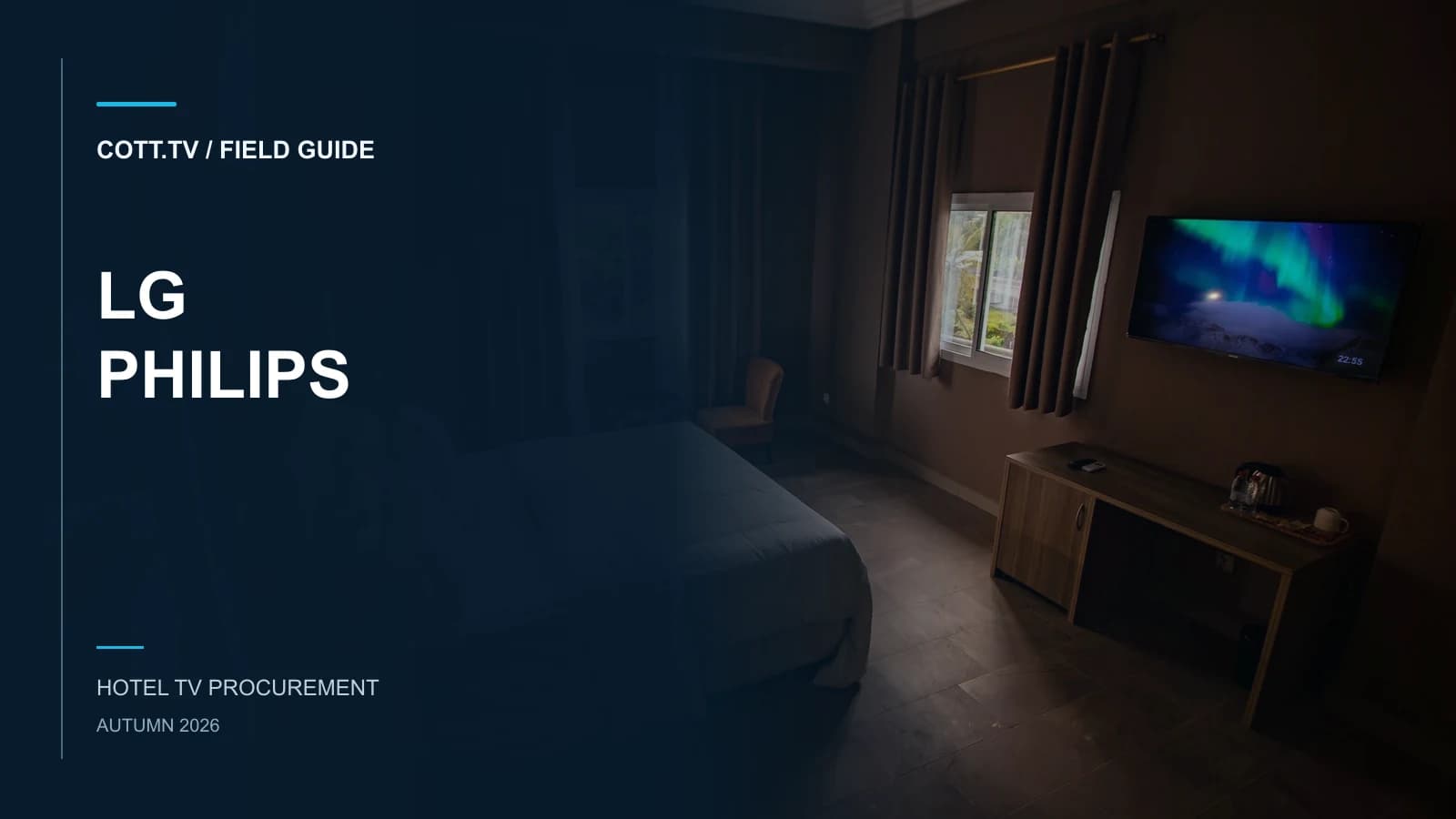
LG Pro:Centric and Philips MediaSuite offer distinct management platforms and casting features. LG’s Pro:Centric focuses on centralized hotel control, while Philips MediaSuite leverages Android TV and built-in Chromecast. Procurement should prioritize workflow fit, management…
A hotel TV tender should begin with the work the system must support: preparing rooms, maintaining settings, helping guests connect devices and protecting their information at checkout. A feature on a manufacturer’s specification page is a starting point, not proof that a complete hotel installation will perform that workflow.
This comparison uses two specific examples: the LG 55UK762H Europe/CIS variant and the Philips 43HFL5114/12 MediaSuite. They differ in size and resolution, so they are useful for examining platform approaches, not for declaring a winner on picture quality, price or value. Neither specification should be applied to every TV carrying the same brand or product-family name.
Start with the room operation
Write down who will change the welcome screen, restrict settings, assist with casting and prepare the TV for the next arrival. Then decide which tasks must be handled at the room, property and group levels. A group may require consistent configuration across properties while allowing local content; an individual hotel may need its front-desk and engineering teams to diagnose a room without specialist assistance. Those are procurement requirements to test, not capabilities established for either model by the existence of a management product.
Separate essential functions from preferences. If guest casting is essential, define the devices and services the hotel intends to support, the approved network arrangement, and what happens when a guest cannot connect. If streaming apps are under consideration, establish who supplies them, whether they are available for the proposed model and region, and what commercial permissions apply. An app listing or casting logo does not establish access to licensed content.
The same discipline applies to integrations. State what information, if any, must pass between a TV system and a property-management system, who is responsible for each interface, and how the hotel will confirm that an event has reached the right room. Do not treat a proposed integration, a TV feature and a working deployment as interchangeable.
What the specified models show
The table reports only features supported by the supplied manufacturer information. A blank capability should not be inferred from another row, nor should an unlisted capability be treated as impossible.
| Specification | LG 55UK762H, Europe/CIS variant | Philips 43HFL5114/12 MediaSuite |
|---|---|---|
| Screen size | 55 inches | 43 inches |
| Resolution | 3840 × 2160 | 1920 × 1080 |
| Platform information listed | Pro:Centric solutions; the specification does not make Pro:Centric an operating system | Android TV 9 |
| Management features listed | Pro:Centric solutions | CMND/IP-RF management and AppControl |
| Casting features listed | Google Cast and AirPlay | Chromecast built-in |
| Relevant room controls listed | Credential clearing | Switch-on and lock controls |
These are different display sizes and resolutions, not matched samples. The table cannot establish comparative image quality, app choice, purchase cost or which interface guests will find easier. It also does not establish that Philips has credential clearing equivalent to the LG feature: switch-on and lock controls address different questions. Ask suppliers for the exact proposed SKU, regional version and current software configuration rather than substituting a family-wide description.
Two paths to managing the guest screen
LG lists Pro:Centric solutions for the specified 55UK762H. In a tender, the practical question is which proposed Pro:Centric components the hotel would actually receive, who would configure them and how staff would publish or correct room content. Pro:Centric is a hotel application and management path, not the TV’s operating system. Its presence on a specification page does not, by itself, confirm a particular server package, app catalogue or connection to the hotel’s other systems.
The Philips specification instead identifies Android TV 9 alongside CMND/IP-RF management and AppControl. That combination warrants a demonstration of the proposed content and app-management process: who approves an app, how settings are distributed, and what an operator sees when a room does not update. Android TV identifies the listed operating system; it does not guarantee that a particular consumer app is available or commercially appropriate for hotel use. Likewise, the presence of CMND or AppControl does not establish which functions, licenses or support arrangements are included in a supplier’s offer.
Neither path should be chosen solely because it sounds familiar to an IT team. Ask the people who will maintain the system to perform ordinary changes on the proposed configuration. Can they identify the affected room, reverse an incorrect setting and document what changed? For a group, add a test of property-level permissions and a locally required change. These are suggested acceptance exercises, not reported results for either product.
Casting and checkout need end-to-end checks
The LG page lists Google Cast and AirPlay; the Philips page lists Chromecast built-in. Those are model-specific statements of capability, not a promise that a guest can cast automatically in a particular hotel. Discovery, connection and playback depend on the deployed network, device, service and TV configuration. Do not assume that the two models offer identical support for every guest device or streaming service.
Build a pilot around the actual guest journey. With approved test devices and accounts, check how a guest finds the correct room TV, starts playback, disconnects and requests help. Include the mobile platforms and services the property plans to support, but record a service as available only after its app, access conditions and playback have been verified for the proposed installation. Test whether the connection remains confined to the intended room. Have IT and operations agree on a support procedure for failures, rather than making the front desk diagnose a network design it cannot control.
Privacy requires a separate test. LG lists credential clearing for this model, but the specification alone does not prove what triggers it, which information it clears or whether it is configured for the hotel’s checkout process. Have the supplier demonstrate the proposed trigger, test with a permitted account and verify the result after a simulated room turnover. Repeat the check when checkout information is delayed or a room is reassigned. The supplied Philips evidence lists switch-on and lock controls, not an equivalent credential-clearing claim; request a specific account-removal and turnover procedure rather than assuming one exists.
A guest’s direct login to an app, a cast session and any information held elsewhere in the hotel’s systems may have different termination paths. Record ownership of each path in the operating procedure. Locking TV settings may reduce unintended changes, but it is not a substitute for establishing what happens to guest accounts.
Ask for a deployable offer, not a feature list
Require each bidder to identify the exact TV model and regional variant it will supply, the firmware proposed for installation and how updates will be approved. Ask which listed functions are enabled in that configuration and which depend on separate software, management infrastructure or licenses. Obtain a demonstration of the actual app and casting arrangements proposed for the property, with commercial access to content addressed separately.
For installation, request a responsibility matrix covering the TV supplier, network team, integrator and hotel. It should name who configures room identity, casting discovery, management access, content changes and checkout procedures. Ask how faults will be distinguished between a TV, an app, a network segment and a management service. Confirm support contacts, warranty terms, spare-unit arrangements and regional availability in the tender response; the two specification pages do not settle those commercial matters.
Evaluate the offer over the period the hotel intends to use it. Hardware, required management components, installation, network changes, licenses, support and staff time belong in the comparison, but none can be priced from these two pages. An apparently simpler configuration might suit one property yet conflict with a group’s control requirements. Conversely, a broader proposed management package is only valuable if the hotel can deploy and maintain the functions it needs. Treat those as purchasing judgments to validate, not measured financial returns.
Make the pilot an acceptance decision
Shortlist configurations against the hotel’s written requirements, then pilot the proposed SKU, firmware and supporting services in a representative room. Include operations, IT and the integrator in the same test. Record expected behavior and observed behavior separately for setup, content changes, casting, fault recovery and room turnover. If a step needs manual intervention, document who performs it and whether that is acceptable at the property’s scale.
Set acceptance criteria before the demonstration: which guest devices and services matter, what staff must be able to manage, what checkout must remove, and what evidence will close a failed test. Preserve a record of unresolved limitations and assign them an owner before a wider rollout. A successful feature demonstration on another TV, software version or network is not acceptance of the tendered installation.
COTT.TV supports compatible LG hospitality and Philips MediaSuite televisions as part of its hotel-TV platform, alongside managed set-top-box deployments. Hotels can keep the interface and operating approach consistent while selecting equipment for each room category. Explore COTT’s hotel-TV range and supported application downloads, then agree the exact model, software and required functions for your property. The pilot checklist above provides a practical way to confirm the finished installation.
Practical questions
Is this a matched picture-quality comparison?
No. The referenced LG and Philips models have different sizes and resolutions. They illustrate management approaches and model-specific features, not an equal-price display test.
What should decide the purchase?
The room requirements, supported software and services, staff workflow, commercial scope and the witnessed pilot on the exact proposed configuration.
Sources and methodology
This comparison uses the LG 55UK762H Europe/CIS manufacturer specification and the PPDS Philips 43HFL5114/12 manufacturer specification, reviewed on 23 October 2026. Their claims concern the identified models and, for LG, the identified regional variant. They are manufacturer descriptions, not independent performance measurements, a matched display test, confirmation of current stock or evidence of a complete installation. App availability, commercial access, firmware, management licenses and deployment acceptance require separate verification. The workflow questions and pilot criteria above are editorial recommendations, not results from a hotel, COTT test or manufacturer certification.
Cover photograph: JAPAZON Fonkwo / Unsplash.
Related Posts
Introducing COTT DESK: Hotel PMS, Built Around the Hotel Day
2026-10-15
COTT DESK brings reservations, reception, housekeeping and guest accounts together. Applications open for a selected 90-day Founding Hotels pilot.
Hotel IPTV Cost per Room in 2027: A Transparent Calculation Method
2026-10-04
A practical cost-per-room model covering software, televisions, STBs, content, networks, integration, support and lifecycle replacement.
Hotel IPTV System Requirements: The 2027 Pre-Tender Checklist
2026-09-24
A vendor-neutral requirements framework for rooms, televisions, networks, content, PMS events, security, monitoring and acceptance.