Hotel IPTV System Requirements: The 2027 Pre-Tender Checklist
September 24, 2026
Research period: September 2026
By COTT.TV Hospitality Technology Research Desk·Published September 24, 2026·7 min read

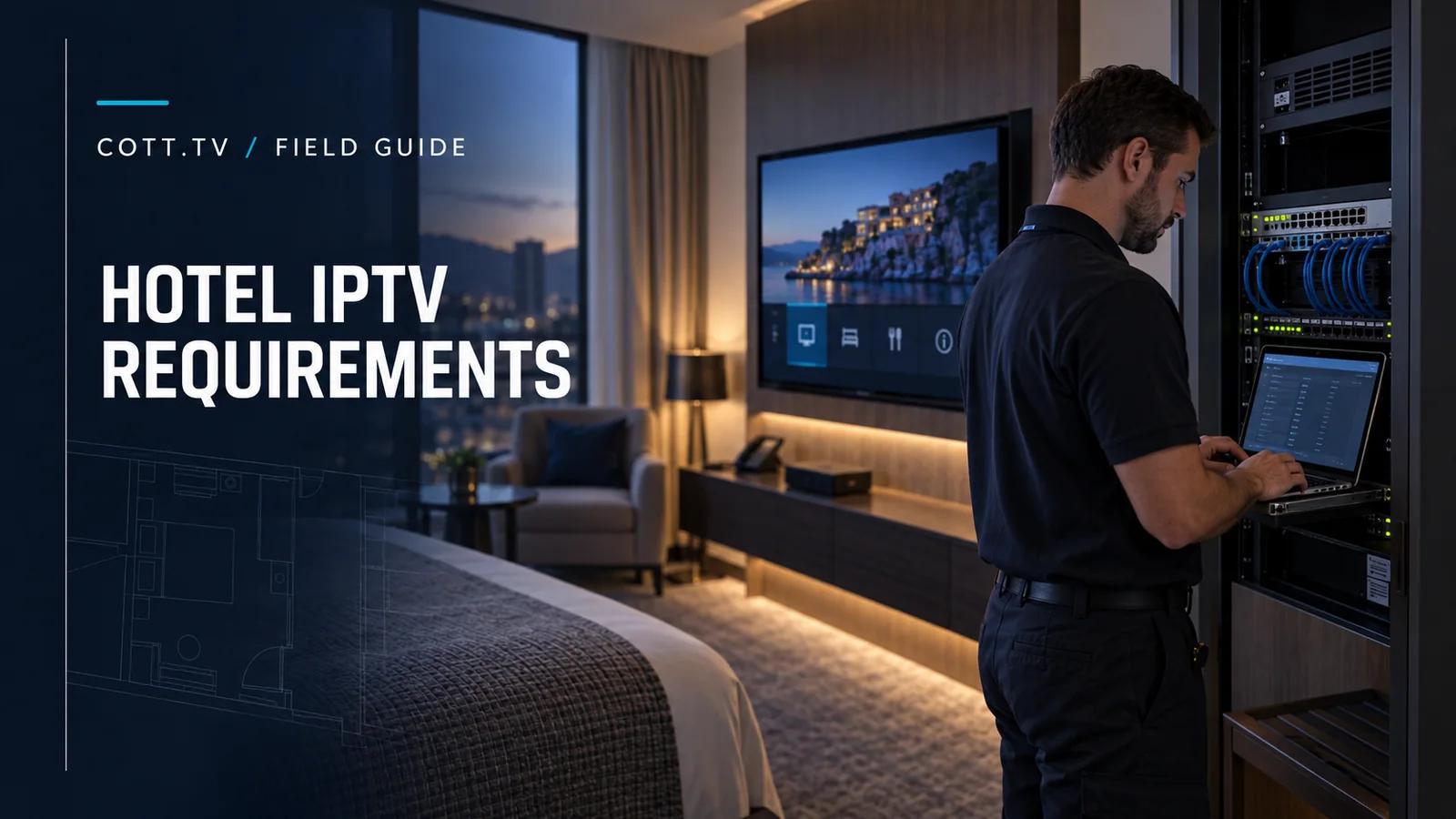
Quick Summary
Define the property and room inventory, exact television models, required guest journeys, channel rights and sources, network conditions, PMS events, security controls, monitoring, support and objective acceptance tests. Require every exclusion to be written.
By the COTT.TV Hospitality Technology Research Desk | Researched September 2026
A hotel IPTV tender often begins with room count, screen size and a desired channel list. That is not enough to produce a reliable system or a comparable quotation. The supplier also needs to understand the existing television fleet, signal sources, network, PMS, guest journey, support obligations and acceptance evidence.
The purpose of a requirements document is not to dictate a fashionable architecture. It is to make every bidder solve the same operating problem and price the same scope.
1. Property and room baseline
Document the facts before discussing products:
- 1property name, country, opening status and renovation phases;
- 2total rooms, sellable rooms, suites and accessible rooms;
- 3buildings, floors and communications rooms;
- 4current televisions by exact model suffix and firmware;
- 5existing coaxial and Ethernet cabling;
- 6Wi-Fi design and managed-network owner;
- 7PMS product, version, interface route and responsible contact;
- 8channel sources, licences and existing headend equipment;
- 9target go-live date and blackout periods.
An estimate such as "about 120 LG TVs" hides the most important compatibility information. Two visually similar models can use different commercial APIs, app deployment methods or DRM capabilities.
2. Define the guest journeys
Write what a guest must be able to do, not merely which modules are included.
At minimum, specify:
- 1television startup after standby and full power loss;
- 2property-branded home screen and room language;
- 3live TV startup and channel changing;
- 4hotel information, Wi-Fi, dining and service discovery;
- 5secure casting or supported OTT launch;
- 6accessibility and remote-control behaviour;
- 7check-in personalisation where lawful;
- 8room move handling;
- 9checkout credential and session clearing;
- 10degraded behaviour when internet or PMS is unavailable.
Each journey should have a measurable result. "Fast channel change" should become a target measured on the final network and exact stream profile.
3. Choose endpoints with the application
There are two common room routes.
Direct hospitality-TV application: fewer visible components, one remote and potentially lower room hardware cost. It requires certification of the exact model, firmware, commercial API and deployment method.
Managed STB: preserves existing televisions, gives the integrator more control over Android and playback, and can standardise mixed fleets. It adds power, HDMI, mounting, remote-control and hardware lifecycle considerations.
LG describes Pro:Centric as a commercial platform that supports local or remote application deployment and can remove the need for a separate set-top box on compatible televisions. Samsung's LYNK Cloud similarly combines content, device management and analytics on supported hospitality displays. These are useful capabilities, but the hotel should validate its chosen application rather than assume that every model in a brand family behaves identically.
4. Describe content as rights plus delivery
For every channel or service, capture:
| Field | Example decision |
|---|---|
| Channel and language | Exact service, not a network family name |
| Territory | Country and property eligibility |
| Hospitality rights | Contract owner, term and room basis |
| Contribution | DVB-S/S2, DVB-T/T2, cable, SRT, HLS or other IP feed |
| Encryption | Free-to-air, CAM/smart card or DRM |
| Output profile | Resolution, codec, bitrate and subtitles |
| Resilience | Local backup, alternate feed or accepted outage |
| Reporting | Rooms, starts, viewing time or other agreed metrics |
Technical reception does not create commercial exhibition rights. Keep the rights schedule and signal design connected but separate.
5. Network requirements
The bidder should state:
- 1unicast or multicast delivery by content type;
- 2expected average and peak bitrate per room;
- 3concurrency assumption;
- 4switch, VLAN, QoS and multicast requirements;
- 5internet egress for cloud streams and updates;
- 6DNS, NTP, certificate and firewall dependencies;
- 7Wi-Fi requirements for casting;
- 8management path for remote support;
- 9behaviour during WAN interruption;
- 10monitoring points from source to screen.
Do not accept a single bandwidth number without its assumptions. A 1080p HLS channel, a 4K VOD asset and a software update create different traffic patterns.
6. PMS and identity scope
Specify the events the TV system needs, not a generic statement that it "integrates with PMS":
- 1check-in or room assignment;
- 2guest-preferred language if supplied lawfully;
- 3room move;
- 4checkout;
- 5reservation update or stay extension;
- 6privacy or do-not-disturb data only if required;
- 7retry, reconciliation and manual reset.
Oracle Hospitality Integration Platform, for example, uses registered applications, OAuth credentials and event subscriptions. The hotel and supplier need the correct environment, hotel identifier, approved events and production access. Budget both vendor work and PMS-side subscription or consulting requirements.
7. Security and privacy
Require:
- 1unique property, room and device identity;
- 2least-privilege administrator roles;
- 3multifactor authentication for privileged access;
- 4encrypted management and API traffic;
- 5secrets outside application packages;
- 6short-lived stream authorisation where appropriate;
- 7tenant and property isolation;
- 8audit logs for configuration and user actions;
- 9vulnerability and update process;
- 10guest-session deletion at checkout;
- 11defined log retention and data-processing roles.
Ask how a compromised room device is revoked without interrupting the entire property.
8. Operations and monitoring
A production system should answer:
- 1which rooms and devices are online;
- 2which application and firmware versions are active;
- 3whether the source, origin, CDN, network or player caused a playback failure;
- 4whether a room is correctly paired;
- 5whether checkout cleanup succeeded;
- 6which changes were published, when and by whom;
- 7how support can reproduce a problem without seeing private guest data.
Define alert ownership. A dashboard that nobody monitors is documentation, not operations.
9. Support and lifecycle
Write the hours, severity definitions, response targets, escalation path and onsite responsibility. Identify who maintains:
- 1server and receiver hardware;
- 2television firmware;
- 3STB image and applications;
- 4channel entitlements and licences;
- 5PMS credentials and subscriptions;
- 6hotel network configuration;
- 7certificates and domain names;
- 8spare devices and replacement stock.
Include an exit and data-export plan. The EU Data Act has strengthened attention to switching and machine-readable export, but the contract still needs concrete deliverables.
10. Acceptance evidence
Final payment should depend on a representative production test, including:
1. every television model and firmware family; 2. every building or network segment; 3. cold boot and standby recovery; 4. live channel startup, change and sustained playback; 5. encrypted content on certified endpoints; 6. casting isolation where included; 7. PMS check-in, room move and checkout; 8. loss and restoration of internet and PMS; 9. administrator roles and audit trail; 10. documented staff handover and rollback.
Pilot rooms should use real content, network and PMS events. A vendor laboratory result does not release a hotel deployment.
A concise tender output
Ask each bidder to return the same six schedules:
- 1architecture and responsibility matrix;
- 2room hardware bill of materials;
- 3content and receiver schedule;
- 4integrations and dependencies;
- 5five-year commercial model;
- 6implementation, acceptance and support plan.
That makes quotations comparable and exposes omissions before contract signature.
COTT.TV planning route
COTT.TV supports cloud, on-premise and hybrid deployments, direct application on validated hospitality televisions and managed STBs for mixed fleets. The platform combines rooms, devices, guest interface, content, PMS events and central management under one operating model.
Use the hotel TV tender questions for display procurement and the five-year cost guide for financial comparison. For a live design review, request the working platform demonstration.
Sources and further reading
- 1LG Pro:Centric Developer platform
- 2Samsung LYNK Cloud hospitality solution
- 3Oracle Hospitality Integration Platform quick start
- 4Hospitality Technology: 2026 Lodging Technology Study
A final specification should be adapted to the property, country, rights schedule and exact hardware. This field guide is a procurement framework, not a substitute for a site survey.
Related Posts
Hotel TV Content Licensing in Europe: Why FTA Is Not Hospitality Rights
2026-08-17
A free-to-air signal is technically receivable, but hotel distribution can still be a communication to the public. Learn how to build a lawful, country-aware channel package and evidence the rights.
Secure Hotel Casting in 2027: AirPlay, Google Cast and Checkout Privacy
2026-09-22
A technical and operational guide to room-specific pairing, network isolation, checkout reset and acceptance testing for hotel casting.
COTT.TV and Al Jazeera Partner for Hospitality Distribution
2026-09-16
COTT.TV and Al Jazeera Media Network have signed an agreement to bring Al Jazeera English and Arabic to hotel guests across approved hospitality markets.