Revenue Is Rising. Is Your Hotel's Profit? A 2027 Margin Budget
November 7, 2026
Research period: November 2026
By COTT.TV Editorial Team·Published November 7, 2026·7 min read

Quick Summary
A higher room rate is welcome. A higher room rate that leaves less money after operating costs is a warning. For a hotel preparing its next budget, the useful question is not simply whether revenue will grow.
A higher room rate is welcome. A higher room rate that leaves less money after operating costs is a warning. For a hotel preparing its next budget, the useful question is not simply whether revenue will grow. It is which part of that revenue will survive distribution costs, payroll, utilities and the cost of delivering the stay.
This guide builds a management budget from room nights upwards. It works for an independent property or a hotel group, provided the accounting scope and denominators remain consistent. The worked example is hypothetical, not a European profitability benchmark or a forecast for your property.
What the European evidence tells us
CBRE's midyear hotel review reports European RevPAR growth of 4.5% year-on-year through June 2026, with ADR up 3.2%. It also highlights market divergence and pressure on margins from costs. The first figures describe a historical period; its later-year commentary is an outlook. Neither is a ready-made growth assumption for an individual hotel.
Use the market evidence as a question for your revenue meeting, not a percentage to paste across every month. A city hotel, a seasonal resort and a conference property can face different demand patterns even in the same country. Compare your own booking pace, event calendar and room mix with the corresponding prior period before accepting the headline trend.
Put the denominator beside every metric
Occupancy is sold room nights divided by available room nights. ADR is net room revenue divided by sold room nights. RevPAR is net room revenue divided by available room nights. TRevPAR uses total operating revenue over the same available-room denominator. These measures answer different questions: pricing, use of capacity and revenue generated from that capacity.
GOPPAR uses gross operating profit rather than revenue. It is meaningful only when the underlying GOP accounting definition is consistent. A quick spreadsheet surplus with selected expenses omitted must not be relabelled as audited GOP, EBITDA or owner cash flow.
In a portfolio, sum revenues and the relevant room-night denominators before dividing. Do not take a simple average of a small hotel's ADR and a much larger hotel's ADR. Document rooms out of service, complimentary stays and package allocations so an apparent improvement is not merely a change in reporting treatment.
A worked budget: growth without more profit
The following hypothetical property has 100 rooms available for 30 days, giving 3000 available room nights. Occupancy of 70% produces 2100 sold room nights. At ADR EUR120, room revenue is EUR252000 and RevPAR is EUR84. Additional operating revenue is EUR48000.
All revenue below is net of VAT. The example uses an explicitly defined management operating-cost scope. Its surplus is before ownership costs excluded from that scope, financing, tax, depreciation and capital investment. It is not a formal GOP benchmark.
| Management measure | Base month | Budget scenario |
|---|---|---|
| Total operating revenue | EUR300000 | EUR309000 |
| Operating costs, same scope | EUR240000 | EUR252000 |
| Management operating surplus | EUR60000 | EUR57000 |
| Surplus as a share of revenue | 20% | 18.45% |
| Surplus per available room night | EUR20 | EUR19 |
Base TRevPAR is EUR100. The scenario increases total revenue by 3% and the same operating-cost base by 5%. Revenue grows, but surplus falls by EUR3000, or 5%. The denominator remains 3000 available room nights; the scenario does not assume an unspecified occupancy increase.
This is a sensitivity test, not a prediction. Its value is that it exposes how little a revenue headline tells an owner about retained value. Before approving the budget, ask which expenses explain the increase and which commercial actions can change the result without damaging service.
Separate price, volume and productivity
A single inflation allowance across every expense hides the decisions managers actually control. For each material cost, separate the price paid from the quantity consumed. Payroll depends on paid hours, contractual rates, benefits, overtime and agency use. Laundry depends on volume and service policy as well as the price per item. Distribution depends on channel mix and booking value.
Some costs are fixed within a capacity range, some vary with occupied rooms, and some change in steps. Utilities contain a building baseload as well as demand-related consumption. Staffing cannot always be reduced in direct proportion to occupancy without weakening reception coverage, safety or guest service.
HOTREC's workforce roadmap identifies training and retention as responses to hospitality skills and labour shortages. In your budget, connect those actions to observable measures such as paid overtime, agency dependence and service consistency. Do not book a saving simply because a training or technology project has been approved.
Build the year month by month
Start with the trading calendar: closures, major events, refurbishment, group commitments and known changes to room inventory. Forecast occupied room nights and net rate by segment. Then add other revenue using a consistent allocation of breakfast, packages and ancillary services. Revenue already included in a room package must not be counted again in the restaurant forecast.
Overlay contracted supplier changes and realistic staffing requirements. Explain each significant movement from the previous comparable period. An annual average can conceal the winter month in which cash becomes tight, or the event period in which overtime consumes the apparent rate premium.
For uncertain assumptions, keep a base case and a downside case with named triggers. A trigger might be slower pickup, a supplier renewal or a staffing gap. Assign responsibility for monitoring it and an action that can actually be taken before the cost is incurred.
Profit is not the same as cash available to invest
After the operating budget, build a separate cash bridge. Include debt principal and interest, rent or ownership charges outside the operating scope, taxes, capital payments, deposits and settlement timing. Advance guest payments improve today's bank balance but can still carry a future service or refund obligation.
Treat a technology or renovation proposal as its own cash decision. Record implementation timing, ongoing charges and which operational benefit can be measured. COTT's published pricing can inform a scoped technology budget; a software price is not evidence of a guaranteed improvement in profit.
A practical budget review routine
Begin with a reconciliation of room-night data, revenue and the general ledger. Give department heads the same reporting definitions. Ask each to explain the largest controllable movement, the capacity constraint and the assumption most likely to fail.
Next, review the downside case alongside the cash forecast. Agree what will be protected, particularly safety and essential guest service, and what discretionary expenditure can be phased. Finish with owners and review dates for the assumptions, rather than a spreadsheet nobody revisits.
During trading, report variance as price, volume, mix or timing. A late invoice is not an efficiency improvement. A room closure may reduce costs while destroying contribution. A better budget explains these differences before they become a surprise at year end.
Questions hotel owners ask
Is a higher RevPAR enough to show better performance?
No. RevPAR measures room revenue against available capacity. It does not deduct the costs of acquiring the booking or serving the guest. Read it alongside consistently defined operating profit and cash measures.
Should a group use the same margin target for every property?
Not automatically. Service level, facilities, seasonality and accounting treatment differ. Use comparable definitions first, then explain why the target is appropriate for each property and for the consolidated group.
Can a hotel improve margin by reducing every department's budget?
An across-the-board cut can remove profitable capacity or weaken service. Examine avoidable cost, operational dependencies and contribution before deciding. Savings should have a measurement method and should not rely on unverified revenue promises.
Research checked 4 November 2026. Market statements are attributed above. The financial example and budgeting framework are illustrative editorial analysis, not audited results, an investment forecast or individual accounting advice.
Inn. TRENDS.
Related Posts

LG Pro:Centric or Philips MediaSuite: A Hotel Procurement Comparison
2026-11-02
A model-specific comparison of two hotel TVs, with practical questions for assessing management, casting, privacy and deployment support before purchase.
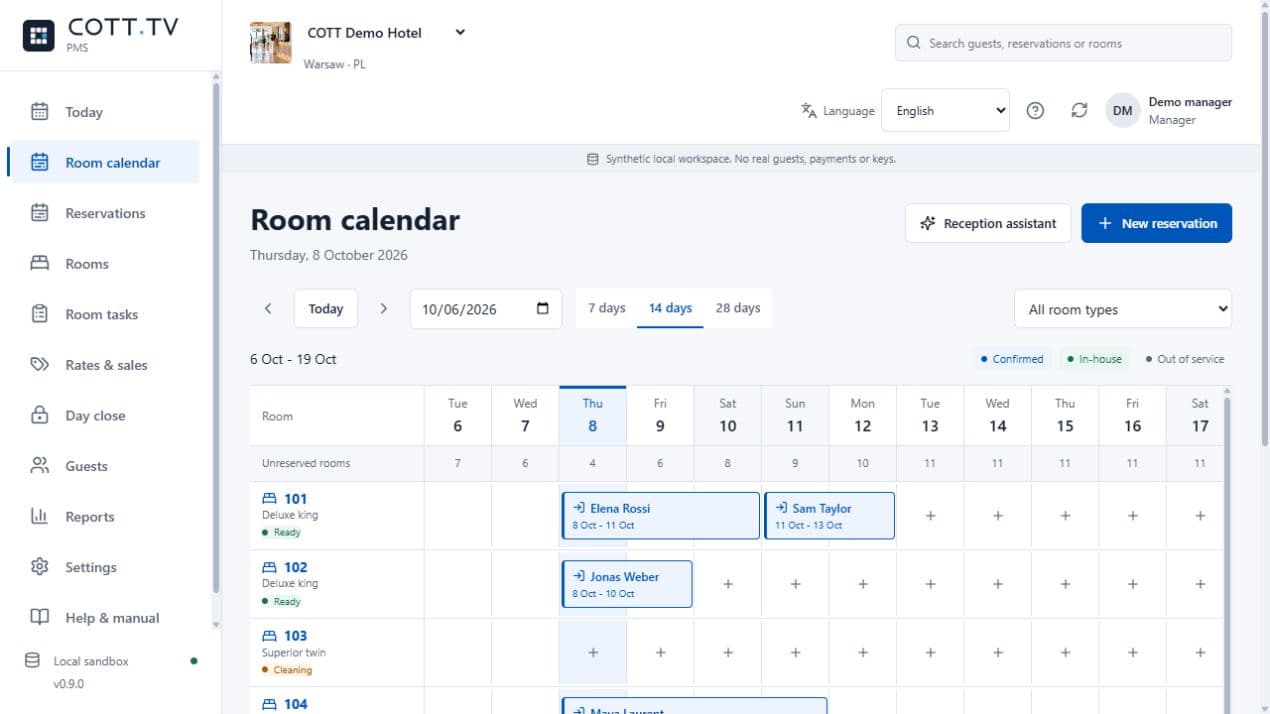
Introducing COTT DESK: Hotel PMS, Built Around the Hotel Day
2026-10-15
COTT DESK brings reservations, reception, housekeeping and guest accounts together. Applications open for a selected 90-day Founding Hotels pilot.

Hotel IPTV Cost per Room in 2027: A Transparent Calculation Method
2026-10-04
A practical cost-per-room model covering software, televisions, STBs, content, networks, integration, support and lifecycle replacement.