Hotel IPTV Cost per Room in 2027: A Transparent Calculation Method
October 4, 2026
Research period: September 2026
By COTT.TV Hospitality Technology Research Desk·Published October 4, 2026·6 min read

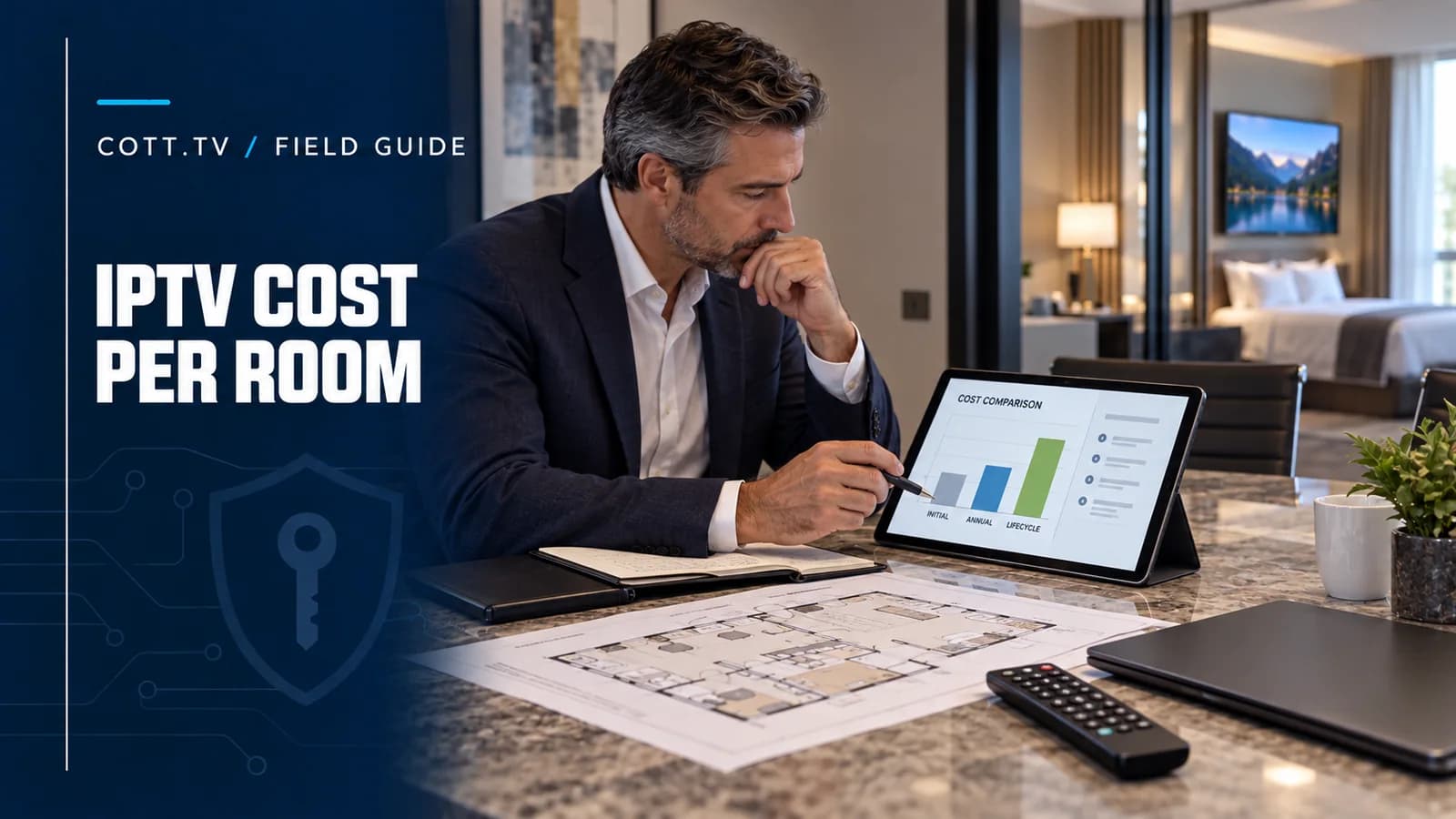
Quick Summary
Calculate one-time property cost, one-time room cost, annual property cost, annual room cost, content, connectivity, support and replacement. Divide by registered rooms and the same evaluation period. State taxes, occupancy assumptions and exclusions.
By the COTT.TV Hospitality Technology Research Desk | Researched September 2026
The phrase "price per room" sounds precise, but hotel IPTV quotations often include different things. One supplier prices software only. Another includes an STB, installation and support. A third includes local headend hardware but excludes channel rights and PMS fees.
A useful comparison converts every option into the same five-year room service and keeps one-time, recurring and lifecycle costs visible.
The core formula
For an evaluation period of Y years and R registered rooms:
Five-year cost per room = (property setup + room hardware + installation + Y × annual platform/support/content/network + lifecycle replacement) ÷ R
For a monthly comparison:
Equivalent monthly cost per room = total evaluation cost ÷ R ÷ total months
This is a planning metric, not necessarily the supplier's billing unit. Content agreements may still charge every registered room regardless of occupancy.
Cost layer 1: platform
Include:
- 1cloud room licences or software subscription;
- 2on-premise server licence and maintenance;
- 3central administration and multi-property control;
- 4guest interface, services and analytics modules;
- 5application updates and certificates;
- 6storage, CDN or media delivery where billed separately;
- 7user, property or API fees.
COTT.TV cloud pricing starts from EUR 10 per registered room per month for the platform scope described on the pricing page. Exact content, hardware, integration and support requirements can change the final proposal.
Cost layer 2: room endpoint
For direct application on a validated hospitality television, include any incremental commercial-TV cost and deployment labour.
For an STB route, include:
- 1box and remote;
- 2power supply;
- 3HDMI cable;
- 4secure mounting;
- 5configuration and room assignment;
- 6spare pool;
- 7replacement labour;
- 8disposal or refurbishment.
An inexpensive consumer box may create a high service cost if it cannot be managed remotely or if its firmware changes without notice.
Cost layer 3: headend and contribution
Local satellite, terrestrial or cable reception can require:
- 1chassis or server;
- 2DVB receiver cards;
- 3dishes, multiswitches and RF distribution;
- 4CAMs and smart cards;
- 5transcoding capacity;
- 6rack, UPS and cooling;
- 7professional commissioning;
- 8annual support and hardware spares.
Pure IP contribution may reduce local reception hardware but add origin, contribution and bandwidth charges. Compare the same authorised channel lineup.
Cost layer 4: content rights
Separate platform cost from channel cost. Record:
- 1free or paid channel;
- 2room basis and minimum commitment;
- 3territory and property eligibility;
- 4reporting requirement;
- 5annual indexation;
- 6sports or event surcharges;
- 7contract term and notice period.
Free-to-air reception does not automatically mean free commercial distribution in hotel rooms. The rights check belongs in the budget.
Cost layer 5: network and connectivity
Do not charge the entire hotel network renewal to IPTV unless the project requires it. Do include incremental work:
- 1access-switch ports and PoE where relevant;
- 2VLAN and multicast configuration;
- 3Wi-Fi changes for casting;
- 4internet capacity dedicated to cloud media;
- 5firewall, monitoring and remote-access setup;
- 6cabling repairs and room visits;
- 7secondary connectivity where required for resilience.
Use measured bitrate and concurrency. Occupancy is not identical to concurrent viewing, but it should be a documented planning input.
Cost layer 6: integration
Include both sides of PMS, casting, POS or building-system interfaces:
- 1platform implementation;
- 2PMS subscription, API or pay-per-call charges;
- 3hotel or vendor professional services;
- 4UAT and production onboarding;
- 5data mapping and testing;
- 6certificate and credential lifecycle;
- 7future version changes.
"PMS integration included" is incomplete unless the supported product, events and third-party fees are named.
Cost layer 7: people and support
Price the operating model:
- 1content and menu administration;
- 2reception troubleshooting;
- 3engineering room visits;
- 4NOC monitoring;
- 524/7 or business-hours support;
- 6onsite response;
- 7staff training and turnover;
- 8annual room audit.
A system that saves five minutes on every common fault can justify a higher licence at scale. Estimate the incident volume rather than assigning zero cost to hotel labour.
Worked example for comparison only
Consider a 100-room hotel comparing two architectures over five years. These are illustrative numbers, not a COTT.TV quote.
| Cost input | Option A: direct TV | Option B: retained TVs + STB |
|---|---|---|
| One-time platform/integration | EUR 8,000 | EUR 8,000 |
| Incremental room hardware | EUR 15,000 | EUR 10,000 |
| Installation and commissioning | EUR 6,000 | EUR 9,000 |
| Five-year software/support | EUR 60,000 | EUR 60,000 |
| Replacement and spares | EUR 5,000 | EUR 9,000 |
| Five-year total | EUR 94,000 | EUR 96,000 |
| Equivalent per room/month | EUR 15.67 | EUR 16.00 |
The totals are close even though the hardware story is different. If existing televisions can be retained, the STB may protect capital. If new validated hospitality screens are already planned, direct deployment may remove room components and service calls.
Content rights, taxes, internet and television purchase cost should be added consistently to both options when relevant.
Scenario analysis
Calculate at least three cases:
Base: expected rooms, channels, support and replacement.
Growth: additional rooms or properties, more paid content and higher integration volume.
Stress: hardware replacement, bandwidth growth, indexation and onsite incidents above plan.
Identify the three assumptions that move the result most. False precision is less useful than knowing whether the decision changes when STB failure rises from 2% to 6%.
Questions that prevent surprise costs
- 1Is pricing per registered room, active room, occupied room or device?
- 2Are content and taxes included?
- 3Is the hotel buying or leasing hardware?
- 4Who owns shipping, customs and installation?
- 5Which PMS-side charges are excluded?
- 6Is support business-hours or 24/7?
- 7What is the annual price index?
- 8What happens when a television model is discontinued?
- 9Are software updates and major versions included?
- 10What data and hardware remain usable at contract end?
COTT.TV quotation approach
COTT.TV can price cloud service per registered room and quote on-premise or hybrid architecture against the exact receiver, PMS, device and support scope. Direct hospitality-TV deployment and managed STBs are compared against the installed fleet rather than forced into one model.
Use the five-year TCO guide for a broader finance model and the system requirements checklist before requesting comparable vendor offers.
Sources and further reading
- 1Hospitality Technology: 2026 Lodging Technology Study
- 2DIRECTV Hospitality: What Hotel Guests Want in 2026
- 3European Commission: Data Act explained
- 4COTT.TV pricing
Illustrative calculations exclude tax and are not a quotation. Use the exact room count, hardware, country, rights schedule, integrations and support terms for a purchasing decision.
Related Posts

Hotel TV Five-Year TCO: Cloud, STB and On-Premise Cost Model
2026-09-07
A transparent five-year cost model for licences, room endpoints, servers, support, internet, content and internal labour.
Hotel IPTV System Requirements: The 2027 Pre-Tender Checklist
2026-09-24
A vendor-neutral requirements framework for rooms, televisions, networks, content, PMS events, security, monitoring and acceptance.
Secure Hotel Casting in 2027: AirPlay, Google Cast and Checkout Privacy
2026-09-22
A technical and operational guide to room-specific pairing, network isolation, checkout reset and acceptance testing for hotel casting.