Secure Hotel Casting in 2027: AirPlay, Google Cast and Checkout…
September 22, 2026
Research period: September 2026
By COTT.TV Hospitality Technology Research Desk·Published September 22, 2026·6 min read

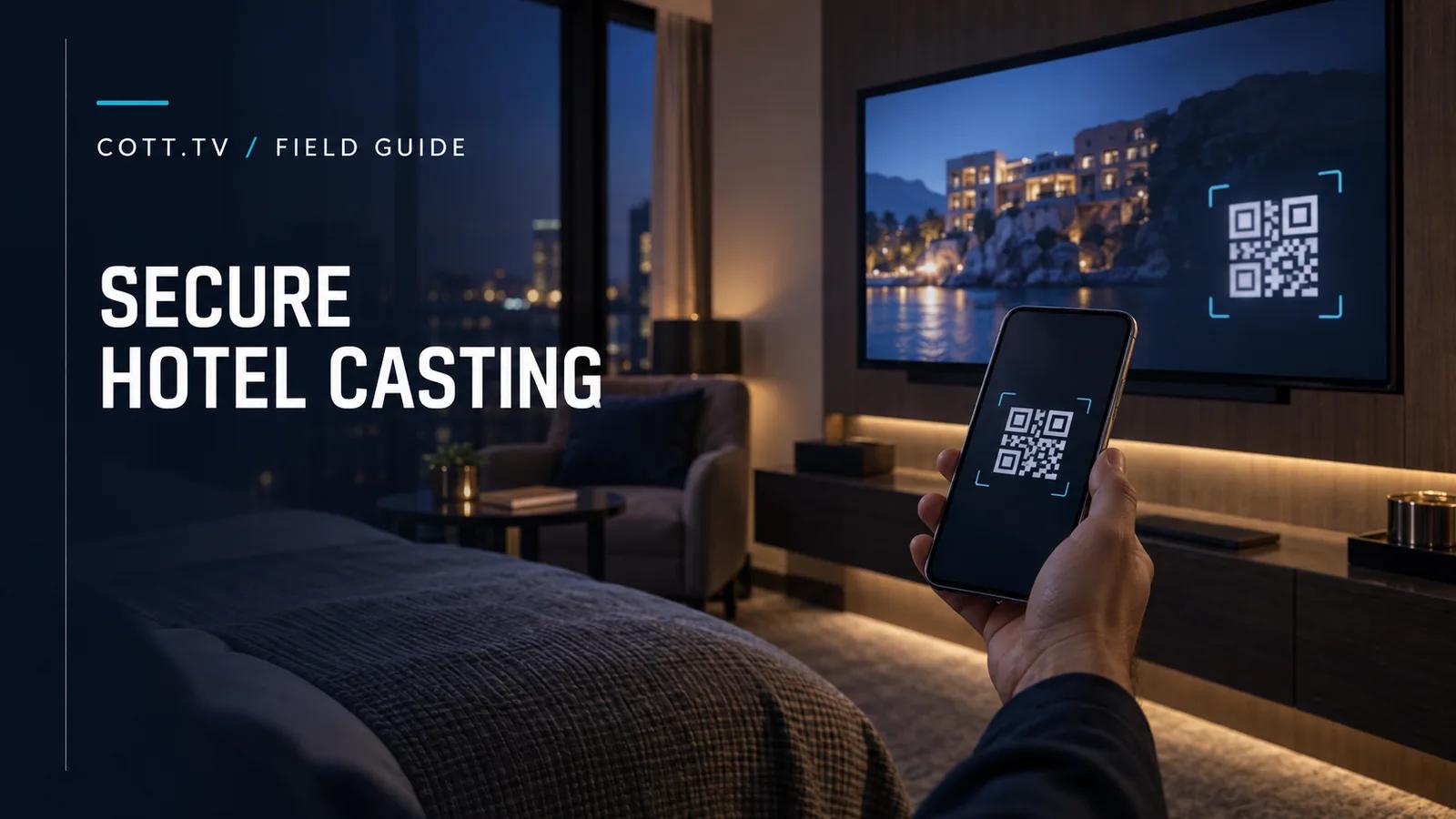
Quick Summary
A secure hotel casting design uses a unique room pairing flow, isolates discovery between rooms, avoids asking guests to type streaming credentials into the television, expires sessions automatically and proves checkout reset through an end-to-end test. A consumer casting logo…
By the COTT.TV Hospitality Technology Research Desk | Researched September 2026
Guests increasingly expect the room television to work like the screen at home, but hotel casting is not a domestic living-room problem. A property has hundreds of temporary users, repeated check-ins and checkouts, shared network infrastructure and a strict requirement that one room must never discover, control or resume another room's session.
The correct question is therefore not simply whether a television supports AirPlay or Google Cast. It is whether the complete hotel design can establish a room-specific relationship, keep media traffic inside that relationship, recover after normal failures and destroy the guest state at checkout.
What the guest should experience
A good journey takes less than a minute:
1. The guest opens the casting or AirPlay option on the room television. 2. The television displays a room-specific QR code or short pairing instruction. 3. The guest scans once and confirms the correct room. 4. The phone remains the account holder and remote control. 5. The television receives only the selected playback session. 6. The relationship expires at checkout or a defined inactivity limit.
Apple's hotel AirPlay implementation uses a unique QR code on a compatible room television. Apple and IHG state that the pairing is designed for the assigned room and that the connection is erased at checkout. That is a useful benchmark because it treats privacy and lifecycle as part of the guest experience rather than a support afterthought.
Google Cast follows a sender-and-receiver model. The guest's phone or web application acts as the sender, while a Cast-enabled device or Android TV receiver handles playback. A hotel deployment still needs an additional room-assignment and network design around that model. Cast support alone does not know which hotel room the guest occupies.
AirPlay, Google Cast and mirroring are not identical
| Method | Typical strength | Hotel design question |
|---|---|---|
| AirPlay | Native Apple-device experience and screen/media handoff | How is the guest securely associated with one compatible room TV? |
| Google Cast | Broad app support and receiver-controlled playback | How are discovery and receiver visibility isolated per room? |
| Miracast or direct mirroring | Can work without a cloud sender service | How are radio proximity, PINs and cross-room discovery controlled? |
| HDMI or guest cable | Simple fallback for presentations | Who supplies, secures and supports the cable and input switching? |
Hotels should not describe all four methods as "casting" in a tender. The network, content protection, user journey and support model are different.
The network problem: discovery must follow the room
Consumer casting normally assumes that the sender and receiver can discover each other on the same home network. A hotel cannot place every guest and every television inside one flat broadcast domain. That may expose hundreds of receivers, increase multicast noise and create obvious privacy failures.
A hotel-ready design normally combines:
- 1guest or stay identity from the captive portal, PMS or a room QR flow;
- 2dynamic receiver visibility limited to the assigned room;
- 3controlled handling of mDNS or other discovery traffic;
- 4segmentation between guest, room-device and management networks;
- 5explicit firewall rules for media and control paths;
- 6monitoring that can distinguish pairing failure from internet failure.
The implementation may use per-room VLANs, private pre-shared keys, policy-driven gateways or an application-mediated pairing service. The product name matters less than the outcome: room 417 should discover room 417, and nothing else.
Do not turn the TV into an account trap
The safest hotel pattern keeps Netflix, YouTube and other personal service credentials on the guest's own device. The television receives a temporary playback relationship, not a permanent username and password.
If a hotel also offers native OTT applications on the screen, that becomes a separate credential-clearing obligation. The PMS checkout event, application logout behaviour and television platform must be tested together. "Factory reset available" is not an acceptable checkout workflow for an occupied hotel.
The minimum privacy controls
Room-specific pairing: a QR code or code must resolve to one current room assignment and expire quickly.
No neighbouring-room discovery: test from the corridor and adjacent rooms, not only beside the television.
Checkout destruction: remove receiver associations, tokens, guest names, watch state and any native-app credentials that the system manages.
Short retention: logs should contain enough technical evidence to support the service, but not a permanent viewing profile tied to an identified guest.
Visible disconnect: the guest should be able to end the session before checkout and see confirmation.
Staff boundaries: reception should be able to reset a room without seeing the guest's media account or content history.
These controls also support the GDPR principles of data minimisation and storage limitation. The operational test is straightforward: the next guest must receive a clean room, while the support team retains only the minimum evidence required to diagnose faults.
A 12-step acceptance test
Run the test on every supported television model, firmware family and network segment:
1. Cold-start the television and open the casting entry point. 2. Pair an iPhone using the approved AirPlay route. 3. Pair an Android device using the approved Cast route. 4. Start, pause, seek and stop a supported video. 5. Change phone orientation and place the phone in standby. 6. Confirm the stream does not jump to an adjacent room. 7. Attempt discovery from a device associated with another test room. 8. Interrupt hotel internet access and observe the recovery message. 9. Reboot the television during an active session. 10. Simulate a room move in the PMS. 11. Simulate checkout and confirm the association is destroyed. 12. Check in a new test guest and confirm no previous state remains.
Record the television model, firmware, receiver version, mobile OS, application, room, network segment and result. "Casting worked" is not a reusable certification record.
Support information that reception actually needs
The front desk does not need a networking course. It needs a small diagnostic view:
- 1room and television online state;
- 2current pairing availability, not the guest's private account;
- 3time of the last successful room association;
- 4approved reset action;
- 5clear escalation code for network, television or third-party application failure.
This keeps first-line support fast while preserving guest privacy.
How COTT.TV fits the design
COTT.TV treats casting as one capability inside the room lifecycle. The platform already links property, room, device and stay state, which allows a casting integration to use the same controlled identity and checkout logic as the television experience. Compatible hospitality televisions can run the guest interface directly; validated STBs provide a consistent endpoint for mixed television fleets.
Hotels evaluating casting should begin with the existing secure hotel casting guide, then use this field guide as the deployment and acceptance checklist. A working room demonstration is more useful than a compatibility logo.
Sources and further reading
- 1Apple: AirPlay is available in select IHG hotel rooms
- 2Google: Cast SDK overview
- 3Google: Web Receiver architecture
- 4European Commission: GDPR processing principles
Compatibility and application availability vary by television model, firmware, country and content provider. Test the exact production combination before purchase.
Related Posts
Hotel TV as a Revenue Channel: Ancillary Sales Without Annoying Guests
2026-08-17
The room television can sell breakfast, spa, late checkout and local experiences, but only when offers are timely, useful, measurable and separate from intrusive advertising over TV content.
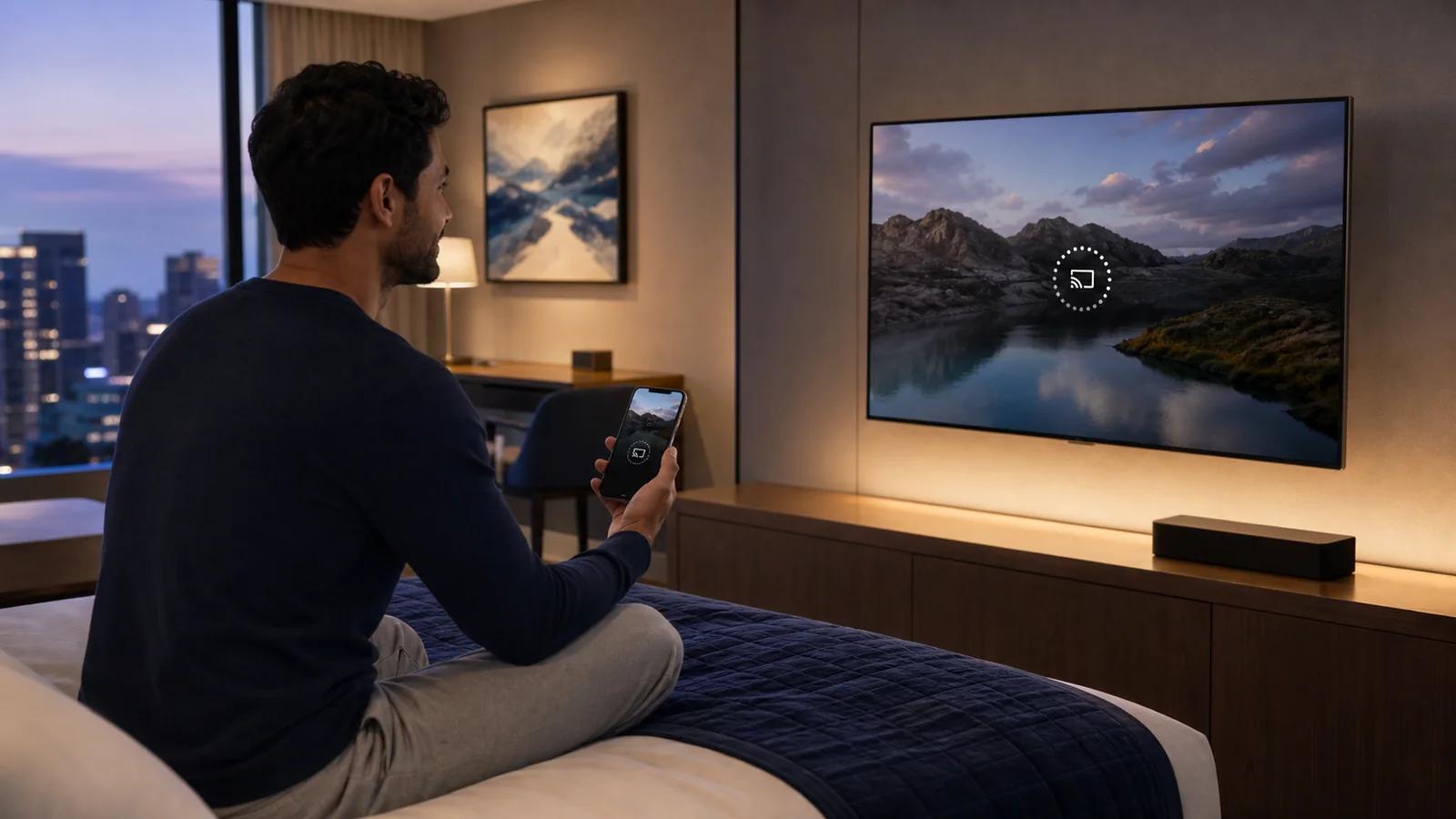
Secure Hotel Room Casting: AirPlay, Google Cast and Guest Privacy
2026-08-17
Hotel casting is convenient only when pairing is room-specific, guest credentials never remain on the television, and checkout reliably destroys the session. This guide explains what to specify and test.

Hotel TV Channel Lineup by Guest Mix: A Rights-Aware Planning Method
2026-09-11
A country, language and guest-segment method for selecting hotel channels without buying a large package that nobody watches.