Hotel TV as a Revenue Channel: Ancillary Sales Without Annoying Guests
August 17, 2026
By COTT.TV Hospitality Technology Research Desk·Published August 17, 2026·5 min read

Quick Summary
By the COTT.TV Hospitality Technology Research Desk | Updated 17 August 2026
By the COTT.TV Hospitality Technology Research Desk | Updated 17 August 2026
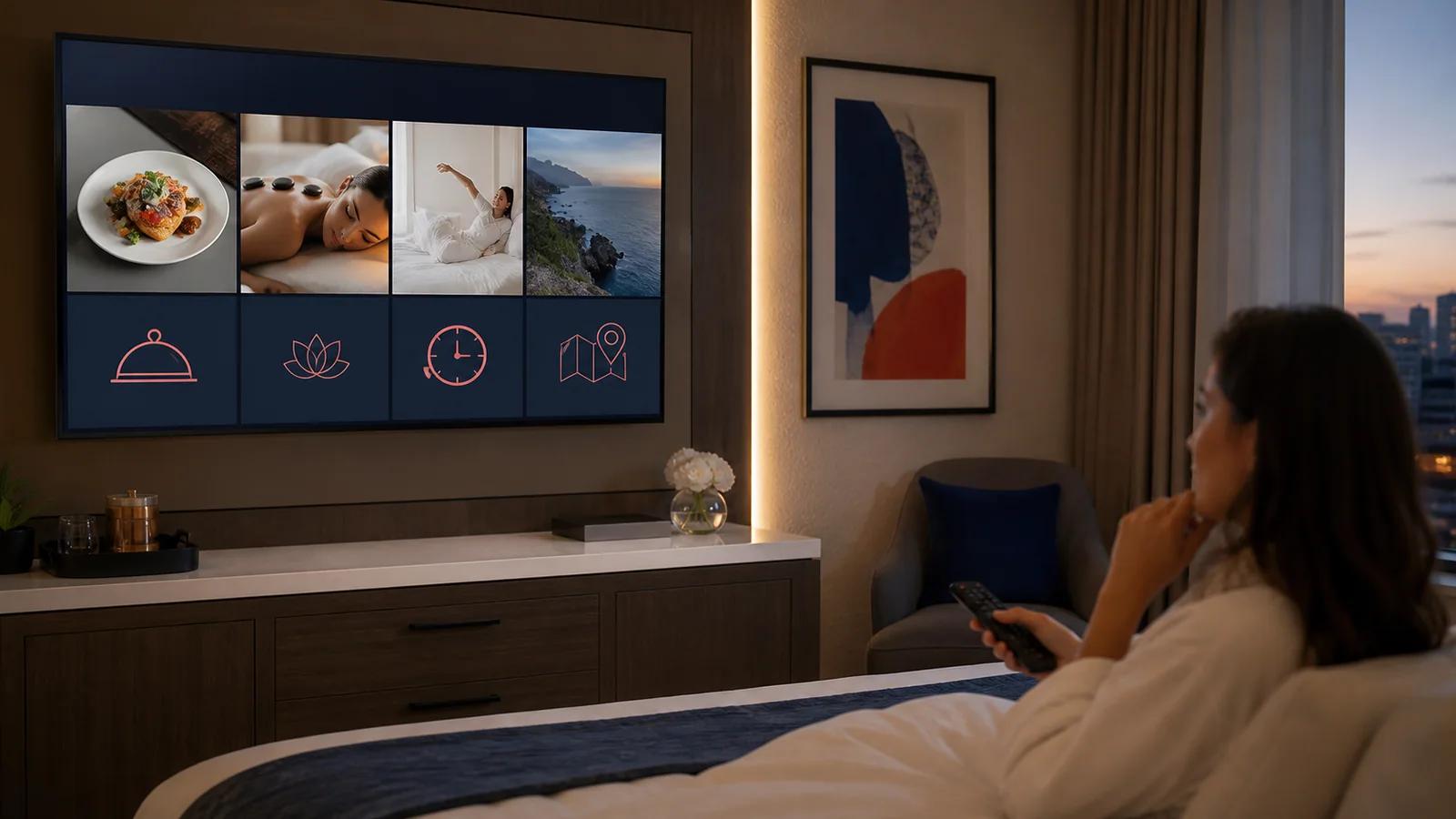
The in-room television is one of the hotel's largest owned digital surfaces, yet many properties use it only for live channels and a static welcome screen. It can do more: present breakfast, spa availability, room service, late checkout, transport and carefully selected local experiences at the moment they are relevant.
The commercial opportunity disappears if the screen feels like an advertising board. Guests have paid for the room. Offers should help them use the stay, not interrupt television content or create pressure.
Start with guest utility
The most effective offer answers a question the guest already has:
- 1"Can I still order food?"
- 2"Can I keep the room until 15:00?"
- 3"Is the spa available tomorrow morning?"
- 4"How do I book the airport transfer?"
- 5"What can we do nearby with children?"
The television can show the answer and a path to action. This is better than a generic banner because the value is immediate and the intent is measurable.
Separate three commercial models
Hotel-owned upselling
Breakfast, food and beverage, spa, parking, upgrades and late checkout. The hotel controls inventory, fulfilment and margin.
Local partner marketplace
Restaurants, tours, transfers, tickets or retail selected by the hotel. Commercial terms may be commission, placement fee or guest benefit. The hotel should verify quality and explain when a service is provided by a third party.
Brand or destination media
Paid placements aimed at a defined hotel audience. This requires stricter creative review, frequency limits, measurement definitions and consent analysis where personal data is used.
Do not mix these into one revenue figure. A restaurant order, a lead sent to a tour operator and an advertising impression have different economics.
Why the hotel TV audience is valuable
The screen is tied to a known property and room. Without identifying the guest, a campaign can still be contextual: country, hotel, language, room type, arrival day, time of day and stay stage. That is useful targeting with less personal data than behavioural advertising across the open web.
For example, an airport transfer is relevant before departure; breakfast is relevant the evening before or early morning; spa availability is relevant when a slot exists. Context improves performance and reduces annoyance.
A respectful placement policy
COTT.TV recommends four boundaries:
1. no advertising layered over live television content; 2. no automatic audio from promotional material; 3. frequency caps for messages and push notifications; 4. hotel approval and immediate campaign suspension.
Use home-menu tiles, service pages, a restrained welcome placement and optional messages. The guest should always be able to reach television and hotel information without navigating through an advert.
Measurement that finance can trust
Define the funnel before launch:
- 1eligible room: the campaign could be shown;
- 2served: the interface delivered the placement;
- 3viewable: the placement was on screen for the agreed condition;
- 4selected: the guest opened the offer;
- 5lead/order: the requested action reached the service system;
- 6completed revenue: the hotel or partner confirmed fulfilment.
Do not call every served tile a viewed advert. Do not call every click revenue. Keep campaign events pseudonymous where possible and establish retention rules.
A simple commercial model
For hotel-owned services, calculate contribution, not gross sales:
Incremental contribution = completed revenue − direct fulfilment cost − partner or payment cost − campaign cost
Late checkout may have high contribution when room operations can support it. Room service has food, labour and delivery cost. A local experience may create a commission without hotel fulfilment, but also creates reputation risk.
Test one service at a time against a control period or comparable rooms. Seasonality and occupancy can otherwise make an ordinary revenue increase look like a campaign result.
Privacy and consent
Property-level context is not automatically anonymous, and a room identifier can still relate to a person during a stay. Map the data used for targeting, select a lawful basis, explain relevant processing and avoid using sensitive or unnecessary guest attributes.
The European Commission notes in its GDPR lawful-grounds guidance that legitimate interest requires balancing the organisation's interest against individuals' rights and freedoms. Direct marketing may be a legitimate interest in some circumstances, but it is not an automatic exemption from transparency, objection rights or ePrivacy rules.
Use legal review for personalised campaigns and national requirements. A conservative contextual model is easier to operate across properties.
The first five campaigns to test
1. Breakfast add-on for room-only guests, where PMS data and lawful processing permit. 2. Same-day spa availability with a clear booking action. 3. Late checkout offered only when housekeeping and occupancy allow it. 4. Restaurant menu and opening hours with order or reservation path. 5. Airport transfer or trusted local experience before departure.
Each campaign needs an owner, availability rule, guest wording, fulfilment workflow and stop condition.
How COTT.TV enables the channel
COTT.TV provides configurable main-menu tiles, information pages, points of sale, guest messages and measurable interactions inside the hotel interface. A hotel group can manage approved campaigns centrally while each property controls local services and inventory.
The objective is a useful commercial layer, not a television ad network. Explore the working guest interface or read about multi-property controls.
Sources and further reading
- 1European Commission: lawful grounds for personal-data processing
- 2Amadeus: Hospitality in 2026
- 3Hilton: 2026 Trends Report
- 4Google: helpful, reliable, people-first content
Revenue examples are frameworks, not forecasts. Hotels should validate guest demand, fulfilment capacity, data protection and partner quality before scaling.
Related Posts
Secure Hotel Casting in 2027: AirPlay, Google Cast and Checkout Privacy
2026-09-22
A technical and operational guide to room-specific pairing, network isolation, checkout reset and acceptance testing for hotel casting.
Secure Hotel Room Casting: AirPlay, Google Cast and Guest Privacy
2026-08-17
Hotel casting is convenient only when pairing is room-specific, guest credentials never remain on the television, and checkout reliably destroys the session. This guide explains what to specify and test.

Hotel IPTV and GDPR: Complete Data Privacy Compliance Guide for European Hotels
2026-04-08
How hotel IPTV systems handle guest data under GDPR. Data collection, consent, storage, and compliance requirements for European hospitality properties.