Hotel Workforce Automation: Use the Room TV to Reduce Service Friction
August 17, 2026
By COTT.TV Hospitality Technology Research Desk·Published August 17, 2026·5 min read

Quick Summary
By the COTT.TV Hospitality Technology Research Desk | Updated 17 August 2026
By the COTT.TV Hospitality Technology Research Desk | Updated 17 August 2026
Hospitality's labour problem is structural, not a temporary scheduling inconvenience. HOTREC estimates that the European sector is missing roughly 10% of the workforce it needs, across an industry of about 10 million workers and two million businesses. Technology will not manufacture experienced hospitality employees. It can stop wasting the time of the people a hotel already has.
The highest-value automation is usually unglamorous. It prevents reception from answering the same opening-hours question 40 times, turns a broken lamp report into a trackable maintenance task, lets housekeeping update room state without a radio chain, and shows the guest whether a request was accepted.
Where hotel time disappears
Repeated low-complexity work appears in every department:
- 1reception explains Wi-Fi, breakfast, parking and checkout;
- 2guests call to request towels or report a fault;
- 3reception relays the request to another department;
- 4the department acknowledges it through a separate channel;
- 5nobody has one view of whether it was completed;
- 6the guest calls again.
The first call is not the real cost. The relay, ambiguity, interruption and duplicate follow-up are.
Use the room TV as an accessible service surface
The television is already visible, powered and associated with a room. It can present hotel information and service categories without requiring the guest to download an app. A good menu answers the first question in seconds and creates a structured request when action is needed.
Useful first-phase services include:
- 1additional towels, pillows or toiletries;
- 2housekeeping timing or do-not-disturb preference;
- 3maintenance issue categories;
- 4breakfast and restaurant information;
- 5late checkout request;
- 6taxi or wake-up request;
- 7spa, local experience and facility discovery;
- 8multilingual AI concierge with staff escalation.
Do not put 40 equal tiles on the home screen. Prioritise what guests need now, based on stay stage and property type.
The request must become work
A guest-facing button without an operational workflow creates disappointment faster than a telephone. Every request type needs:
1. an owning department; 2. a service target or expected response; 3. an acknowledgement to the guest; 4. assignment or acceptance by a staff member; 5. completion and exception status; 6. escalation when the task is not accepted; 7. an audit trail for recurring problems.
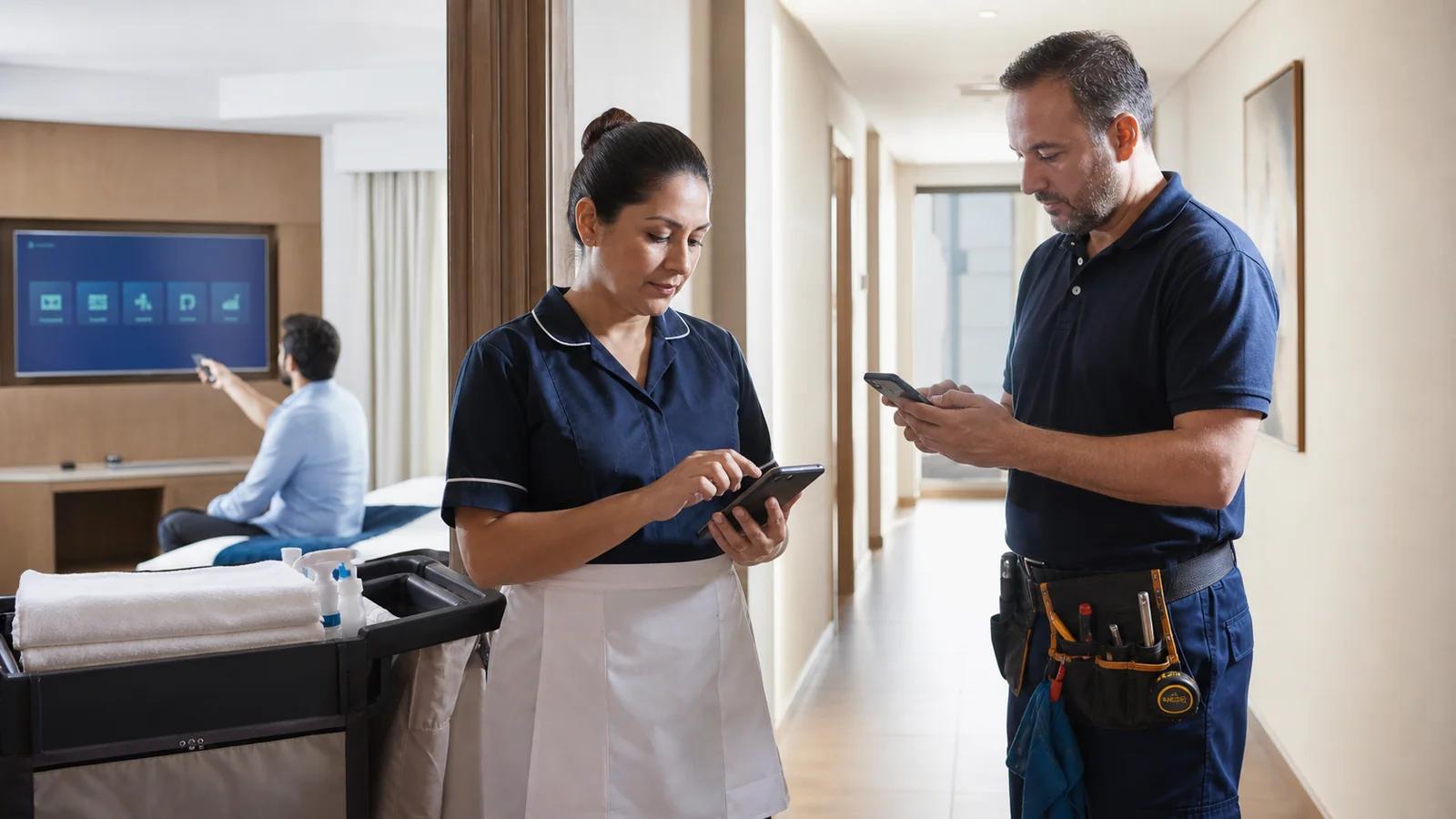
Housekeeping and maintenance applications should be simple enough for a busy employee holding equipment, not designed like a general enterprise dashboard. Show assigned tasks, room, priority, essential detail and one clear next action.
Automation should protect the human moment
Guests usually accept automation for speed and control. They dislike it when the hotel uses automation to avoid responsibility. A complaint, accessibility need, safety concern, billing dispute or emotionally charged request should reach a person quickly.
The interface should therefore offer a visible route to reception. An AI concierge should acknowledge uncertainty. A late request should display realistic availability rather than an instant confirmation that operations cannot honour.
This division is the core psychology: machines handle repetition and status; people handle judgement and care.
A practical 90-day rollout
Days 1–15: measure the interruption load
Sample reception calls and messages by topic. Record volume, handoffs and completion uncertainty. Do not collect more personal data than needed for the analysis.
Days 16–30: choose five workflows
Pick high-volume, low-risk requests with clear owners. Define status and escalation before designing the screen.
Days 31–60: pilot one floor or property
Train staff, test multiple languages and observe where guests hesitate. Keep phone and in-person options.
Days 61–90: expand from evidence
Add services only after the first workflows close reliably. Compare repeated calls, completion time, reopened requests and guest feedback.
Metrics that reveal whether it works
| Metric | What it tells management |
|---|---|
| Self-service answer rate | Routine questions resolved without staff relay |
| Task acceptance time | Whether department ownership is working |
| Completion time | Actual operational performance |
| Reopened request rate | False completion or poor quality |
| Human escalation rate | Where automation reaches its limit |
| Repeated issue by room | Maintenance or process root cause |
| Guest language mix | Where translation and staffing matter |
Avoid celebrating total digital requests in isolation. A rise may mean adoption, or it may mean the hotel has created more friction elsewhere.
Labour data and the technology case
HOTREC's 2026 roadmap on skills and labour shortages describes persistent staffing shortages and gaps in digital and green skills. Technology should therefore reduce training burden as well as guest friction. One consistent interface for tasks is more sustainable than adding a new chat group for every property.
The 2026 European Accommodation Barometer also shows a capability divide: large properties report stronger cybersecurity readiness than very small operators. Cloud tools can make useful workflows accessible to smaller hotels, but only if setup, permissions and support are genuinely simple.
How COTT.TV fits the workflow
COTT.TV combines the guest television, information pages, service menus and AI concierge in one property environment. Planned staff applications extend the same workflow to housekeeping and technical teams, so the guest request and the staff task do not live in separate systems.
The platform is designed for both small independent hotels and multi-property groups. Compatible LG, Samsung and Philips hospitality televisions can run the system directly; other rooms can use a preconfigured COTT set-top box. See the platform demonstration and deployment options.
Sources and further reading
- 1HOTREC: skills and labour shortages roadmap
- 2Booking.com: 2026 European Accommodation Barometer
- 3Amadeus: Hospitality in 2026
- 4Hospitality Technology: 2026 Lodging Technology Study
Automation outcomes depend on process ownership, staff adoption and property operations. Technology should support employment quality and guest service, not disguise understaffing.
Related Posts
Housekeeping and Maintenance Requests: Designing a Closed-Loop Workflow
2026-09-01
A practical workflow for turning guest and staff requests into accepted, timed and verified tasks instead of messages that disappear between departments.
Digital Guest Service KPIs: What Hotels Should Actually Measure
2026-09-05
A balanced measurement model for discovery, task completion, response quality, room technology and guest trust without mistaking clicks for service.
Hotel TV Tender Specification: 24 Questions Before Ordering Screens
2026-08-22
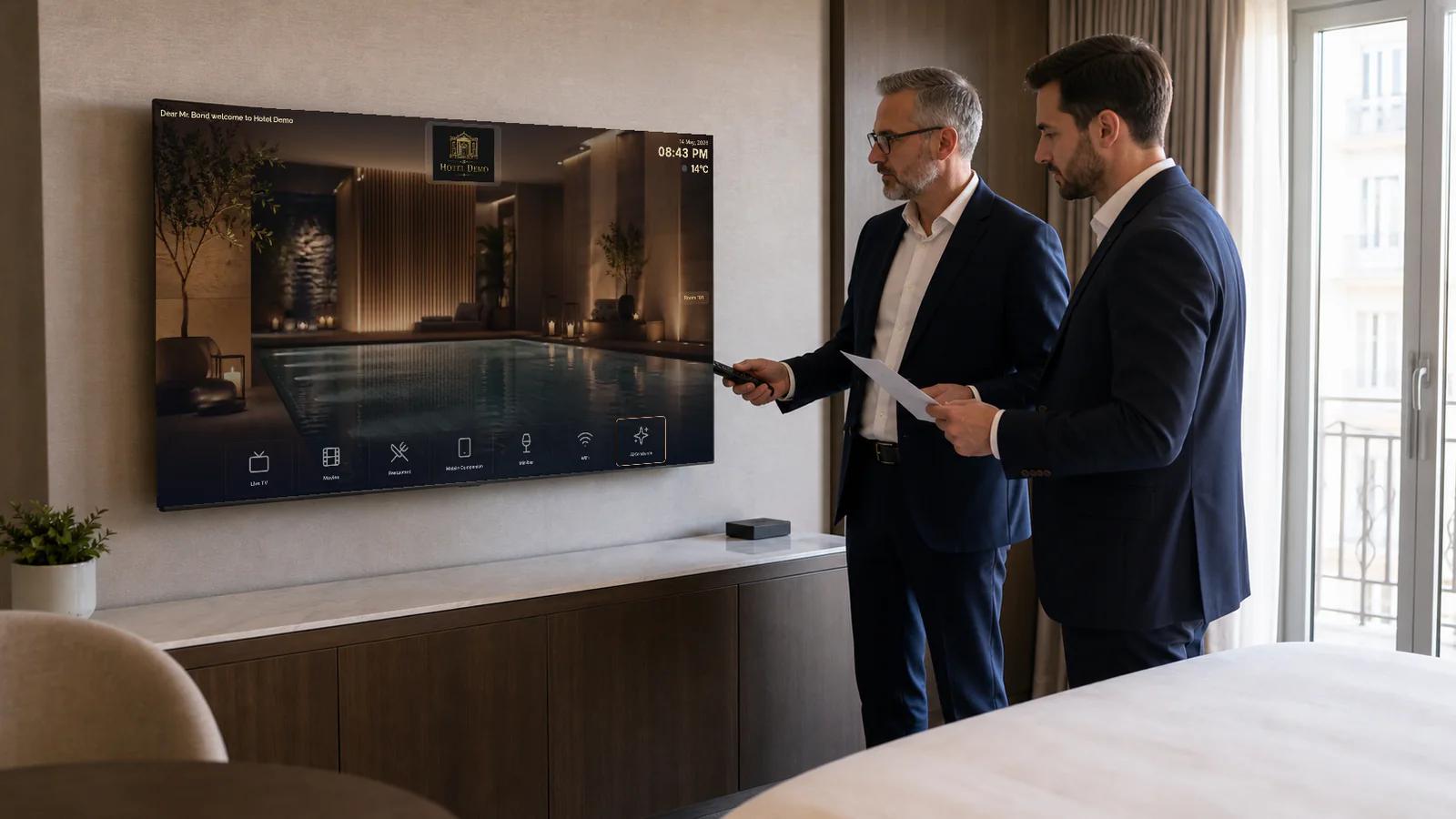
The procurement questions that separate a supported hospitality-TV deployment from a cheap screen purchase that creates years of operational cost.