Hotel IPTV Bandwidth and Network Design: A Practical Planning Guide
August 17, 2026
By COTT.TV Hospitality Technology Research Desk·Published August 17, 2026·6 min read

Quick Summary
By the COTT.TV Hospitality Technology Research Desk | Updated 17 August 2026
By the COTT.TV Hospitality Technology Research Desk | Updated 17 August 2026
Hotel IPTV does not need a mysterious "special network," but it does need arithmetic and disciplined separation. The design question is not how many rooms the hotel has. It is how many televisions may stream concurrently, at what average and peak bitrate, from which source, across which network path and with what failure tolerance.
Cloud IPTV, local headend distribution and hybrid architecture can all be correct. A 20-room boutique hotel with good fibre has a different optimum from a 600-room resort receiving satellite channels locally. Procurement should begin with traffic and operating assumptions rather than a preferred box.
The basic bandwidth formula
For unicast delivery, each active television receives its own stream:
Estimated media load = concurrent active TVs × average stream bitrate
Then add headroom for bitrate variation, protocol overhead, software updates, telemetry and ordinary internet traffic. A simple planning factor is 1.25, but the correct reserve depends on the circuit and how close the hotel is willing to operate to its limit.
Example: 120 rooms, 40% expected TV concurrency, average 5 Mbit/s video.
- 1120 × 0.40 = 48 active televisions;
- 248 × 5 Mbit/s = 240 Mbit/s media traffic;
- 3240 × 1.25 = 300 Mbit/s planned capacity for that media path.
This is not a promise that every stream will use exactly 5 Mbit/s. Measure the actual channel variants. Apple's HLS authoring specification distinguishes average and peak segment bitrate for a reason.
HLS, multicast and local reception
Unicast HLS
Each room requests media over standard HTTP. Apple's HLS overview explains that HLS works through ordinary web servers and CDNs, adapts to network conditions and supports encryption and authentication.
For hotels, HLS is attractive because it works over normal routed IP networks, supports territorial and device authorisation, and avoids multicast configuration across every switch. It scales through CDN infrastructure, but internet egress grows with simultaneous rooms.
UDP/RTP multicast
One stream can be replicated by the local network to multiple receivers. This is bandwidth-efficient inside a properly designed LAN, especially for large linear-TV estates. It requires multicast-aware switching, IGMP configuration, careful VLAN design and compatible endpoints. It also does not solve licensing or guest-interface requirements by itself.
Local headend or appliance
Satellite, terrestrial, cable or authorised IP inputs are received and processed on site. This can reduce external media traffic and keep linear television available during an internet outage. It introduces local hardware, receiver-card, CAM, smart-card, monitoring and maintenance responsibilities.
Hybrid
Local sources carry high-volume or operationally critical channels while cloud delivery supplies international, territorial or lower-demand content. Hybrid is often the most practical architecture for a large property with existing RF or IPTV infrastructure.
Separate IPTV from guest and hotel systems
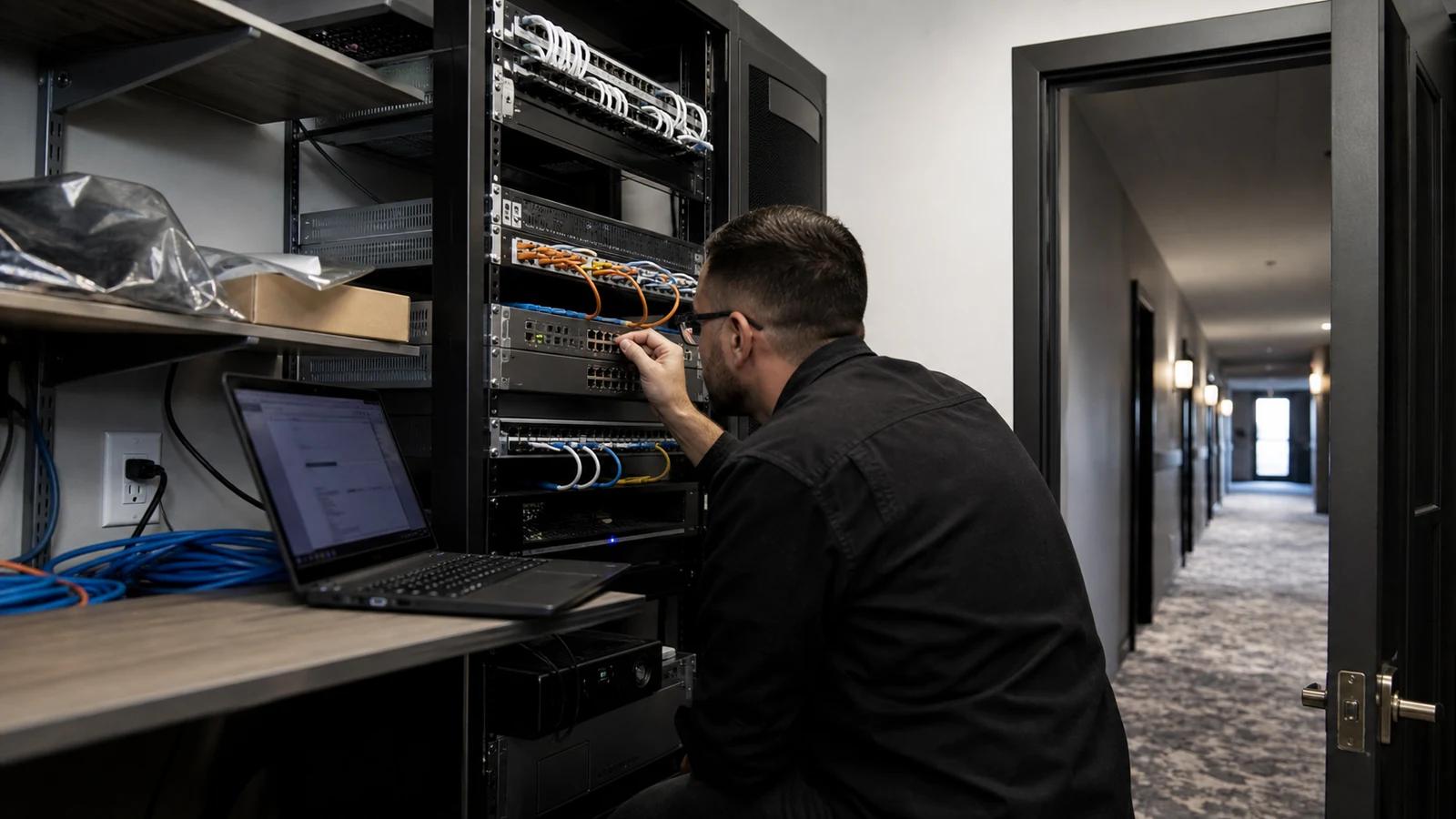
Use a dedicated VLAN for managed televisions and set-top boxes. Permit only the destinations and ports the solution needs. Avoid unrestricted lateral routes to PMS, POS, staff devices or building systems.
CISA's 2025 microsegmentation guidance notes that IoT and legacy devices may require network-based segmentation because they cannot run endpoint agents. Hospitality televisions and STBs fit that operational reality.
A typical logical design separates:
- 1managed TV/STB endpoints;
- 2guest Wi-Fi devices;
- 3casting discovery or pairing gateway;
- 4hotel management and PMS services;
- 5local headend or media server;
- 6vendor management access.
The firewall policy should document flows, not rely on the VLAN name to create security.
Wired or wireless rooms?
Wired Ethernet remains the predictable choice for fixed room televisions where cabling exists. Wi-Fi can work well, particularly in renovations, but a coverage map designed for guest phones is not automatically suitable for hundreds of continuously streaming fixed endpoints.
For Wi-Fi television, validate signal strength and interference at the actual TV position, not the room door. Test channel reuse, roaming behaviour, multicast or discovery requirements, peak client count and how the endpoint reconnects after access-point maintenance.
Resilience has three layers
Source resilience
What happens if the broadcaster feed fails? A monitored backup source or clear unavailable state is better than a frozen last frame.
Distribution resilience
CDN and origin monitoring must detect stale live manifests, not only HTTP errors. AWS's streaming failure-management guidance explains that a manifest can return successfully while no longer advancing, which still causes playback failure.
Property resilience
Define behaviour when the hotel internet circuit fails. Local channels may continue from an on-site source; cloud channels may display a controlled notice; hotel information should remain cached where appropriate. A second internet circuit helps only if routing and failover have been tested.
The acceptance test that procurement should require
Run at least the planned peak concurrency plus a safety margin. Test a mix of channel bitrates, rapid channel changes, overnight playback, circuit failover, switch restart, endpoint reboot and simultaneous software update prevention.
Measure:
- 1startup time and channel-change time;
- 2buffering events and black frames;
- 3packet loss, interface errors and Wi-Fi retries;
- 4CDN/origin response and manifest freshness;
- 5CPU, memory and tuner health on local appliances;
- 6reconnect behaviour after interruption.
Do not approve based on one television in a meeting room.
A decision table
| Property condition | Strong starting option |
|---|---|
| Small hotel, reliable fibre, no headend | Cloud HLS on compatible TVs or STBs |
| Large hotel with satellite/terrestrial sources | On-premise or hybrid |
| Multi-country group needing territorial content | Cloud or hybrid with central rights controls |
| Weak internet but good local TV plant | Local reception with controlled cloud additions |
| Renovation with mixed TV models | Preconfigured STBs or phased direct-TV validation |
How COTT.TV deploys
COTT.TV supports cloud, on-premise and hybrid hotel television. The cloud route can run directly on validated hospitality televisions or COTT STBs. On-premise projects can combine middleware, media processing and requested satellite, terrestrial or IP receiver configuration. The correct route is selected from room count, television model, available network, required channels and support model.
Compare hotel IPTV pricing, review software downloads, or request a live technical demonstration.
Sources and further reading
- 1Apple: HTTP Live Streaming overview
- 2Apple: HLS authoring specification
- 3AWS: streaming media failure management
- 4CISA: zero-trust microsegmentation guidance
Final capacity must be based on measured streams, the hotel's real topology and an agreed concurrency model. The examples above are planning tools, not a substitute for a network survey.
Related Posts

Cloud vs On-Premise vs Hybrid Hotel IPTV: The 2027 Decision Guide
2026-08-17
A clear comparison of cloud, on-premise and hybrid hotel IPTV covering total cost, internet dependence, local channels, support, security, resilience and multi-property control.
Android TV Boxes for Hotels: Google TV, AOSP, Widevine L1 and Kiosk Control
2026-09-26
How to select a manageable hotel STB by separating consumer certification, DRM security, device-owner control, networking and lifecycle support.
Hotel IPTV System Requirements: The 2027 Pre-Tender Checklist
2026-09-24
A vendor-neutral requirements framework for rooms, televisions, networks, content, PMS events, security, monitoring and acceptance.