Android TV Boxes for Hotels: Google TV, AOSP, Widevine L1 and…
September 26, 2026
Research period: September 2026
By COTT.TV Hospitality Technology Research Desk·Published September 26, 2026·6 min read

Quick Summary
A hotel STB needs stable hardware identity, Ethernet, controlled provisioning, device-owner or equivalent kiosk management, verified Widevine security, secure updates, remote diagnostics, HDMI-CEC testing and a documented commercial lifecycle. A consumer Google TV box may play…
By the COTT.TV Hospitality Technology Research Desk | Researched September 2026
An Android television box can extend the life of an existing hotel screen and standardise the guest interface across mixed brands. It can also create a support problem in every room if the hotel buys a consumer product that cannot be locked, updated, identified or restored remotely.
The words Android TV, Google TV and AOSP describe related but different product and management choices. Procurement should begin with the hotel's operating requirements, not the launcher shown on a retail box.
Understand the three labels
Android Open Source Project (AOSP): the open platform base. An OEM can customise the launcher, boot flow and management stack deeply. Google consumer services are not automatically included.
Android TV: Google's television platform and app ecosystem, subject to device certification and licensing. Product capabilities still vary by manufacturer.
Google TV: a consumer experience and content-discovery layer used on top of Android TV OS. It is designed for a signed-in household, which is not the same operating model as a temporary hotel room.
For a hotel, the most controllable AOSP device can be a better endpoint than a famous consumer box. In another project, certified Android TV and its app ecosystem may be essential. There is no universal winner.
Consumer convenience versus hotel control
Consumer devices optimise for personal accounts, recommendations and app choice. Hotels need almost the opposite:
- 1automatic launch into the hotel interface;
- 2no setup wizard after a power interruption;
- 3restricted settings and inputs;
- 4stable room and device identity;
- 5central application and configuration updates;
- 6guest-state removal;
- 7remote health and restart;
- 8controlled replacement and re-enrolment.
If the hotel cannot guarantee those behaviours, every room visit becomes a manual repair.
Device-owner and dedicated-device management
Android's fully managed device mode gives an organisation device-level policy control and is intended for company-owned endpoints. Google's Android Open Source documentation specifically identifies kiosks and digital signage as dedicated-device use cases.
The important provisioning rule is that device owner is normally established during out-of-box setup or after a factory reset. A retail box that has already completed consumer setup may not be convertible through a simple application install.
Verify that the proposed hardware and firmware support the selected management method. Some TV boxes expose only a limited subset of Android enterprise features even when they use Android internally.
The minimum hardware specification
| Area | Practical requirement |
|---|---|
| Processor and memory | Sized for the real UI, codec and update lifecycle, not only a demo video |
| Storage | Enough for two application versions, logs and safe updates |
| Ethernet | Stable wired networking preferred for fixed room endpoints |
| Wi-Fi | Required only where the operating design supports it; verify 5 GHz behaviour |
| HDMI | Correct resolution, refresh rate, HDCP and EDID handling |
| HDMI-CEC | Power, source and key behaviour tested with every TV family |
| Remote | Appropriate key map, replaceable and supportable at scale |
| Identity | Unique serial/MAC or secured identifier available to management |
| Power | Correct regional supply, reliable cold boot and mounting route |
| Thermal design | Sustained playback test inside the actual mounting position |
Do not approve a device from a chipset name alone. OEM firmware determines much of the real behaviour.
Widevine L1 is necessary, but not the whole DRM test
Widevine is Google's DRM system for premium media. Security Level 1 generally means that sensitive content processing occurs inside a trusted execution environment. A product listing that says "Widevine" may support only a lower security level.
For each sample device, verify:
- 1reported Widevine security level;
- 2HDCP state at the television output;
- 3DASH/HLS profile and encryption scheme;
- 4actual licence acquisition from the intended DRM service;
- 51080p or 4K entitlement from the intended content provider;
- 6secure playback after standby and reboot;
- 7behaviour when the clock, certificate or network is wrong.
The content provider decides which robustness level and output protection its licence requires. L1 does not grant a commercial content right.
Launcher and kiosk questions
Ask the OEM to demonstrate, on a production firmware image:
1. automatic boot into the hotel application; 2. suppression of the consumer home launcher; 3. blocking unauthorised settings and app installation; 4. controlled access for technicians; 5. hotel-branded boot and recovery state where licensed; 6. watchdog recovery after application failure; 7. remote restart and application update; 8. factory reset followed by automated re-enrolment.
Avoid undocumented ADB scripts as the only management route. ADB is useful in a laboratory, but exposed or manually enabled debugging is not a production fleet strategy.
App and firmware updates
Use staged deployment:
- 1internal device;
- 2small hotel test group;
- 3representative floor or model cohort;
- 4controlled production wave;
- 5rollback if health signals deteriorate.
The device should validate signed updates and retain a safe previous version or documented recovery route. Confirm how long the OEM supplies security patches and whether component substitutions can occur without a new model number.
Television control is a matrix, not one checkbox
HDMI-CEC behaviour varies by television brand, model and hotel configuration. Test:
- 1TV power-on from STB wake;
- 2correct HDMI source after cold boot;
- 3volume and mute;
- 4remote key routing;
- 5standby and wake;
- 6overscan and resolution;
- 7loss of CEC after firmware update;
- 8recovery when the guest changes the source.
Where CEC is unreliable, use an approved alternative such as serial or IP control if the television supports it.
Procurement sample test
Before ordering 500 units, run at least a seven-day soak test on multiple samples. Measure crashes, temperature, memory, playback starts, update success and network recovery. Remove power repeatedly. Test a nearly full storage condition. Replace one unit as a technician would and time the re-enrolment.
Require the OEM to freeze the bill of materials or notify and re-certify any change that affects firmware, Wi-Fi, DRM or HDMI behaviour.
COTT.TV deployment model
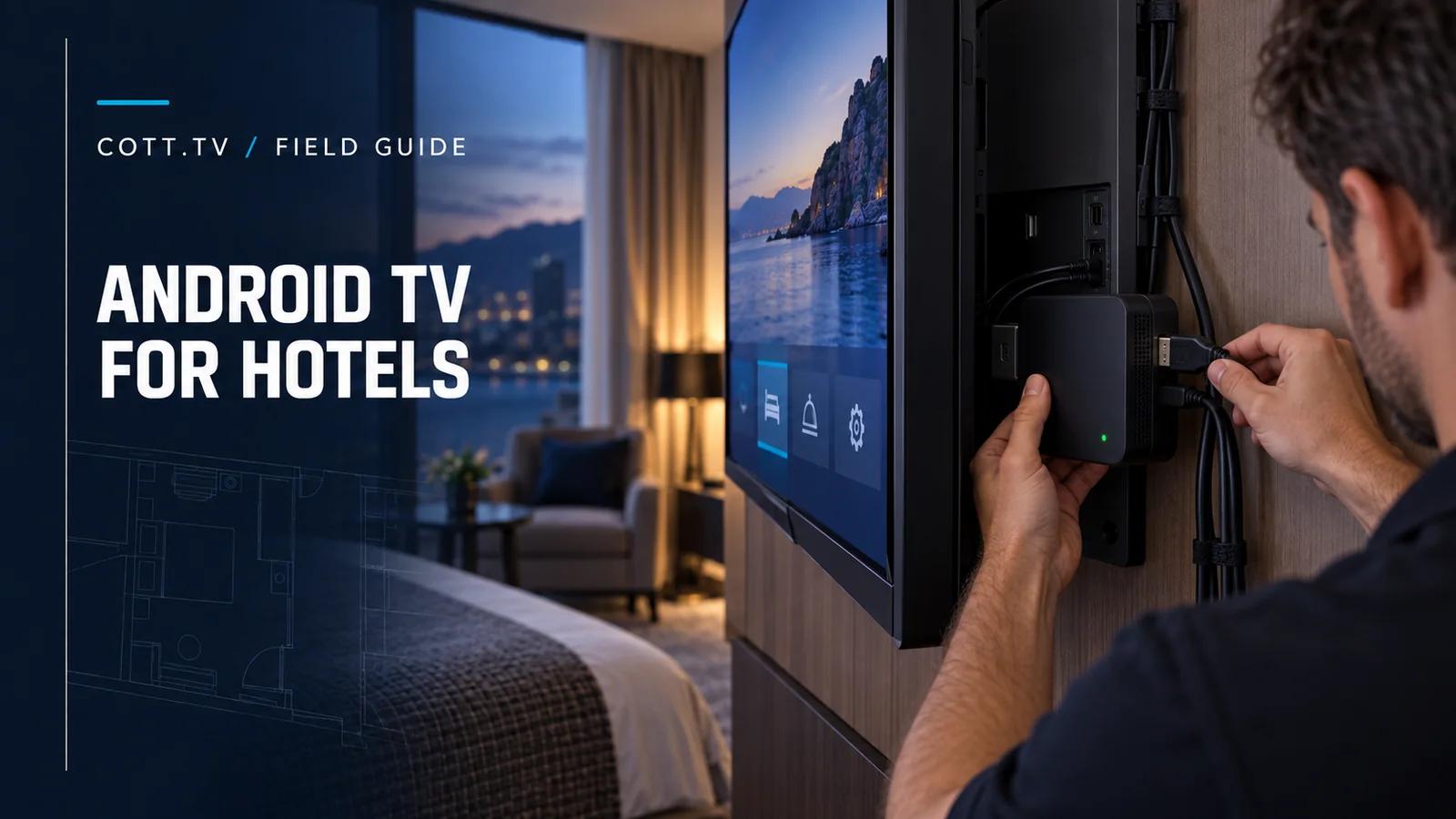
COTT.TV uses managed Android STBs where direct deployment on a hospitality television is unavailable or where a mixed fleet needs one consistent endpoint. The application, launcher behaviour, device registration and room pairing are tested as one deployment profile. For compatible commercial televisions, direct installation can remove the STB entirely.
Compare both routes in the cloud, on-premise and hybrid decision guide and calculate the full five-year cost, including power supplies, HDMI cables, mounting, remotes, spares and room visits.
Sources and further reading
- 1Android Open Source Project: device management overview
- 2Google: Widevine overview and supported platforms
- 3Google Cast: Android TV receiver overview
- 4LG webOS TV: web APIs and engine versions
Platform certification, DRM capability and enterprise-management support must be verified on the exact production hardware and firmware supplied to the hotel.
Related Posts

How Hotels Get Found in AI Search: A Practical GEO and SEO Guide for 2026
2026-08-17
AI travel discovery rewards consistent facts, original local expertise and pages that answer real questions. Here is a practical hotel workflow for Google, ChatGPT-style search and direct-booking visibility.
Hotel IPTV System Requirements: The 2027 Pre-Tender Checklist
2026-09-24
A vendor-neutral requirements framework for rooms, televisions, networks, content, PMS events, security, monitoring and acceptance.
Secure Hotel Casting in 2027: AirPlay, Google Cast and Checkout Privacy
2026-09-22
A technical and operational guide to room-specific pairing, network isolation, checkout reset and acceptance testing for hotel casting.