White-Label Hotel IPTV for Integrators
October 10, 2026
Research period: September 2026
By COTT.TV Hospitality Technology Research Desk·Published October 10, 2026·6 min read

Quick Summary
Define territory, lead ownership, customer contract, pricing, support levels, branding scope, data roles, hosting, hardware certification, content rights, roadmap authority and exit. If the platform waives a normal setup fee, document it as a commercial investment with value,…
By the COTT.TV Hospitality Technology Research Desk | Researched September 2026
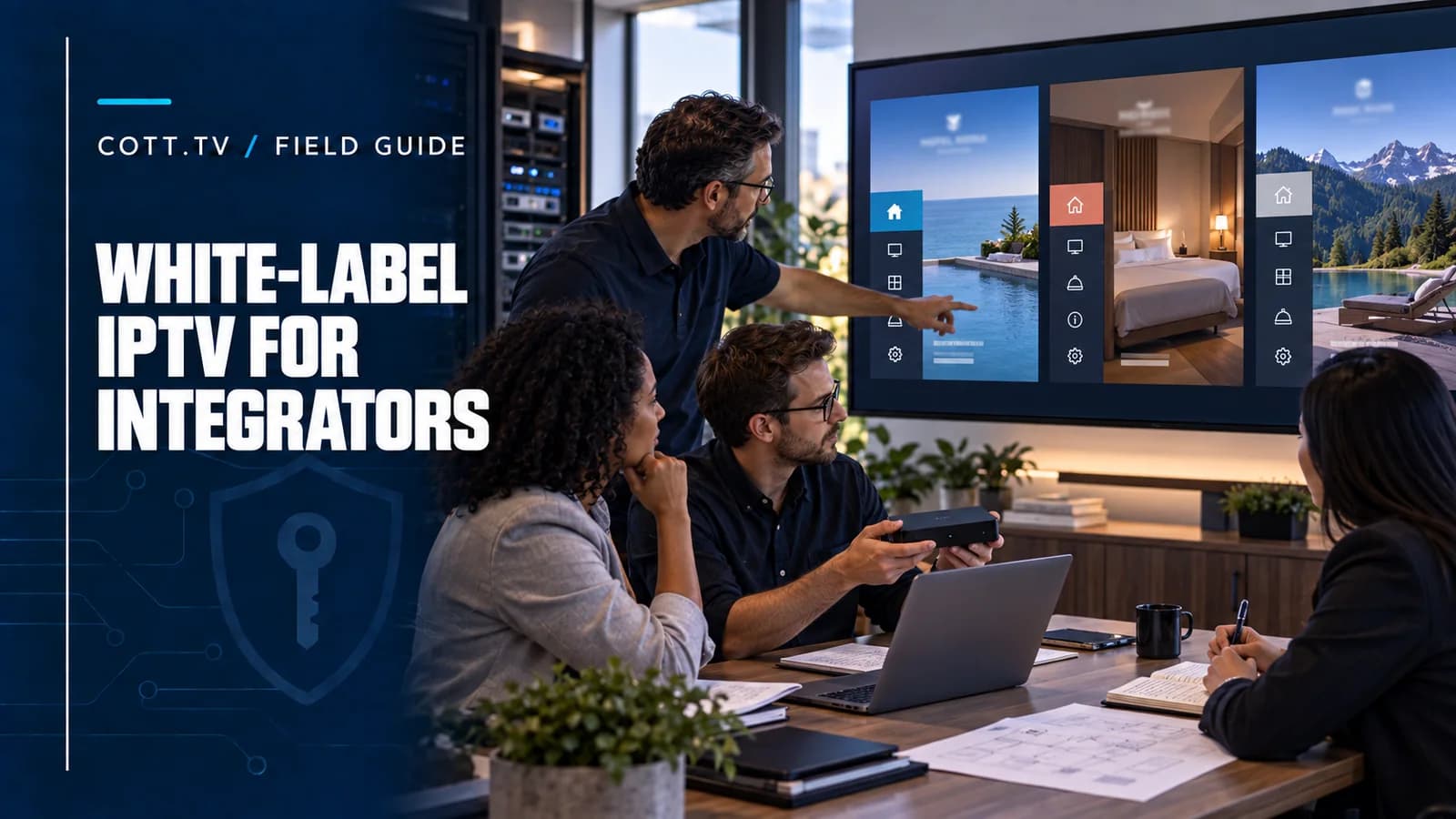
A white-label hotel television platform lets a systems integrator sell under its own brand, keep the customer relationship and enter the market without funding the complete software stack. It also creates shared responsibility: the local partner may own sales and installation while the platform operator still carries software, cloud, security and product risk.
The partnership works when those boundaries, economics and quality controls are explicit before the first hotel is promised a launch date.
White-label is more than changing a logo
A production white-label scope can include:
- 1partner domain and TLS;
- 2partner name, logo, colours and email templates;
- 3branded hotel and guest interfaces;
- 4partner-level customer and property administration;
- 5role-based users;
- 6pricing and billing route;
- 7support and escalation workflow;
- 8application package or managed endpoint profile;
- 9local language and legal content;
- 10documentation and sales material;
- 11analytics under the agreed data roles.
Custom product behaviour, exclusive features or a separate code branch should be priced and governed separately. Unlimited customisation usually damages both partners.
Choose the partner operating model
| Function | Platform operator | Local integrator | Joint decision |
|---|---|---|---|
| Core software and hosting | Usually owner | Informed | Architecture and SLA |
| Local sales and relationship | Support | Usually owner | Lead registration |
| Site survey and network | Standards | Usually owner | Acceptance evidence |
| Hardware sourcing | Certification | Supply/logistics | Approved models |
| Content rights | Marketplace controls | Local sourcing may assist | Territory approval |
| First-line support | Tools/training | Usually owner | Escalation rules |
| Product roadmap | Usually owner | Requests/evidence | Strategic priorities |
| Billing | Wholesale or direct | Retail or commission | Credit and tax terms |
Do not leave the customer guessing who answers a fault at 22:00.
Commercial models
Common structures include:
Wholesale licence: the partner buys rooms or properties at an agreed rate and sets its resale price.
Revenue share: the platform invoices or recognises the customer and shares agreed net revenue.
Referral: the platform contracts and supports the customer, paying the integrator a commission.
Territory partnership: the partner receives defined commercial rights in exchange for minimum performance, local investment and service capacity.
The agreement should state registered-room rules, discounts, currency, tax, overdue accounts, hardware margin, content pass-through, renewal and price review.
Treat free setup as investment
Professional white-label setup has economic value even when no invoice is issued. If the platform operator waives a one-time branding or deployment fee, record it as an investment into the partnership.
The commercial schedule should state:
- 1normal setup value;
- 2amount waived or invested;
- 3assets and work included;
- 4milestones such as first property or room target;
- 5exclusivity, if any, and its performance conditions;
- 6what happens if the partner does not launch;
- 7ownership and reuse of created assets;
- 8paid scope outside the investment.
This is clearer than describing substantial engineering work as "free" and arguing about its value later.
Require evidence before exclusivity
A single prospect can justify a pilot, not necessarily a country right. Before exclusivity, assess:
- 1qualified pipeline and named decision stages;
- 2hotel and systems-integration references;
- 3installation and support capacity;
- 4legal entity, tax and credit standing;
- 5local content and broadcaster relationships;
- 6language and market coverage;
- 7annual room commitment;
- 8marketing plan and reporting cadence.
Use time-limited, performance-based exclusivity with review dates and carve-outs for existing customers or strategic accounts.
Product and data ownership
The contract should distinguish:
- 1platform source code and generic product improvements;
- 2partner brand assets;
- 3hotel configuration and operational data;
- 4content-provider information;
- 5custom feature funding and reuse;
- 6exported data at termination;
- 7domains, certificates and application-store accounts.
The EU Data Act has increased attention to cloud switching and portability. A practical agreement still needs export format, timing, assistance, cost and deletion evidence.
Technical due diligence
The integrator should test:
- 1multi-tenant separation;
- 2customer, property, room and device hierarchy;
- 3direct-TV and STB deployment routes;
- 4application startup and remote control;
- 5PMS check-in, room move and checkout;
- 6content territory and package controls;
- 7stream authorisation and DRM;
- 8roles, audit logs and partner impersonation controls;
- 9monitoring, alerting and incident history;
- 10backups, recovery and update process;
- 11branding without a separate fragile code fork.
Use a real pilot hotel or representative lab, not only a browser mock-up.
Hardware programme
If the integrator supplies STBs or televisions, define:
- 1approved models and firmware;
- 2bill-of-material freeze and substitution rules;
- 3factory provisioning and serial import;
- 4shipping, customs and local certification;
- 5warranty, dead-on-arrival and spare policy;
- 6remote and HDMI-CEC compatibility;
- 7Widevine and output-protection result;
- 8re-enrolment after replacement;
- 9end-of-life notification.
A white-label interface cannot compensate for an unmanaged room endpoint.
Support design
Use a three-level model:
Level 1, integrator: hotel contact, room identification, basic reset, network and power checks.
Level 2, platform NOC: tenant, device, application, entitlement, stream and integration diagnosis.
Level 3, engineering or vendor: software defect, firmware, DRM or infrastructure incident.
Specify response and restoration targets by severity, evidence required for escalation, maintenance windows and who communicates with the hotel. Give the partner a status view rather than forcing support through private chat messages.
Protect the customer relationship without hiding the operator
White-label does not require misleading claims. Contracts, privacy notices and subprocessors should accurately identify the entities that host or process data. The partner can remain the commercial face while the hotel understands the technical operator and support chain.
Agree how references, case studies and manufacturer certifications may be used. Do not invent a certification or place a manufacturer's logo without permission.
Pilot-to-scale sequence
1. sign NDA and non-exclusive partner terms; 2. create branded demo tenant; 3. train commercial and technical teams; 4. certify one hardware and network profile; 5. launch one representative hotel; 6. close defects and document acceptance; 7. confirm wholesale economics and support load; 8. expand pipeline and volume discount; 9. consider territory rights only after evidence; 10. review quarterly against rooms, service and revenue.
This protects both sides while allowing a serious partner to move quickly.
COTT.TV partner model
COTT.TV can provide a branded commercial control layer, hotel administration, guest interface, managed device routes and content-marketplace controls for qualified integrators. Wholesale room pricing can improve with committed scale. One-time white-label work may be treated as COTT.TV investment when the partner opportunity, milestones and mutual obligations justify it.
Partners should begin with a real demonstration and one production-capable property. Explore the platform, partner information and live demo before defining territory or custom scope.
Sources and further reading
- 1European Commission: Data Act explained
- 2Android Open Source Project: fully managed and dedicated devices
- 3LG Pro:Centric Developer platform
- 4Hospitality Technology: 2026 Lodging Technology Study
Commercial examples are frameworks, not legal or tax advice. Territory, investment and exclusivity terms should be documented in a signed agreement tailored to the parties and market.
Related Posts
Hotel IPTV Cost per Room in 2027: A Transparent Calculation Method
2026-10-04
A practical cost-per-room model covering software, televisions, STBs, content, networks, integration, support and lifecycle replacement.
Hotel Upselling Without Dark Patterns: Timing, Relevance and Consent
2026-09-03
How to build profitable in-stay offers that remain useful, honest and operationally deliverable instead of pressuring guests through deceptive interfaces.
Hotel TV as a Revenue Channel: Ancillary Sales Without Annoying Guests
2026-08-17
The room television can sell breakfast, spa, late checkout and local experiences, but only when offers are timely, useful, measurable and separate from intrusive advertising over TV content.