Protecting Hotel TV Streams: Device Identity, Tokens, CDN Controls…
October 6, 2026
Research period: September 2026
By COTT.TV Hospitality Technology Research Desk·Published October 6, 2026·6 min read

Quick Summary
Register every endpoint, issue short-lived stream authorisation, keep origins private, apply territory and channel entitlement centrally, use DRM when rights require it, rotate keys and signing secrets, revoke individual devices and monitor unusual reuse without collecting unn…
By the COTT.TV Hospitality Technology Research Desk | Researched September 2026
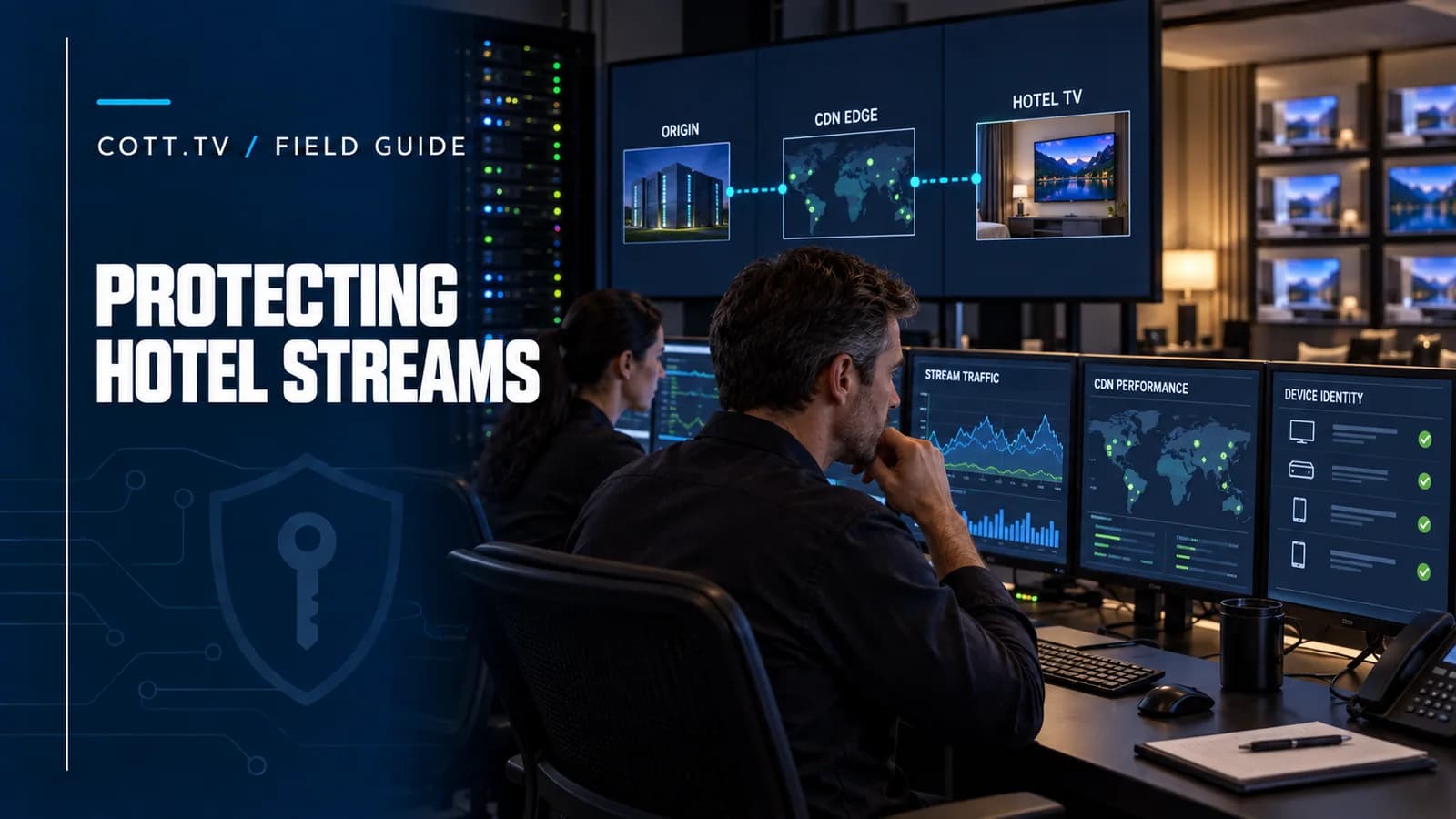
An HLS or DASH address copied from a television can become a permanent public link if the distribution system trusts the URL alone. A hotel platform needs to decide which property, room and device may request a channel, for how long, in which territory and under which content agreement.
No single feature solves that problem. Tokens control access to the delivery path, DRM protects keys and playback policy, the CDN shields the origin, and monitoring detects abuse. They must share the same entitlement model.
Begin with a canonical entitlement decision
Before returning a stream, the platform should answer:
- 1Is this property active?
- 2Is this room or endpoint registered to the property?
- 3Is the requested channel licensed in the property's country?
- 4Is the package assigned to the property?
- 5Is the device profile approved for the stream and DRM policy?
- 6Is the request within concurrency and contract rules?
- 7Has the device or credential been revoked?
Keep this decision in a controlled backend. A static playlist embedded in an APK or web package cannot express current commercial rights safely.
Device identity
Use a platform-issued device record tied to property and room. Hardware identifiers such as serial or MAC can help enrol the endpoint, but they should not be the only secret because they may be visible or spoofable.
A strong pattern is:
1. an authorised administrator initiates enrolment; 2. the device proves or presents its installation identity; 3. the backend issues a device credential; 4. the credential is stored using the platform's protected storage where available; 5. each session exchanges it for short-lived access; 6. the backend can revoke that one device without changing every room.
Track credential age and last successful rotation. A device that has been offline for a long period may require revalidation.
Short-lived tokens
The television should request a playback session rather than receive an immortal channel URL. The session can include signed claims such as:
- 1device and property identifier;
- 2channel or package;
- 3territory;
- 4issue and expiry time;
- 5optional IP or network constraint;
- 6nonce or session identifier;
- 7authorised playback profile.
Keep expiry short enough to limit sharing but long enough to avoid breaking normal segment requests. Renewal should happen before expiration and fail gracefully when the control plane is temporarily unavailable.
AWS documents signed URLs and signed cookies as two routes for private CDN content. Signed cookies can be convenient for multiple HLS segments, while signed URLs suit individual resources or clients that do not use cookies. The same design principle applies to other CDNs and media servers.
Protect the origin
If the public can bypass the CDN and fetch the origin directly, edge tokens provide incomplete protection. Restrict origin access to authorised CDN or gateway paths using network rules, mutual authentication, origin access controls or rotated custom headers as appropriate.
Also:
- 1require HTTPS between viewer, edge and origin;
- 2separate contribution ingest from public delivery;
- 3remove default management ports from the public internet;
- 4rotate administrative credentials;
- 5limit media-server APIs to the control plane;
- 6back up configuration without embedding live secrets in the backup archive.
Territory and package policy
Use the property's verified country and contract, not the guest's phone location, as the main hospitality entitlement context. Apply geo controls as an additional defence where required, recognising that IP geolocation is imperfect.
Every channel should have a machine-readable policy:
- 1allowed countries;
- 2effective and expiry dates;
- 3free or paid package;
- 4room basis and concurrency;
- 5device or output restrictions;
- 6reporting obligations;
- 7fallback behaviour after expiry.
The administration interface should not allow an operator to select a channel outside the permitted territory.
When DRM is required
DRM protects the media keys and secure playback path. Use it when required by the content owner or when premium value justifies the operational complexity.
The end-to-end design includes:
- 1encrypted packaging;
- 2protected key exchange;
- 3licence proxy and business rules;
- 4certified client and secure decoder;
- 5HDCP or other output protection;
- 6revocation and key rotation;
- 7playback and licence telemetry.
Tokenised delivery without DRM can still be appropriate for authorised free channels. DRM without CDN and entitlement protection can still leave manifests or licences open to abuse. Choose the layers by rights and threat model.
Key and secret management
Separate:
- 1contribution credentials;
- 2CDN signing keys;
- 3device credentials;
- 4DRM content keys;
- 5DRM service credentials;
- 6administrator and API secrets.
Store them in a managed secret system, define owners, rotate on schedule and record emergency rotation steps. Never log complete bearer tokens or licence secrets.
Use key identifiers so verification can accept a new and previous signing key during a controlled rotation window.
Monitoring without guest surveillance
Useful security signals include:
- 1token requests by property, device and channel;
- 2repeated invalid signatures;
- 3the same device credential used from impossible locations;
- 4concurrency above the room or contract limit;
- 5origin requests that bypass the CDN;
- 6unusual licence denial rates;
- 7expired contracts still generating requests;
- 8device versions outside the approved profile.
Aggregate viewing analytics separately from security logs. Content partners may need property and territory reporting, not identified guest histories.
Failure and revocation tests
Test that:
1. a copied URL expires; 2. a token for channel A cannot request channel B; 3. a device from property A cannot claim property B; 4. a revoked device stops receiving new sessions; 5. an expired territory agreement blocks selection and playback; 6. direct origin access fails; 7. key rotation does not interrupt valid playback unexpectedly; 8. clock drift produces a diagnosable error; 9. control-plane interruption follows the agreed grace policy; 10. logs contain evidence without secrets.
Run the tests after major media-server, CDN, application and DRM changes.
COTT.TV security model
COTT.TV can bind playback to the registered customer, property, room and endpoint, enforce channel territories and issue time-limited delivery authorisation. Premium profiles can add Widevine through the authorised DRM service. The content-provider portal can then report authorised hotel distribution without exposing unrelated customer or guest data.
Pair this guide with Widevine L1 for Hotel TV and the European hotel content licensing guide.
Sources and further reading
- 1AWS: restrict access to private content
- 2AWS: signed URLs versus signed cookies
- 3Google: Widevine DRM overview
- 4European Commission: GDPR processing principles
Security controls should be reviewed against the actual CDN, media server, DRM provider, device fleet and content agreements. Do not treat this article as a substitute for a formal security assessment.
Related Posts

Hotel TV Content Analytics: What Broadcasters and Hotels Should Measure
2026-10-08
A privacy-safe reporting model for channel reach, authorised hotels, viewing time, playback quality, territory and monthly partner reports.

COTT.TV and FashionTV partner for hotel entertainment
2026-11-03
Our signed hospitality distribution partnership with FashionTV brings a fashion and lifestyle direction to COTT.TV, with hotel-controlled channel selection and clear service pricing.
Widevine L1 for Hotel TV: What to Verify Before You Promise Premium Content
2026-09-30
A practical DRM acceptance guide covering security level, encryption profiles, licence policy, HDCP, playback and operational evidence.