Hotel TV Platform Guide: webOS, Tizen, MediaSuite and Managed Android
September 28, 2026
Research period: September 2026
By COTT.TV Hospitality Technology Research Desk·Published September 28, 2026·6 min read

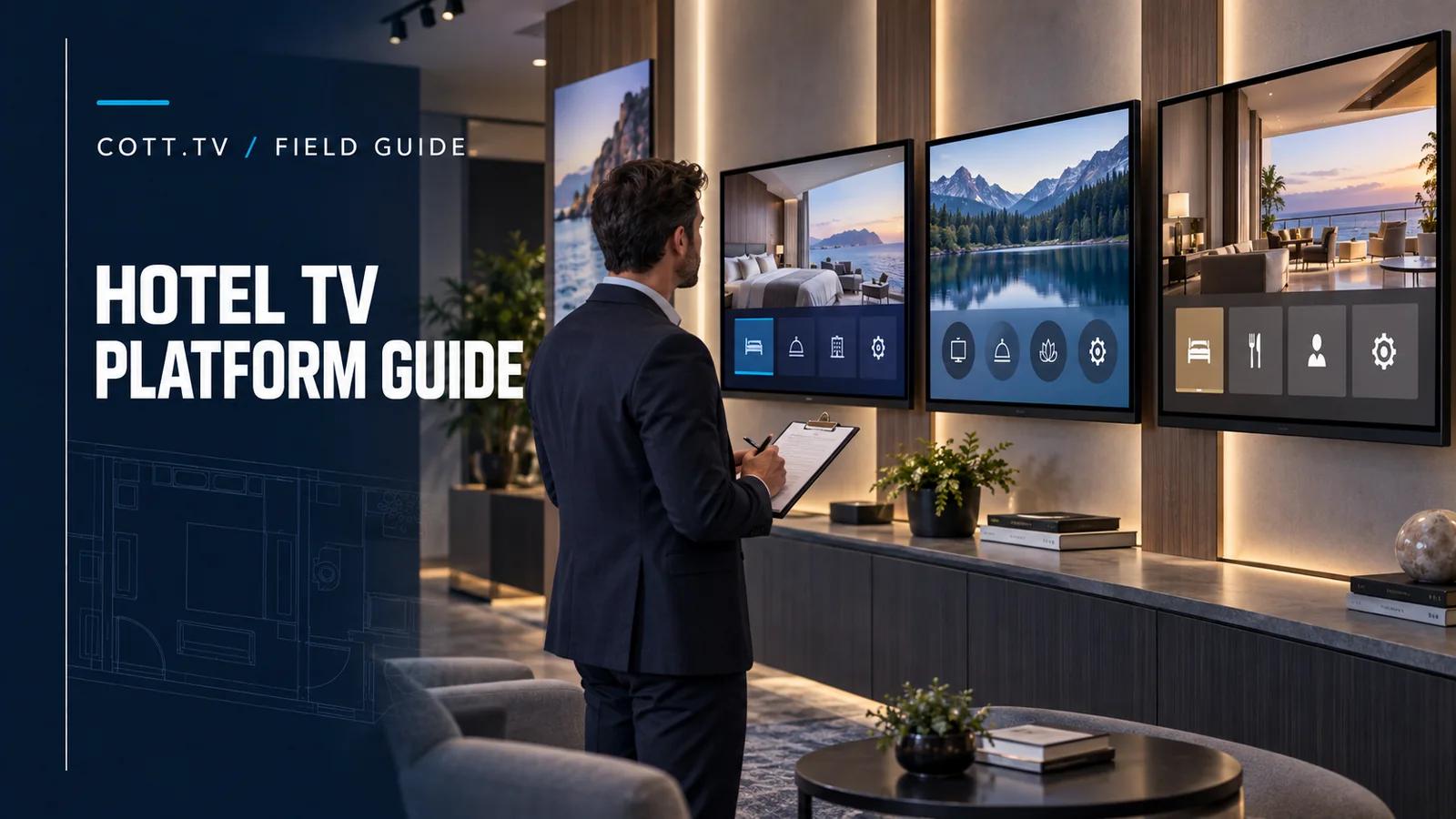
Quick Summary
Buy the exact commercial model, not a brand promise. Test application deployment, automatic launch, remote keys, device identity, DRM, casting, PMS checkout, firmware and support on physical samples. Use a managed STB when the existing screen cannot provide the required contro…
By the COTT.TV Hospitality Technology Research Desk | Researched September 2026
The hotel television market is not divided simply into "smart" and "not smart" screens. Commercial models expose different application environments, management tools, hospitality controls, casting routes and update policies. A solution that runs well on one platform may need a different package, API or operational model on another.
The objective is not to choose a winning operating system. It is to select a screen and deployment route that the hotel can certify, operate and support for its planned lifecycle.
Start with the commercial model
Hospitality televisions differ from consumer products in ways that may not appear on a retail comparison page. Commercial functions can include startup application control, cloned settings, restricted menus, volume limits, remote management, room identity, PMS integration and credential clearing.
Record the complete model code and regional suffix. The same marketing family can vary by country, tuner and firmware. If the tender allows substitution, require the replacement model to pass the same acceptance suite before shipment.
LG Pro:Centric and webOS
LG describes Pro:Centric as a commercial application platform using familiar web technologies with local and remote deployment options. HCAP and IDCAP APIs provide television and commercial-device control on supported models.
For a hotel application, verify:
- 1HCAP/IDCAP or Smart application type required by the model;
- 2local package, remote-run or remote-deploy path;
- 3automatic launch after AC power loss;
- 4channel and remote-control key handling;
- 5television identifiers and persistent storage;
- 6live and DRM playback in the model's web engine;
- 7availability of required OTT applications in the country;
- 8partner access needed for SDKs, firmware and documentation.
The consumer webOS developer site is useful for understanding web-engine versions, but a hospitality implementation also needs the commercial Pro:Centric documentation and regional LG support route.
Samsung Tizen and LYNK
Samsung's hospitality portfolio uses Tizen-based displays and LYNK tools on supported models. Samsung positions LYNK Cloud as a platform for content, device management and analytics, with PMS-linked credential clearing on compatible deployments.
The integration team should confirm:
- 1exact application packaging and signing route;
- 2partner or seller account requirements;
- 3permitted launch and hospitality-control APIs;
- 4LYNK Cloud, REACH or third-party middleware responsibilities;
- 5remote key codes and source control;
- 6application and firmware rollout policy;
- 7model-specific OTT and casting capability;
- 8regional availability and licensing.
Do not assume that a consumer Tizen application can be installed on a hospitality fleet through the same route.
Philips MediaSuite and Android-based hospitality TVs
PPDS positions Philips MediaSuite as an Android-powered hospitality range with built-in Google Cast on supported models, custom branding and CMND/Check-in capabilities. This can reduce room hardware where the integrated feature set matches the hotel's needs.
Verify:
- 1model generation and Android version;
- 2Google Cast architecture, server or network dependencies;
- 3application distribution and AppControl policy;
- 4Netflix or other OTT activation requirements;
- 5checkout data removal;
- 6CMND or Philips Wave management scope;
- 7how mixed older and newer displays are handled;
- 8country-specific feature availability.
Built-in casting still needs room pairing, network isolation and checkout testing. Integration removes a dongle; it does not remove the operating design.
Managed Android STB
A managed STB is television-brand independent and can give the platform operator control over launcher, application, playback and updates. It is often the most practical route for existing consumer televisions or mixed fleets.
Its costs and risks are physical:
- 1another power supply and HDMI cable;
- 2mounting and ventilation;
- 3HDMI-CEC differences;
- 4remote-control mapping;
- 5device replacement and spares;
- 6OEM firmware and component lifecycle;
- 7management and DRM certification.
The strongest STB design uses device-owner or equivalent control and can be enrolled, diagnosed, updated and reset without entering the guest interface.
Capability matrix
| Decision area | Direct hospitality-TV app | Managed Android STB |
|---|---|---|
| Visible room hardware | Minimal | Additional box, cable and power |
| Existing TV reuse | Model-dependent | Strong where HDMI is available |
| Platform control | Constrained by TV APIs | Greater control over endpoint image |
| Remote and source | Native when integrated correctly | Requires CEC, IR, serial or IP validation |
| Firmware ownership | Television manufacturer | STB OEM plus platform operator |
| Cross-brand consistency | Requires platform-specific packages | Stronger across mixed screens |
| Replacement | Exact compatible TV or recertification | Replace enrolled STB independently |
| Casting and OTT | May be integrated by model | Depends on STB certification and design |
The correct comparison includes room installation and five-year support, not only the unit price.
Build a compatibility record
For every approved profile, store:
- 1manufacturer, full model and region;
- 2firmware and operating-system version;
- 3application package and release;
- 4installation and launch method;
- 5remote key map;
- 6live playback codecs and profiles;
- 7DRM and HDCP result;
- 8casting or OTT result;
- 9check-in, room move and checkout result;
- 10known limitations and rollback path;
- 11test date and evidence owner.
A statement that a platform is "supported" should always resolve to this evidence.
Test old and new web engines
LG's published webOS engine table illustrates the lifecycle problem: webOS TV generations use materially different Chromium or WebKit versions. Modern JavaScript syntax, media APIs, TLS roots and DRM behaviour may differ. Similar generational variation exists across other TV platforms.
Build for the oldest supported profile, use progressive enhancement and test on physical screens. A desktop browser and simulator cannot reproduce every media pipeline, remote-control or standby behaviour.
Update governance
Hotels often freeze firmware to protect a validated deployment. Security and application compatibility still require controlled change. Use a policy that distinguishes:
- 1urgent security update;
- 2mandatory platform or certificate update;
- 3tested feature release;
- 4optional manufacturer update;
- 5prohibited unvalidated update.
Maintain a pilot device for each major profile and test before a portfolio rollout. Record who can approve firmware, application and configuration changes.
A purchase decision in five steps
1. Define the room experience and content requirements. 2. Shortlist exact commercial models available in the country. 3. Run the application and acceptance suite on samples. 4. Compare direct-TV and STB lifecycle cost. 5. Contract the validated model, firmware, support and substitution rules.
This sequence prevents the television purchase from locking the hotel into an unsuitable application route.
COTT.TV compatibility approach
COTT.TV maintains deployment profiles for validated hospitality televisions and a managed STB route for unsupported or mixed fleets. The guest interface and central management stay consistent while platform adapters handle the model-specific controls.
Use the hotel TV tender checklist before purchasing screens and the no-STB deployment guide when comparing direct application economics.
Sources and further reading
- 1LG Pro:Centric Developer platform
- 2LG webOS TV: web APIs and engine versions
- 3Samsung LYNK Cloud hospitality solution
- 4PPDS: Philips MediaSuite hospitality televisions
Features vary by country, exact model and firmware. Manufacturer product pages are starting points; physical certification is the purchase evidence.
Related Posts
Hotel TV Tender Specification: 24 Questions Before Ordering Screens
2026-08-22
The procurement questions that separate a supported hospitality-TV deployment from a cheap screen purchase that creates years of operational cost.
Hotel IPTV System Requirements: The 2027 Pre-Tender Checklist
2026-09-24
A vendor-neutral requirements framework for rooms, televisions, networks, content, PMS events, security, monitoring and acceptance.
COTT.TV and Al Jazeera Partner for Hospitality Distribution
2026-09-16
COTT.TV and Al Jazeera Media Network have signed an agreement to bring Al Jazeera English and Arabic to hotel guests across approved hospitality markets.