Hotel TV Without a Set-Top Box: A 2026 Procurement Reality Check
May 15, 2026
By COTT.TV Editorial·Published May 15, 2026·10 min read
Quick Summary
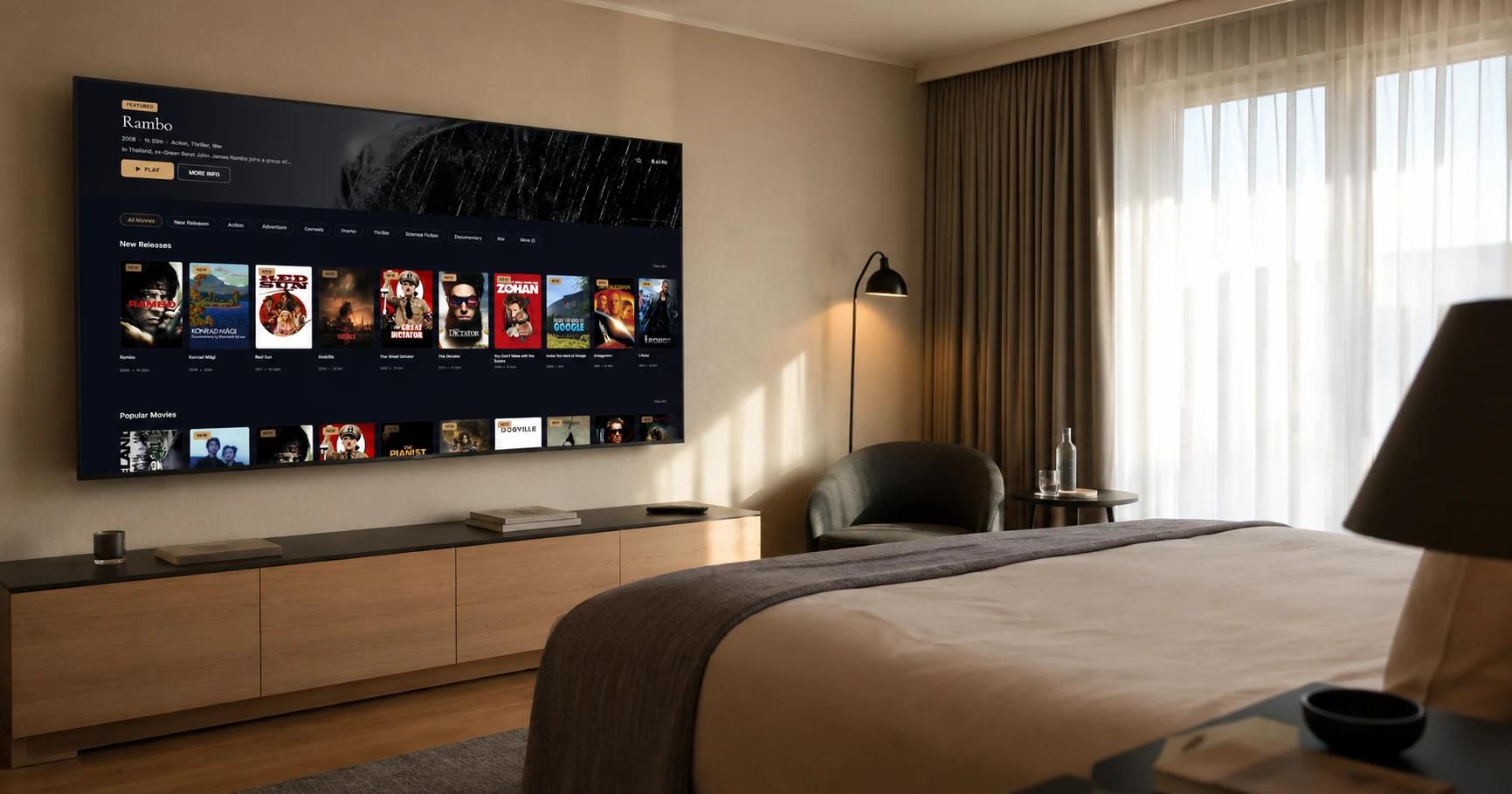
In 2026, hotels do not need to choose ideologically between Smart TV apps and set-top boxes. Native LG webOS and Samsung Tizen apps can work for modern, uniform TV estates with light-to-moderate IPTV requirements. Dedicated hospitality STBs remain the safer choice for mixed TV…
In 2025, Samsung introduced its HU8000F hospitality TV line with Google Cast support, AirPlay in selected configurations, and business-app deployment through the Tizen Enterprise Platform. LG's Pro:Centric Smart and webOS hospitality ecosystem has been moving in the same direction, with native hotel TV applications, centralised management, and expanded casting capabilities.
The message to hotels is simple: the guest-room TV can now do more of the work itself.
That message is partly true. It is also partly marketing.
The question every hotel IT director should ask before removing the set-top box from the budget is not "can this app run on the TV?" It is "what do we need the screen to do in year one, year three, and year seven?"
What "no set-top box" actually means in 2026
There are four deployment models in active use across mid-market European hotels.
Native Smart TV app. The IPTV vendor publishes an app to Samsung's Tizen Enterprise Platform (TEP) or LG's Pro:Centric Smart. The TV runs it directly. No additional hardware in the room. Works if the property's TV estate is uniform, modern, and certified for the vendor's app.
Off-the-shelf Android TV STB. Generic Android TV device connects via HDMI to whatever TV is already in the room. The IPTV vendor publishes an Android TV app. Works regardless of TV brand or age. Brings its own Google Cast and Netflix-certified runtime.
Custom hospitality STB. Vendor-controlled hardware. A typical specification today: an Amlogic-class SoC with hardware AV1 decode, 2-4 GB RAM, a dedicated VPU, and custom Android firmware locked to the vendor's UI. Hotels keep these for years. The vendor pushes updates over the air on its own cadence, not the TV manufacturer's.
Hybrid estate. Mix. Native app on the new Samsung Tizen TVs in renovated floors, STBs on the older Philips or Vestel TVs in unrenovated floors. Most large European properties end up here whether they planned to or not.
The marketing answer to "do I need a set-top box" is "no, if you buy our new platform." The honest answer is "it depends entirely on what TVs you have in the building and what you actually want the screen to do."
Where native Smart TV apps work well
The case for skipping the STB is strongest when the conditions below are all true.
The hotel runs a single TV brand. Samsung or LG. Newer hospitality models (Samsung Tizen Enterprise Platform 8.0 or higher, LG Pro:Centric Smart on current webOS) ship with the right API surface and reasonably modern silicon. A 2025 Samsung HU8000F or a current LG Pro:Centric Smart can run a competent IPTV app, support casting, and integrate with PMS.
The IPTV interface stays light. A welcome screen, a few information layers, channel zapping, light VOD navigation, occasional menu and services overlays. Smart TV app runtimes are sandboxed and operate within tighter memory and sandbox limits than dedicated hospitality STBs. For straightforward interfaces this is fine. For richer experiences it becomes the binding constraint.
Casting is the only "guest device" integration the hotel needs. Samsung 2025 and 2026 hospitality TVs ship with Google Cast and AirPlay built in. LG TVs handle Cast and AirPlay through Pro:Centric. If casting is the headline feature, the TV's native runtime is enough.
CAPEX matters more than control. No STB hardware saves €50-100 per room. For a 300-room property that is €15,000-30,000 plus installation, cabling, and storage logistics. The trade-off can be real.
Where set-top boxes still win
The case for STBs gets stronger as soon as any of the conditions above stops being true.
Mixed TV estate. Most independent and mid-market European hotels run three or four TV brands across the property: a renovation cohort of new Samsung or LG, a five-year-old layer of Philips, a residual cohort of Vestel or Hyundai or whatever was installed in the early 2010s. A native Smart TV app strategy requires certifying and maintaining apps for each brand and each generation. An STB normalises this. One firmware. One UI. Every room behaves identically regardless of what is mounted on the wall.
Hardware horsepower. Hospitality TVs are designed first as displays. Their compute is sized for the OS plus a tuner plus a small app. A modern STB chipset (an Amlogic-class SoC at 12nm or 6nm with hardware AV1 decode and a dedicated Mali GPU) is designed first for media playback. It has more usable RAM, faster decoders, and modern codec support. For complex VOD libraries, animated interfaces, multi-stream channel previews, QR pairing flows, and frequent UI updates, the STB has headroom the TV does not.
Update cadence. Pushing a new app build to a Samsung Tizen or LG webOS fleet requires running it through the manufacturer's certification process. That process adds weeks of delay compared with a vendor-controlled STB update path. For routine product iteration this is workable. For an urgent bug fix or a security patch it is painful. STB firmware ships when the IPTV vendor decides it ships.
Refresh independence. Hospitality TVs live in a hotel room for 7-10 years. The chipset and OS in the TV at year seven is the chipset and OS that shipped at year zero, plus whatever firmware updates the manufacturer chose to push (usually few, after year three). An STB has a separate refresh cycle. Replacing a €60 STB at year four is straightforward. Replacing a €500-2,000 TV at year four is not.
Network and security control. STBs run on the hotel's own infrastructure with full visibility. VLAN isolation, firewall rules, per-device traffic shaping, multicast routing for IPTV, custom DRM handling. These are all controllable at the STB layer. Native Smart TV apps live inside the TV manufacturer's sandbox. What the TV does on the network is what the TV vendor decided it should do.
Custom protocols and content licensing. Some content licensing arrangements (especially with national broadcasters and premium content distributors) require specific DRM, encryption, or device whitelisting that hotel TV firmware doesn't always handle. STBs give the operator a place to implement what the deal requires.
The hidden procurement question
Underneath the technical comparison sits a quieter one.
If the IPTV runs as a native app on a Samsung or LG TV, there are three vendors with control over what the guest sees: the TV manufacturer, the IPTV software vendor, and the hotel. The TV manufacturer controls the OS, the app store certification, the firmware update schedule, and what APIs the app can use. The IPTV vendor builds inside that envelope. The hotel operates within that envelope.
If the IPTV runs on a hospitality STB owned by the hotel or supplied by the IPTV vendor as part of the contract, there is one vendor with control over what the guest sees. The hotel deals with the IPTV vendor for everything: features, updates, integration, support.
Neither model is universally better. The first is cheaper and lighter to deploy. The second is more controllable and more durable through TV generation changes. Which one fits a property depends on how operationally lean the team is, how much variation the TV estate has, and how strategic the in-room experience is to the brand.
A 2026 decision framework
Mid-market European hotel, 100-300 rooms, mixed TV estate, modest IPTV feature requirements, lean IT team: STB. It is the cheapest answer to "make every room behave the same."
New-build hotel, 50-200 rooms, single TV brand procurement (typically Samsung Tizen or LG Pro:Centric), modest IPTV requirements, comfort with vendor lock-in to one TV manufacturer: Native Smart TV app. The CAPEX saving is real. The TV brand will be in place for the next 7-10 years anyway.
Mid-market to upmarket hotel, 200-500 rooms, sophisticated guest-facing features (AI concierge, advanced VOD library, multi-stream channel previews, casting plus screen mirroring plus QR pairing), strong IT or strong IPTV vendor partnership: Custom hospitality STB. Hardware headroom matters more than CAPEX here.
Hotel group, 1,000+ rooms across multiple properties with different ages and TV brands: Hybrid. Native apps on the renovated cohort. STBs on the legacy cohort. One central IPTV platform managing both. Cleaner financially than trying to standardise the entire estate on one model.
Boutique or design-led hotel where the in-room device count matters: Native Smart TV app, accepting the constraint on what the interface can do. Aesthetic argument beats technical argument here.
What COTT.TV ships, and why
COTT.TV supports both endpoint strategies. For hotels with mixed or older TV estates, the COTT STB432 provides a consistent Android-based runtime across rooms, independent of TV brand or model year. The current STB432 generation runs on an Amlogic S905W2 SoC with 2 GB RAM and 32 GB storage, with hardware AV1 decode and full HDR support. The product roadmap moves the next generation to a 4 GB configuration on Amlogic S905X4 or S905Y4, with timing depending on the global DRAM market.
For modern Smart TV deployments, COTT.TV is preparing native LG webOS and Samsung Tizen apps for properties where the TV estate is uniform enough to justify a no-STB approach.
The pattern across mid-market European properties is that the cleanest answer is often hybrid. Newer floors can move toward native Smart TV apps as those certifications come online. Older floors continue on STBs. The central management plane remains the same, so the guest sees one brand experience even when the endpoint architecture differs behind the screen.
That is the answer most vendors won't give. The right deployment in 2026 is usually not one or the other. It is whichever model fits each part of the property, with a single platform connecting them.
What to evaluate before signing a 2026 contract
If a hotel is going through a TV refresh or an IPTV procurement this year, three checks are worth running.
Audit the current TV estate. How many brands, how many generations, how many of each. The answer determines whether a native-app-only strategy is realistic.
Ask the IPTV vendor explicitly: does the platform run as a native app on Samsung TEP and LG Pro:Centric, does it run on a vendor-supplied STB, and what is the same and what is different between the two? If the answer is "we only do one," that is a finding.
Look at the certification path for app updates. How long does the vendor take to ship a critical fix through Samsung or LG cert? On an STB-based deployment, what is the OTA update window? These numbers matter when something breaks.
In five years, the hotels that look strongest will not be the ones that picked an architecture for ideological reasons in 2026. They will be the ones that picked the architecture that matched their TV estate, their IT capacity, and their experience targets. Sometimes that means different floors of the same property running different architectures. That is fine.
Want to walk through the STB-or-not question for your property? Talk to the COTT.TV team. Because COTT.TV supports both deployment paths, the recommendation can start with your TV estate rather than a fixed hardware preference.
This article reflects industry practice in early 2026. Specific TV models, chipsets, firmware capabilities, and certification timelines change over time. Hotels making procurement decisions should verify current specifications with the relevant TV manufacturer and IPTV vendor before committing.
Related Posts
Hotel TV Cybersecurity in 2026: A NIS2 and IoT Reality Check
2026-05-15
Hotel cybersecurity is no longer limited to PMS, payments, and reservation systems. Smart TVs, STBs, casting middleware, PMS integrations, and guest-room IoT now belong in the procurement risk file.

Hotel IPTV Systems in Europe: 2026 Buyer's Guide
2026-04-08
A practical 2026 guide to hotel IPTV in Europe: architecture, TV compatibility, cloud and on-premise deployment, costs, licensing and provider evaluation.

Hotel IPTV and GDPR: Complete Data Privacy Compliance Guide for European Hotels
2026-04-08
How hotel IPTV systems handle guest data under GDPR. Data collection, consent, storage, and compliance requirements for European hospitality properties.