Who Plans to Visit Europe Before Year-End? Reading the Autumn 2026…
October 31, 2026
Research period: October 2026
By COTT.TV Hospitality Technology Research Desk·Published October 31, 2026·8 min read


Quick Summary
The ETC Autumn 2026 Long-Haul Travel Barometer shows a 4 percentage point drop in Europe-bound travel intention versus last year. These are planning signals, not direct forecasts of bookings or arrivals. Hotels should combine this data with their own pickup, cancellation, and…
The European Travel Commission’s autumn long-haul travel barometer offers a useful question for hotel leaders: are prospective travellers still considering an overseas trip, and are they considering Europe? Its public summary concerns travel intentions for September–December 2026. It does not count reservations at a particular hotel, predict room revenue or tell a general manager how many people will arrive next week.
That distinction matters when a market indicator reaches an operations meeting. A change in stated intention can justify closer scrutiny of pickup, cancellations and arrival needs. It cannot, by itself, justify cutting a staffing roster or changing a rate. The practical task is to put the external signal beside property evidence, then decide what action that combination supports.
What the barometer covers
The European Travel Commission’s public summary addresses long-haul travel intentions for September–December 2026. It reports an overseas-trip intention measure and a separate Europe intention measure. Both concern plans expressed by prospective travellers, rather than completed journeys or hotel transactions.
The summary also notes a new collection panel. That makes comparisons with the previous-year figures less straightforward than a simple like-for-like movement might suggest. The reported direction is worth noting; it is not proof that an identical population changed its mind by the stated amount. The evidence used here is the public summary, not the full report, and it does not establish country-specific percentages or cohort sample sizes for this article.
For an operator, the geographical distinction is equally important. Interest in visiting Europe is not demand for every European destination, still less demand for an individual property. A hotel’s exposure depends on its own booking mix, access routes, events, length-of-stay patterns and competing sources of business. Those are questions for the hotel’s records, not conclusions supplied by the barometer.
Read the intention measures separately
Overseas-trip intention is 50%, compared with 55% in the previous-year comparison: a decline of 5 percentage points. Europe intention is 34%, compared with 38%: a decline of 4 percentage points. A percentage-point change subtracts one reported percentage from another. Neither movement should be described as a 5% or 4% change.
Do not subtract the Europe figure from the overseas figure to infer a count of travellers choosing other destinations. Nor should a hotel divide one measure by the other to produce a supposed conversion rate to Europe. The supplied evidence does not establish the respondent bases and question relationship needed for that calculation. The safe reading is that these are two reported intention measures, each with its own previous-year comparison.
The figures also need a time label. They concern a September–December travel horizon and evidence reviewed on 23 October 2026. By that review date, part of the horizon had already passed. The figures are not a fresh observation of demand in November, a tally of year-end arrivals or a later update simply because a hotel discusses them after October.
An indication of sentiment, not a room forecast
A guest can consider Europe without selecting a destination, securing transport or reserving accommodation. A reservation can subsequently be cancelled or moved. These steps separate a survey answer from a hotel stay, and the supplied evidence gives no conversion factor between them.
The barometer therefore cannot tell a revenue manager to reduce an occupancy forecast by four points. Even the sign of a property-level change might differ from the broad intention signal. A convention date, a reopened route or a change in group business could affect one hotel’s pickup; another property might encounter a different pattern. These are possible explanations to investigate locally, not findings of the ETC summary.
Use the indicator to frame a question instead: does our remaining autumn business show softer demand from the source markets on which we rely? If the answer is not visible in current reservations, avoid manufacturing an operational response merely to match an external headline. If it is visible, check which stay dates, segments and channels account for it before deciding what to change.
Put the signal beside property data
Start with stay dates rather than the date on which a booking was made. For the remaining autumn period, examine confirmed rooms on the books, recent net pickup and cancellations by arrival date. Compare with an appropriate prior period where records and trading conditions make comparison meaningful. Keep new reservations and cancellations visible separately: a stable net figure can conceal movement in both directions.
Next, review booking lead time. If reservations are arriving closer to check-in, an apparently weak future date may still fill; that is a hypothesis to test against the property’s own history, not a reason to assume it will. Look at cancellation terms and the time at which cancellations occur as well. These details help the reservations, revenue and front-office teams agree on when a decision must be made.
Segment the analysis only as far as the data are reliable. A property may be able to compare its direct, intermediary and contracted business, or identify the markets recorded in confirmed reservations. Do not treat a guest’s residence as proof of their language, nationality or flight itinerary. Residence may help describe an existing customer mix, but arrival needs should be checked through reservation details and appropriate guest communication.
A useful meeting note states three things plainly: what the ETC measure says, what the hotel’s current reservations show and what remains unknown. That prevents a survey percentage from silently becoming an occupancy target. It also gives technology and operations teams a clear brief: which information must be available to staff, and when will they review it again?
Make arrival information useful
Demand planning has a guest-facing side. For international arrivals already booked, confirm whether arrival instructions explain transport options, check-in arrangements, dining hours and where to request assistance. If an early arrival or late meal cannot be accommodated, a clear description of available alternatives is more useful than an implied promise.
Language provision should follow demonstrated guest needs and the property’s ability to maintain accurate translations. A residence field alone cannot select a guest’s preferred language. Ask for that preference where appropriate, make essential instructions easy to find and check that translations remain correct when opening hours or services change. For a group, agree which information is common across properties and which details each hotel owns; an outdated local dining schedule can undermine an otherwise consistent message.
In-room screens can carry arrival information alongside pre-arrival messages and staff assistance. The COTT.TV TV Marketplace helps hotels explore channels for their audience, while the guest-TV demo shows the guest-facing interface. Use those views to plan your hotel’s approved content, language priorities and responsibility for keeping local information current.
Different hotels, different decisions
A city hotel can inspect whether changes are concentrated around particular arrival dates, meetings or transport schedules before adjusting its staffing plan. A resort can compare remaining stays and cancellations across its relevant booking sources rather than assuming an aggregate Europe measure describes its own guests. Neither property type has a guaranteed booking window or a predetermined response to this survey.
For a multi-property operator, use a shared definition of pickup, cancellation and lead time, then let local teams explain exceptions. A common dashboard is valuable only when users know whether it counts rooms, reservations or nights, and whether cancelled bookings remain in the comparison. One hotel’s apparent deviation may reflect a different business mix or a data-definition issue rather than a market opportunity.
Set decision points that match the cost and reversibility of an action. A manager might first refresh arrival instructions, then review a flexible staffing plan against confirmed business, while leaving a less reversible commercial decision until property evidence supports it. Assign an owner to each review and record what would trigger a change. This is an editorial planning recommendation, not a measured result or a claim that the barometer prescribes a particular operating policy.
Decision reference
| Intention measure | Autumn 2026 comparison | Interpretation |
|---|---|---|
| Overseas trip | 50% versus 55% previously | Travel intentions, not completed stays |
| Europe trip | 34% versus 38% previously | A separate measure; not a hotel occupancy forecast |
| Survey collection | New panel | Read the methodology before comparing waves |
Practical questions
Are travel intentions the same as reservations?
No. The barometer describes stated plans. A hotel should compare that signal with its own pickup, cancellations and confirmed stays.
Can the autumn percentages be converted into a hotel revenue forecast?
Not from the cited summary. The respondent measures and new-panel methodology do not establish a proportional change in a property’s demand.
Sources and methodology
The numerical intention claims above come from the ETC Long-Haul Travel Barometer 3/2026 public summary. Evidence was reviewed on 23 October 2026. The September–December horizon describes intended travel; the previous-year comparisons require caution because of the new collection panel. The public-summary evidence used for this article does not support country-level estimates, cohort sample sizes, hotel bookings, arrivals, revenue forecasts or a property-level causal explanation.
Eurostat’s release on EU tourism nights in the first half of 2026 concerns a different geography, period and measure: recorded nights in the EU, rather than autumn intentions concerning Europe. No figure from that release is used to forecast the rest of the year, and EU results should not be relabelled as results for all of Europe. The operational steps in this article are editorial recommendations for testing the relevance of a broad signal against a hotel’s own data; they are not additional findings from either source or reported COTT.TV customer outcomes.
Editorial visual: Inn. TRENDS.
Related Posts

Direct Bookings, Booking.com and Expedia: Reading HOTREC’s 2026 Study
2026-10-29
HOTREC’s study of 2025 hotel distribution finds direct channels account for the largest weighted share of overnights. Here is what its channel figures mean—and how hotels can use them without mistaking share for profitability.

EU Tourism Demand in H1 2026: What Hotels Can—and Cannot—Learn
2026-10-25
EU tourist-accommodation guest nights rose in the first half of 2026, but national changes are not hotel forecasts. Here is how to use the data alongside property records to make better service and distribution decisions.
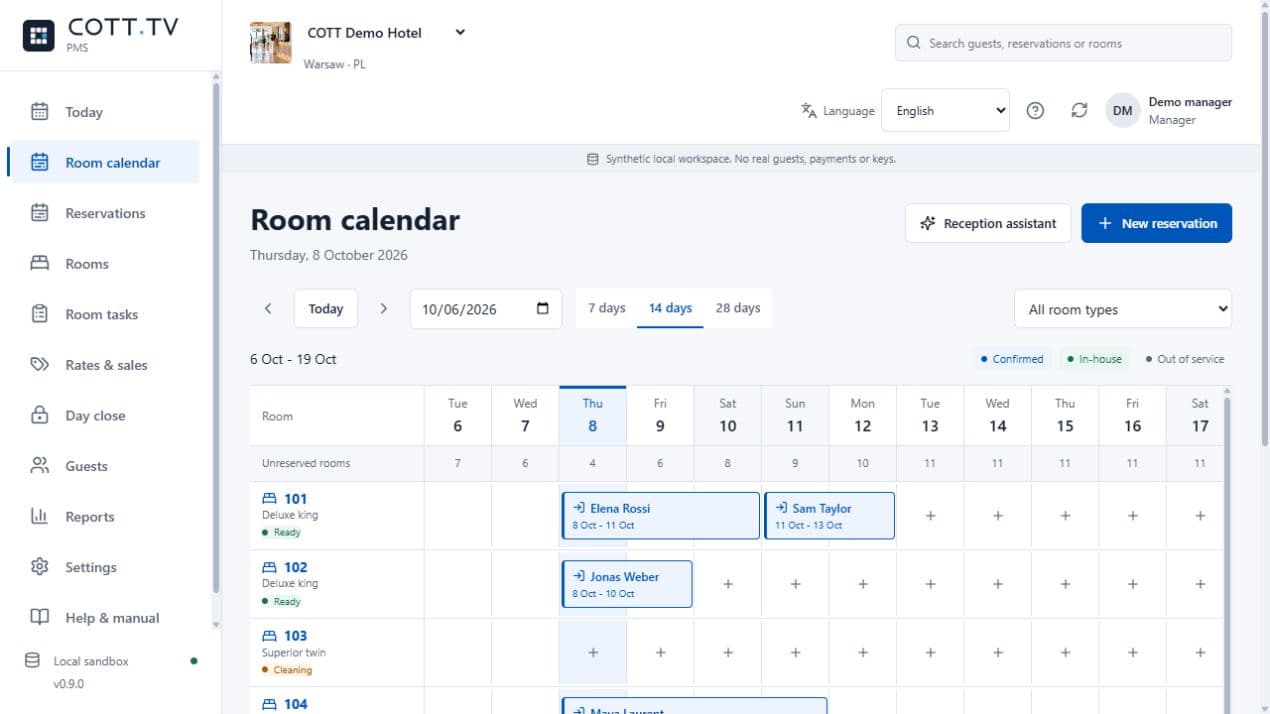
Introducing COTT DESK: Hotel PMS, Built Around the Hotel Day
2026-10-15
COTT DESK brings reservations, reception, housekeeping and guest accounts together. Applications open for a selected 90-day Founding Hotels pilot.