Emergency Messaging on Hotel TVs: A Property-Level Response Plan
August 26, 2026
Research period: May 2026
By COTT.TV Hospitality Technology Research Desk·Published August 26, 2026·2 min read

Quick Summary
Treat television messaging as a governed secondary channel. Pre-approve scenarios, restrict activation rights, keep wording short, test power and network assumptions, provide multilingual variants and record every activation.
A room television can reinforce an emergency instruction, but it cannot replace alarms, public-address systems, staff procedures or statutory life-safety equipment. Its value is reach and clarity: a large screen can repeat the approved instruction in the guest's language and show what to do next.
Define the role before the incident
The property emergency plan should state who may activate a message, which authority approves the wording and how the message interacts with alarms, PA, SMS, staff calls and physical evacuation. The television must never create contradictory instructions.
Use scenario templates for evacuation, shelter in place, severe weather, utility failure and local security events. Each template needs a severity, target area, start time, expiry, owner and cancellation message.
Write for a guest under stress
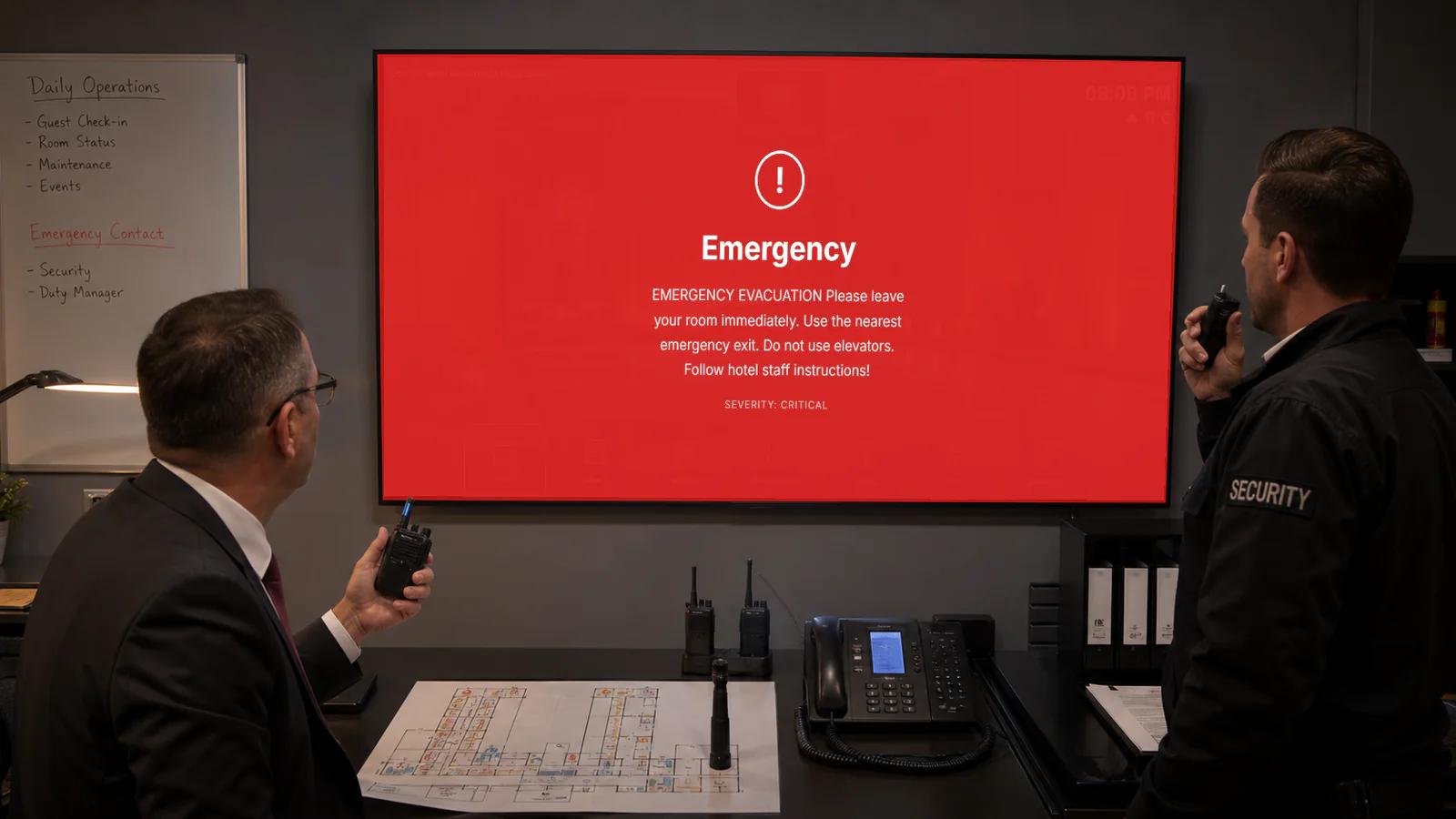
Lead with the action. Use short sentences and concrete locations. Avoid internal codes. State whether lifts may be used, where guests should go and whose instructions they should follow. Show one message per screen with strong contrast.
Translations should be reviewed before the emergency, not generated for the first time during it. Local legal and fire-safety teams should approve the operational wording.
Control activation
Use named accounts, least privilege and multi-person approval for the highest severity where time allows. The system should log who activated the message, affected properties or rooms, text, language, time and acknowledgement or delivery state.
Separate a marketing push from an emergency override. Staff should not be able to select a critical red-screen template from the same casual workflow used for a restaurant offer.
Test the real dependencies
Ask what happens when the property internet is down, the TV is in standby, a guest is watching an external HDMI source or a room device is offline. Test representative models and deployment paths. Keep another communication channel for every failure mode.
Run a silent quarterly drill to verify targeting and device reach, followed by a controlled visible test in designated rooms. Record gaps by floor, model and network segment.
Close the incident properly
Every emergency message needs an expiry or explicit all-clear. After the event, preserve the audit record, remove stale overlays and review delivery failures. Update templates after lessons learned.
COTT.TV emergency layer
COTT.TV can display a full-screen high-priority message across targeted room endpoints from central administration. Property and group roles allow the operating procedure to match the organisation. This capability should be integrated into the hotel's approved response plan and tested alongside, never instead of, mandatory safety systems.
Sources and further reading
- 1European Commission: GDPR integrity and confidentiality principles
- 2CISA: Zero Trust Microsegmentation Guidance
- 3AWS: Streaming Media Failure Management
Hotels must follow national law, fire authority instructions and their approved emergency plan. Television messaging is an additional communication channel, not certified life-safety equipment.
Related Posts

Hotel TV Content Analytics: What Broadcasters and Hotels Should Measure
2026-10-08
A privacy-safe reporting model for channel reach, authorised hotels, viewing time, playback quality, territory and monthly partner reports.
Secure Hotel Casting in 2027: AirPlay, Google Cast and Checkout Privacy
2026-09-22
A technical and operational guide to room-specific pairing, network isolation, checkout reset and acceptance testing for hotel casting.

Hotel Technology Vendor Lock-In: Exit, Data and Device Portability Checklist
2026-09-13
The contractual and technical exit questions hotels should answer before placing property data, room devices and operational workflows inside a platform.