What the European Accessibility Act Actually Requires from Hotel TVs
May 15, 2026
By COTT.TV Editorial·Published May 15, 2026·12 min read
Quick Summary
The European Accessibility Act took effect on 28 June 2025. Modern hotel TV and IPTV systems can fall within scope when they provide access to audiovisual media or interactive guest services. Hotels procuring new systems in 2026 should ask vendors for WCAG 2.1 AA conformance d…
On 28 June 2025, an EU directive that few in hospitality had been tracking quietly came into force across all 27 member states. Almost no one in the industry wrote about it. Most hotel technology vendors still haven't.
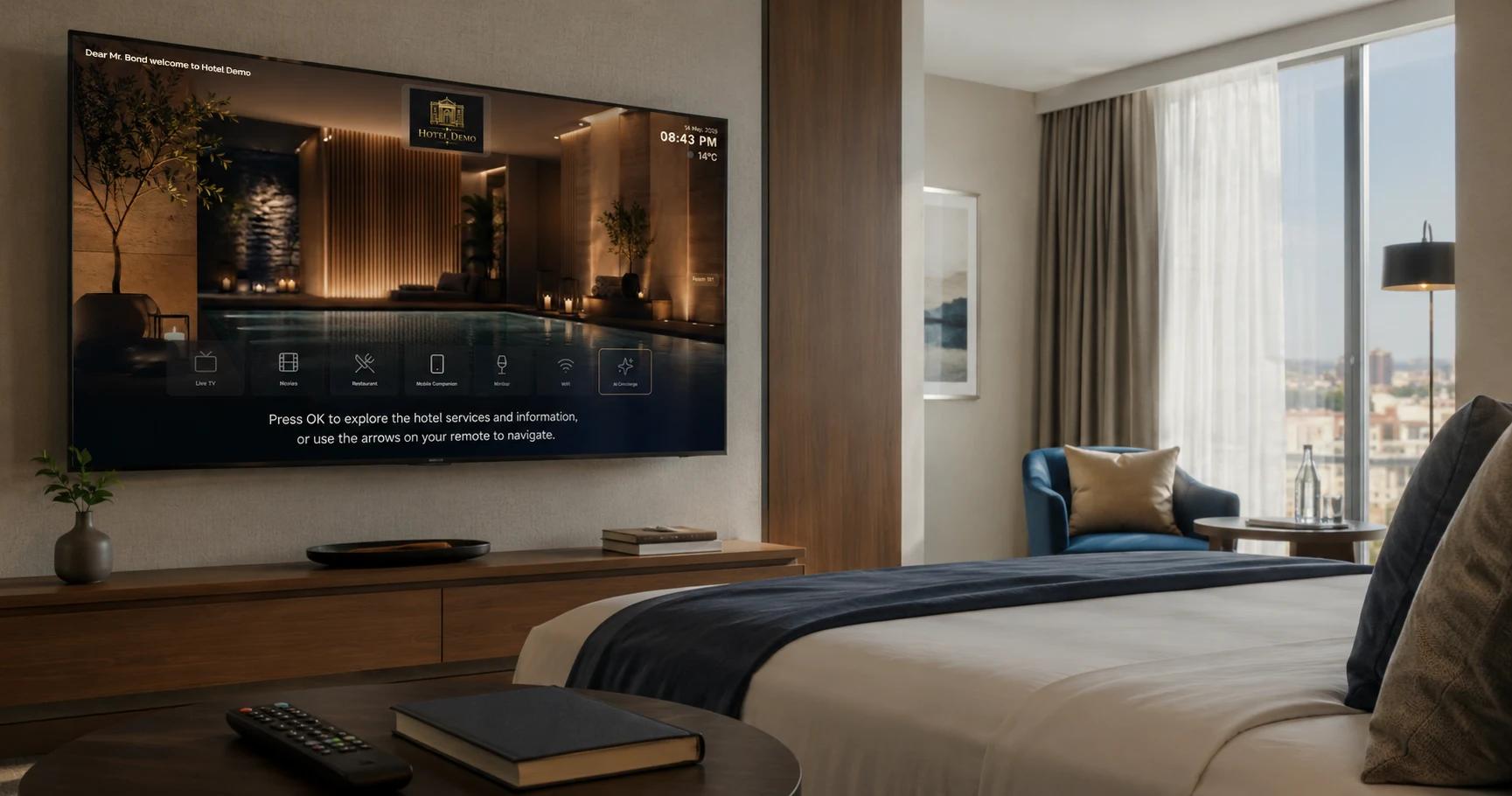
The European Accessibility Act, Directive (EU) 2019/882, applies to consumer electronics, audiovisual media services, e-commerce, banking, and a dozen other categories that touch hotel operations every day. Modern hotel TV and IPTV systems can fall within scope when they provide access to audiovisual media, interactive guest services, booking flows, or e-commerce-style functions. That covers most cloud-based platforms in the European market. It also covers the guest-facing apps and digital menus that ride on the screen, and the booking flows and concierge interfaces that connect to them.
Within weeks of the deadline, French disability advocacy groups issued formal legal notices to four major grocery retailers. By November 2025, emergency injunctions were filed against companies whose remediation efforts proved insufficient. Germany, Italy, and Spain have each designated enforcement authorities and started building case loads. Several other member states have moved into active monitoring through autumn 2025.
Penalties vary by member state. National frameworks include corrective orders, administrative fines, service restrictions, product withdrawal, daily penalties, and in some jurisdictions turnover-based sanctions. Fines in the tens or hundreds of thousands of euros appear in several national transpositions. The regulatory logic mirrors GDPR: accessibility shifts from voluntary best practice to market-access requirement.
What this means for hotel operators, in plain terms, is that the screen mounted on every guest room wall is increasingly subject to the same accessibility scrutiny as a corporate website.
Who has to comply
The EAA's reach is broader than most hoteliers assume. The directive applies to businesses that sell products or services to consumers in the EU, regardless of where the business is incorporated. A hotel in Tbilisi that accepts bookings from EU residents falls under EAA scope for those bookings. A hotel outside the EU that actively offers covered services to EU consumers (online booking, paid digital services, guest-facing platforms accessible during a stay) may also be in scope. Simply being incorporated outside the EU is not, on its own, a defence.
The microbusiness exemption is real but narrow. Companies with fewer than ten employees and annual turnover under €2 million are exempt from the services provisions. Almost no hotel chain qualifies, and many independent hotels with more than a handful of rooms have already passed the turnover threshold.
Existing services have until June 2030 to come into full compliance. New services launched after June 2025 must comply immediately. The distinction matters. An in-room TV system installed in 2023 has runway. A system being installed now does not.
The list of products and services in scope includes consumer general-purpose computer hardware, audiovisual media services and the equipment that delivers them, e-readers, ticketing and check-in machines, transport-related digital services, banking, e-commerce, and services providing access to audiovisual media services. Hotel IPTV systems sit at the intersection of several of these categories.
What the directive actually requires
The EAA itself doesn't list technical specifications. It states functional accessibility outcomes and points implementers to harmonised European standards for the engineering detail. The relevant standard is EN 301 549, which currently incorporates the Web Content Accessibility Guidelines (WCAG) 2.1 at Level AA. WCAG 2.2 is on the roadmap, but for now WCAG 2.1 AA is the operative benchmark.
For a hotel TV system, that translates into roughly the following.
Captions and subtitles must be available for prerecorded and live audiovisual content where the original broadcast supports them. Where audio description tracks exist for video-on-demand content, the system must surface them. Screen reader compatibility is required for menus and information layers, which means the interface markup needs to expose semantic structure rather than ship pixel-perfect images of text.
Contrast ratios in user interfaces must hit 4.5:1 for normal text and 3:1 for large text. Users must be able to enlarge text to 200% without losing functionality. Information conveyed through colour must also be conveyed through some other means. Navigation must work entirely with the remote, with no mouse-equivalent fallbacks. The language of each page or screen must be programmatically declared so screen readers can pronounce it correctly.
None of this is exotic. Most of it has been web accessibility standard practice for fifteen years. The shift is that it is now a regulatory requirement on platforms that historically lived outside the web accessibility conversation.
One requirement that does surprise vendors: an accessibility statement must be published in accessible formats, describing how the service meets the applicable accessibility requirements and where limitations remain. For multilingual hotel services, the statement should be available in the languages used for the guest-facing service itself. This is the part that most hotel TV vendors have not yet produced.
Enforcement is already underway
The first six months of EAA enforcement have not been quiet. Within ten days of the 28 June 2025 deadline, French disability advocacy organisations issued formal legal notices to four major grocery retailers demanding their e-commerce platforms be brought into compliance by September. When the September deadline arrived with the retailers still non-compliant, emergency injunctions followed in November.
France routes EAA enforcement through ARCOM and the DGCCRF. Germany uses the Federal Network Agency. Italy uses AGID and the Ministry of Enterprises. National enforcement authorities in Spain, the Netherlands, Sweden, Denmark, and Ireland have each begun their own market surveillance programmes through 2025.
The pattern across member states is consistent. Remediation comes before fines, with escalation paths that get expensive quickly. Some member states allow private civil action by disability advocacy groups, which means hotels can find themselves in court without a regulator ever opening a case.
Hospitality has not been an enforcement priority in the first wave. Retail, banking, and transport have. But the trajectory is clear, and the EAA explicitly lists services providing access to audiovisual media services, a category that includes hotel TV, in its scope.
What hoteliers should be asking vendors
A review of public-facing materials from major hospitality TV vendors in spring 2026 finds few current WCAG conformance reports and almost no public accessibility statements. Accessibility documentation remains uncommon in this category. That is not a final answer, just the current state. The right move for any hotel doing a 2026 tech procurement or audit is to put accessibility in writing.
A short list of questions that get past the marketing layer.
Does the product conform to WCAG 2.1 AA? If so, when was the conformance evaluation done and by whom? Independent third-party audits carry more weight than self-attestation, though both should appear in the answer.
Does the platform support closed captions on live and on-demand video, and does the interface let guests toggle them with two clicks or fewer? Captions are the single most common accessibility feature guests actually use. If a vendor can't demonstrate caption toggle on the TV demo, that is a finding.
Where audio descriptions are available in source content (BBC, ARTE, ARD, and many streaming providers now ship them by default), does the system pass them through? Audio descriptions are mandatory under WCAG 2.1 success criterion 1.2.5 at Level AA.
Is the interface tested with screen readers? Hotel TVs typically don't ship with screen readers built in, but the interface still needs to be semantically structured to permit external assistive technology pairing.
Has the vendor published an accessibility statement? If not, ask when one will be ready. Under the EAA, that statement is not optional once a service is sold into the EU market.
One last question worth asking: who at the vendor owns accessibility? In most hotel tech companies, the answer today is "nobody specifically." That is also a finding.
Where the industry actually stands
The pattern across vendor marketing is consistent. Most hospitality TV vendor websites list features by guest-experience benefit: casting, AI concierge, brand customisation, integration with property management systems. Accessibility appears, when it appears at all, as a single bullet point.
This is not because vendors are hostile to accessibility. The category is mostly indifferent. Accessibility has historically been a checkbox item in RFPs, not a strategic priority, and the engineering culture in hospitality tech has favoured features that drive procurement decisions over features that satisfy compliance obligations no one was enforcing.
The EAA changes the equation by making enforcement plausible. It doesn't make accessibility a marketing differentiator overnight, but it does make accessibility absence a risk-management problem. Hotels that buy without due diligence may find themselves liable for non-compliance their vendor never warned them about.
There is one practical upside. Modern hospitality TV platforms built on web technology (HTML, modern browser engines, structured data) have a much shorter path to compliance than legacy on-premise systems that mix proprietary middleware with hardware-driven UIs. The vendors that have already moved to cloud-native architectures are mostly there technically. They just haven't done the conformance work and the documentation.
COTT.TV's approach
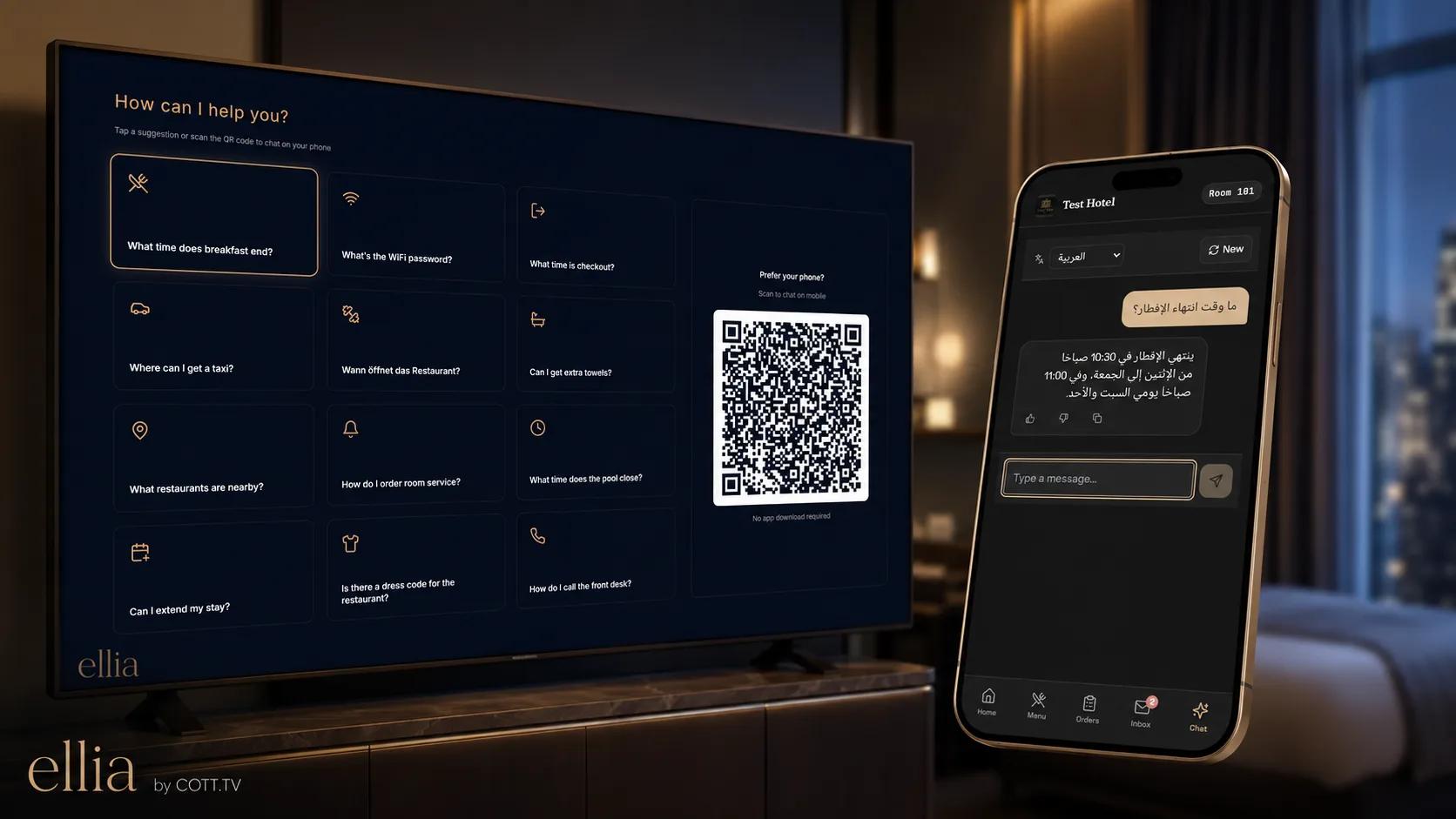
COTT.TV's posture reflects the direction the EAA pushes the industry toward. The architecture is cloud-native, the user interface is HTML-based and rendered with modern web engines, and the platform's multilingual layer (35 languages via the Ellia AI concierge) supports one prerequisite for EAA-aligned accessibility: each interface language needs to be programmatically declared and exposed through semantic UI structure so that assistive technologies can render it correctly.
What the platform doesn't do, and what no vendor should claim to do, is "make a hotel EAA compliant." Compliance is a property-level posture that depends on how the TV system is configured, what content the hotel licenses, and how the hotel documents its own accessibility statement. The role of a vendor is to provide the technical substrate that makes compliance achievable.
COTT.TV's accessibility direction includes work toward a formal statement aligned with EN 301 549, alongside caption and audio description handling, contrast modes, and remote-control navigation patterns suited to the EAA's functional requirements.
What changes in the next twelve months
Three things will define the EAA's impact on hospitality through the second half of 2026 and into 2027.
First, enforcement will move down the priority list. Retail e-commerce was the obvious first target because it generates the most consumer complaints. Banking and transport will follow. By late 2026, market surveillance authorities will start audits in sectors that haven't yet been touched, and hospitality is on the list. A hospitality test case is becoming increasingly plausible as enforcement reaches beyond retail, banking, and transport. If one emerges, it is unlikely to involve the major chains. Large chains have legal teams that have been working on this for two years. The first case is more likely to surface at a mid-sized property or regional chain that bought a hotel TV system without asking the right questions.
Second, WCAG 2.2 is likely to shape the next compliance cycle. The EU is updating EN 301 549 to incorporate WCAG 2.2, with a publication target of late 2026 or early 2027. The standard isn't yet the harmonised benchmark, but hotels and vendors working toward WCAG 2.1 AA today should already be planning for the 2.2 deltas. The substantive changes are not dramatic, but they include several new success criteria around dragging movements, focus appearance, and consistent help availability that affect interface design.
Third, accessibility will start appearing in procurement RFPs as a hard pass/fail item rather than a soft preference. This shift is already happening in EU public-sector tenders. It will reach corporate hospitality procurement within the year.
What to do this quarter
If you operate hotels that sell to EU consumers, three actions are worth taking before the end of Q2 2026.
Run a current-state audit of your hotel TV system against WCAG 2.1 AA. This can be done internally with automated tools (which catch roughly 30 to 40% of issues) and supplemented with manual review of caption availability, contrast, and remote-control navigation. Document what you find.
Send your hotel TV vendor a written request for their accessibility documentation. Their response, or absence of response, becomes part of your compliance file.
Begin drafting your property-level accessibility statement. The statement does not need to claim full compliance. It needs to describe accurately what your service does and does not yet do, what the timeline for remediation looks like, and how guests with accessibility needs can contact the property.
For most hotels, the EAA won't show up as a dramatic enforcement event. It will show up as a series of small procurement, audit, and documentation requirements that gradually become non-negotiable. Working on accessibility this year is cheaper than catching up later, particularly once the first hospitality enforcement action lands somewhere in the EU.
Want to walk through hotel TV compliance for your property? Talk to the COTT.TV team. A 30-minute call covers your current system, the practical compliance path for your property profile, and where the gaps actually sit.
This article is general information about the European Accessibility Act and is not legal advice. Hotels with specific compliance questions should consult qualified counsel in their jurisdiction of operation.
Related Posts
How Hotels Get Found in AI Search: A Practical GEO and SEO Guide for 2026
2026-08-17
AI travel discovery rewards consistent facts, original local expertise and pages that answer real questions. Here is a practical hotel workflow for Google, ChatGPT-style search and direct-booking visibility.

Hotel TV Cybersecurity in 2026: A NIS2 and IoT Reality Check
2026-05-15
Hotel cybersecurity is no longer limited to PMS, payments, and reservation systems. Smart TVs, STBs, casting middleware, PMS integrations, and guest-room IoT now belong in the procurement risk file.
Beyond Chatbots: How Ellia AI Serves Hotel Guests in 35 Languages
2026-05-14
How Ellia, COTT.TV's AI concierge, serves hotel guests in 35 languages across 200+ European properties, and what production data reveals about front desk economics.