Beyond Chatbots: How Ellia AI Serves Hotel Guests in 35 Languages
May 14, 2026
By COTT.TV Editorial·Published May 14, 2026·8 min read
Quick Summary
Walk into any European hotel front desk on a Saturday morning and watch what happens. The receptionist switches languages three times in five minutes: English, German, French, maybe Polish or Italian if the property is in a tourist corridor. Behind the counter, the morning s…
Walk into any European hotel front desk on a Saturday morning and watch what happens. The receptionist switches languages three times in five minutes: English, German, French, maybe Polish or Italian if the property is in a tourist corridor. Behind the counter, the morning shift handles check-ins, late-checkouts, restaurant reservations, taxi bookings, and a dozen smaller asks. The math is simple and brutal. A single front desk speaks four or five languages well, sometimes six. Hotel guests speak thirty-five.
That gap is where most hotel technology has failed. "Multilingual" usually means a static menu translated by an agency once, plus a chatbot that handles English in five canned scripts. Guests notice. They give up and call the front desk anyway. Or worse, they don't ask at all and rate the stay lower.
Over the past eighteen months, COTT Electronics has been building a different answer. Ellia is an AI concierge live in 200+ European hotels, fluent in 35 languages, available on the in-room TV and every guest's phone. This piece explains how Ellia works, why language coverage is the unsolved problem in hospitality tech, and what the deployment data tells us about where AI in hospitality is heading next.
What makes Ellia different from a generic chatbot
Most hotel chatbots are autocomplete with branding. They map common questions to canned responses. When they hit a gap, they fall back to "let me connect you to the front desk." And they forget the guest the moment the session ends.
Ellia operates on three different design principles.
Stay-context awareness. Ellia knows the room she's talking to. Each room number carries context: the guest's check-in date, check-out date, languages they've used in past queries, and the requests they've made during the stay. When a guest in room 412 asks "what time should I leave for the airport?" at 6 a.m. on departure day, Ellia answers using their actual check-out time, the actual airport, and current traffic. No generic FAQ.
Hotel-specific knowledge ingestion. Hotels upload their service menus, policies, local guides, and seasonal information once. Ellia reads everything, structures it internally, and stays accurate without per-message tuning. When the restaurant changes its breakfast hours next quarter, the hotel updates one document. Ellia speaks the new hours in 35 languages within the hour.
Tone calibration. A luxury resort and a budget business hotel both deploy Ellia, but the guest never hears the same voice. Each hotel configures Ellia's response style (formal, conversational, regional) and the calibration holds across every language. A guest asking "können Sie mir einen Tisch im Restaurant reservieren?" in a five-star Berlin property gets a different register than the same question in a boutique aparthotel in Tbilisi. Both feel like the hotel's own voice.
The architecture sits on Anthropic's Claude API, the same model family used by Fortune 500 companies for production AI deployments. COTT.TV wraps it in a hospitality-specific orchestration layer that handles room state, language detection, brand voice rules, and PMS integration.
35 languages, one consistent voice
European hospitality is structurally multilingual in a way most other industries aren't. A single property in Vienna might serve guests from the EU institutions, the IAEA, OSCE delegations, business travelers from MENA, summer tourists from East Asia, and weekend visitors from neighboring Bratislava and Budapest. None of them share a default language with the rest.
In Ellia's first eighteen months of production deployment across 200+ properties, five languages account for the majority of guest query volume:
Top Languages by Guest Query Volume
The distribution reflects the geographic spread of COTT.TV deployments. English dominates as the lingua franca of European business travel. German concentrates in DACH-region deployments and Vienna's diplomatic corridor. Georgian carries the Tbilisi and Batumi properties. Arabic reflects Gulf travel patterns into Mediterranean and Caucasus destinations. Spanish covers Mediterranean resorts and Latin American business inbound.
The long tail matters too. Ellia regularly handles queries in Japanese, Mandarin, Hebrew, Turkish, Polish, Czech, Italian, French, Portuguese, Dutch, Greek, Bulgarian, Romanian, Hungarian, Korean, Russian, Ukrainian, Hindi, Persian, Thai, Vietnamese, Indonesian, Swedish, Norwegian, Danish, Finnish, Croatian, and Serbian. No front desk can staff that coverage. No static translation can provide it.
The difference between Ellia and translation tools is consistency. Google Translate gives a different sentence every time. Ellia preserves the hotel's brand voice: a chosen register, a specific level of formality, the way the hotel writes about itself. That voice reproduces across every language. A guest asking about the spa in Korean gets the same warmth and specificity as the English version. The brand fingerprint stays the same. That consistency is what guests perceive as "the hotel cares" rather than "the hotel uses software."
Where Ellia lives: TV and mobile, same brain
The in-room TV is the highest-value surface in hospitality. Guests look at it. They expect entertainment. They don't expect to talk to it. Ellia uses that surface to do something different: become the room's information layer.
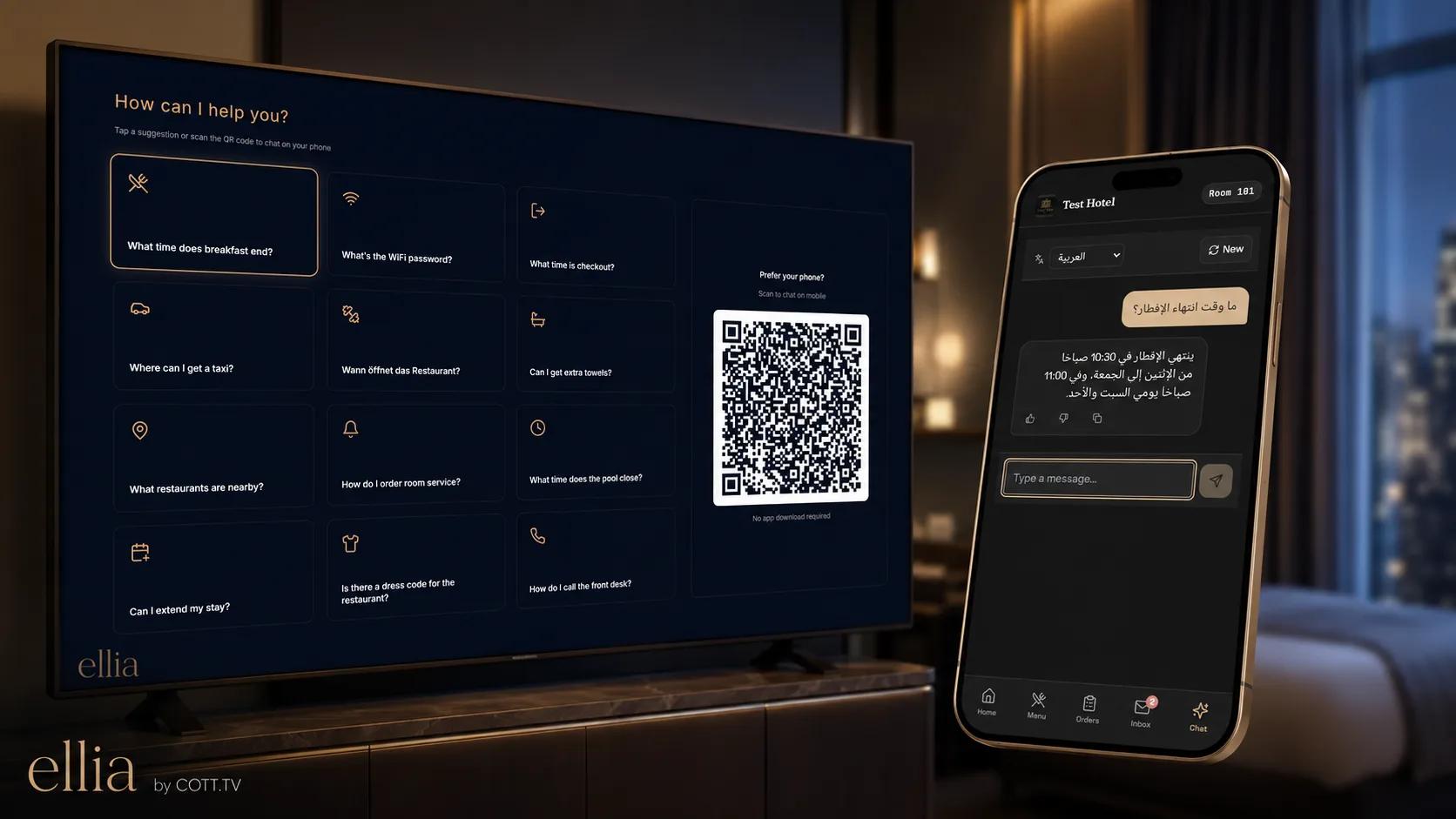
The TV experience is tile-based by default. Ellia surfaces the questions guests most often ask ("What time does breakfast end?", "What's the WiFi password?", "Where can I get a taxi?") as one-tap cards, then opens into conversation when the guest taps in. No remote control gymnastics, no app to install. The TV is already on.
For longer conversations (restaurant orders, detailed local recommendations, language switching mid-conversation), guests scan a QR code on the TV and the conversation transfers to their phone in one tap. No download, no account, no friction. The session state moves with them. An order started on the TV finishes on the phone. A question started on the phone picks up on the TV.
The dual-surface design solves a real problem. The TV is great for discovery (large screen, low effort) but useless for typing or privacy. The phone handles sustained interaction well, but it's not the first thing a guest reaches for when they walk into a room. Ellia handles both surfaces as one system. The conversation history sits on the hotel's secure platform, encrypted, EU-hosted, and deleted at checkout under GDPR.
Beyond Q&A: front desk deflection economics
The hospitality industry has measured guest service in heads on the front desk for sixty years. AI is starting to change the unit economics in a way that has nothing to do with replacing humans.
Across production deployments (ORBI City in Batumi, Hotel Georgia Palace, Alliance Palace, and 200+ other European properties), Ellia handles between 30% and 45% of guest inquiries that would otherwise reach reception. The deflection is heaviest on three categories: WiFi credentials, hours-of-operation questions, and language-specific information requests. None of these require a human. When they reach a human anyway, they pull staff away from the inquiries that actually do need a person.
The economic effect is straightforward. A mid-sized property with 150 rooms and a four-person front desk team typically logs 80 to 120 routine guest inquiries per day depending on occupancy. Removing 35 to 45% of those frees roughly one staff-hour per shift. That hour goes back to check-in friction, complaint resolution, and the in-person interactions that move guest reviews.
Hotels deploying Ellia don't report layoffs. They report that front desk staff are visibly less stressed during peak check-in and check-out windows. Guest review sentiment improves on attributes like "responsive staff" and "personalized service." Those attributes are easier to deliver when the team isn't being interrupted every six minutes to hand out a WiFi password.
The other side of the economics is what guests do more of when AI is available. Properties deploying Ellia consistently report a measurable uplift in room service orders, spa reservations, and late-checkout requests. These are services guests already wanted. They just didn't bother calling the front desk to ask, because that felt like an imposition. A chat interface lowers that friction to near-zero.
What is next for AI in hospitality
Ellia today is text-first and reactive. Guests ask, Ellia answers. The next phase of hospitality AI gets more proactive and more sensory.
Voice-first interactions. The in-room TV becomes a voice surface, not only a tap interface. Guests speak to Ellia naturally ("what time does the pool close" instead of typing), and the conversation feels closer to talking to a concierge in person.
Proactive recommendations. Ellia today answers when asked. The next version initiates: noticing that a guest hasn't ordered room service in two days, suggesting the new restaurant has tables tonight, or alerting reception that a flight has been delayed and offering a late check-out automatically.
PMS-aware automation. Deep integration with property management systems lets the AI act, not only inform. A guest asking "can I extend my stay by one night" gets an answer that checks real availability, applies the right rate, processes the change with reception's approval, and updates the room status. All in one conversation.
COTT.TV is investing in all three directions. Voice rollout is in private testing across pilot properties. Proactive recommendations are scheduled for the second half of 2026. Deeper PMS automation is the 2027 roadmap.
See Ellia in production. Start a 14-day free trial, all features included, no credit card required. Or explore Ellia in detail to see how a 35-language AI concierge fits your property.
Related Posts
Secure Hotel Casting in 2027: AirPlay, Google Cast and Checkout Privacy
2026-09-22
A technical and operational guide to room-specific pairing, network isolation, checkout reset and acceptance testing for hotel casting.

Hotel TV Channel Lineup by Guest Mix: A Rights-Aware Planning Method
2026-09-11
A country, language and guest-segment method for selecting hotel channels without buying a large package that nobody watches.

Hotel Mobile Keys in Apple Wallet and Google Wallet: What Hotels Need to Know
2026-08-18
A practical guide to hotel mobile keys, NFC locks, Apple Wallet, Google Wallet, PMS integration, security and realistic deployment planning.