Hotel IPTV and GDPR: Complete Data Privacy Compliance Guide for…
April 8, 2026
By COTT.TV Editorial·Published April 8, 2026·17 min read

Quick Summary
The General Data Protection Regulation (GDPR) is the most comprehensive data privacy framework in the world, and it applies to every system within a hotel that processes guest personal data, including your IPTV platform. Since modern hotel IPTV systems integrate deeply with P…
Hotel IPTV and GDPR:
Complete Data Privacy Compliance Guide for European Hotels
The General Data Protection Regulation (GDPR) is the most comprehensive data privacy framework in the world, and it applies to every system within a hotel that processes guest personal data, including your IPTV platform. Since modern hotel IPTV systems integrate deeply with Property Management Systems (PMS), they inevitably handle personal information such as guest names, language preferences, loyalty status, and behavioural data generated through interactive features.
The consequences of non-compliance are severe. Supervisory authorities across Europe can impose fines of up to €20 million or 4% of a company's global annual turnover, whichever is higher. Beyond financial penalties, a data breach or compliance failure can cause lasting reputational damage to a hotel brand, particularly damaging in an industry built on trust and guest satisfaction.
This guide provides a complete, practical overview of how GDPR applies specifically to hotel IPTV deployments across Europe. Whether you are evaluating a new IPTV provider, auditing your current system, or preparing for a compliance review, this article covers the data types involved, the legal principles at play, a step-by-step compliance checklist, country-specific requirements, and common mistakes to avoid. By the end, you will have a clear roadmap for ensuring your hotel's IPTV system fully respects guest privacy while still delivering the personalised, modern experience that today's travellers expect.
---
What Guest Data Does Hotel IPTV Collect?
Understanding what data flows through your IPTV system is the essential first step towards compliance. Hotel IPTV data falls into three categories: data received from the PMS, data generated by guest interaction with the TV, and data that the IPTV system does not handle at all.
Data from PMS Integration
When a guest checks in, the PMS sends a subset of reservation data to the IPTV system to enable personalisation features. This typically includes:
- 1Guest name, used to display a personalised welcome message on the in-room television screen upon arrival.
- 2Language preference, allows the TV interface, electronic programme guide, and informational content to be displayed in the guest's preferred language automatically.
- 3Loyalty programme status, used to trigger special welcome messages, VIP content, or tailored promotions for returning guests or members of the hotel's loyalty scheme.
- 4Check-in and check-out dates, enables the system to activate and deactivate the guest profile at the correct times, and to schedule automatic data deletion.
- 5Room number, the fundamental identifier that links the guest profile to the correct television set within the property.
All of these data points constitute personal data under GDPR because they can directly or indirectly identify a natural person. Even a room number, when combined with dates, can identify a specific guest.
Data Generated by IPTV Usage
Once the guest begins using the in-room television, the IPTV system may generate additional data through interaction:
- 1Channel viewing history, which live TV channels the guest watched and for how long.
- 2Video on Demand (VoD) selections, which films, series, or other on-demand content the guest chose to watch.
- 3Room service orders, if the hotel offers room service ordering through the TV interface, the items ordered and the time of each order are recorded.
- 4Interactive feature usage, engagement with features such as the digital city guide, spa and restaurant booking modules, hotel information pages, and feedback surveys.
- 5Session timestamps, when the guest turned the TV on and off, and the duration of each viewing session.
This usage data, when linked to a guest profile, constitutes personal data. Even anonymised viewing statistics may be considered personal data if they can be re-linked to a specific room and date, and therefore to a specific guest.
Data NOT Typically Collected by IPTV
It is equally important to understand what a well-designed IPTV system does not collect:
- 1Credit card or payment information, financial transactions are handled entirely within the PMS or a dedicated payment gateway. The IPTV system should never store or transmit payment card data.
- 2Passport or identity document details, these are collected at reception for legal registration purposes and are not required for television personalisation.
- 3Guest location data beyond room number, IPTV systems do not track guest movement within the property. The only location data is the static room assignment.
---
GDPR Principles Applied to Hotel IPTV
GDPR is built on a set of core principles that must be applied to every system processing personal data. Here is how each principle translates into practical requirements for hotel IPTV.
1. Data Minimisation
Article 5(1)(c) of the GDPR requires that personal data be "adequate, relevant and limited to what is necessary in relation to the purposes for which they are processed." For hotel IPTV, this means the system should only request the minimum data fields from the PMS that are genuinely needed for TV personalisation. If your IPTV provider is pulling the guest's full reservation record, including dietary preferences, billing address, or passport number, that is a clear violation of data minimisation. A compliant IPTV system should be configurable to receive only the specific fields required: typically guest name, language, loyalty tier, room number, and stay dates.
2. Purpose Limitation
Article 5(1)(b) states that data must be "collected for specified, explicit and legitimate purposes and not further processed in a manner that is incompatible with those purposes." Guest data received by the IPTV system should be used solely for the stated purpose of personalising the television experience. Using guest names to compile marketing lists, or sharing viewing habits with third-party advertisers, would violate purpose limitation unless separate, explicit consent has been obtained for those specific additional purposes.
3. Storage Limitation
Article 5(1)(e) requires that personal data be "kept in a form which permits identification of data subjects for no longer than is necessary." In the hotel IPTV context, this translates to a clear requirement: guest personal data must be automatically purged from the IPTV system when the guest checks out. Best practice is immediate deletion triggered by the PMS checkout event. At maximum, data should be removed within 24 hours of checkout. There is no legitimate reason for an IPTV system to retain a guest's name, viewing history, or room service orders weeks or months after departure.
4. Consent and Lawful Basis
GDPR requires a lawful basis for processing personal data (Article 6). For hotel IPTV, the applicable bases are:
- 1Legitimate interest (Article 6(1)(f)), for basic TV operation and personalisation such as the welcome screen, language settings, and EPG display. The hotel has a legitimate interest in providing a functional, personalised guest experience, and the processing is proportionate and expected by the guest.
- 2Consent (Article 6(1)(a)), may be required for non-essential processing such as behavioural analytics, marketing messages displayed on the TV, or sharing anonymised usage statistics with third parties. If your IPTV system collects detailed viewing analytics for purposes beyond direct service delivery, you should obtain opt-in consent, which can be presented via the TV interface itself.
The key distinction is between what is necessary for the service the guest expects and what goes beyond that expectation.
5. Right to Access and Deletion
Under Articles 15 and 17, guests (data subjects) have the right to request access to all personal data held about them and to request its deletion. Your IPTV provider should offer mechanisms, whether through an admin dashboard or an API, that allow hotel staff to retrieve or delete a specific guest's data on request. While such requests are relatively rare in hospitality, the capability must exist and the procedure must be documented.
6. Data Processing Agreement (DPA)
Article 28 mandates that when a data controller (the hotel) engages a data processor (the IPTV provider), a written Data Processing Agreement must be in place. The DPA must specify the nature and purpose of processing, the types of data involved, the duration, and the obligations of the processor regarding security, sub-processors, data transfers, and breach notification. If your IPTV provider cannot or will not sign a DPA, that is an immediate red flag and potentially a compliance violation for the hotel.
---
Compliance Checklist for Hotels
This practical checklist covers the key actions every European hotel should complete to ensure GDPR compliance for their IPTV deployment:
1. ✅ Privacy notice displayed on TV welcome screen, Guests should see a brief, clear privacy notice when they first use the TV, explaining what data is collected and why. This can be a dedicated screen or a link to the full privacy policy accessible via the TV menu.
2. ✅ Data Processing Agreement signed with IPTV provider, Ensure a comprehensive DPA is in place that covers all GDPR Article 28 requirements. Review it annually and update it whenever the scope of processing changes.
3. ✅ Auto-deletion policy configured, Verify that your IPTV system is configured to automatically delete all guest personal data upon checkout or within a maximum of 24 hours. Test this regularly to confirm it functions correctly.
4. ✅ Guest rights procedure documented, Create a written internal procedure for handling data access and deletion requests related to IPTV data. Front desk and IT staff should know who to contact and what steps to follow.
5. ✅ EU-based data storage confirmed with provider, Request written confirmation that all guest data processed by the IPTV system is stored on servers located within the EU or EEA. If any data is transferred outside the EU, ensure adequate safeguards (such as Standard Contractual Clauses) are documented.
6. ✅ Encryption verified (in transit and at rest), Confirm that data transmitted between the PMS, the IPTV server, and the in-room TV sets is encrypted using modern protocols (TLS 1.2 or higher). Data stored on the IPTV server should be encrypted at rest using AES-256 or equivalent.
7. ✅ No unnecessary data sharing with third parties, Review your IPTV provider's sub-processor list. Ensure that guest data is not shared with advertising networks, analytics companies, or other third parties without a lawful basis and guest consent where required.
8. ✅ Staff trained on data privacy procedures, Include IPTV data handling in your regular staff GDPR training programme. Receptionists, IT staff, and management should understand the basics of what data the IPTV system handles and what to do if a guest raises a privacy concern.
9. ✅ Regular compliance audits scheduled, Schedule at least annual reviews of your IPTV data processing activities. This should include testing the auto-deletion mechanism, reviewing the DPA, checking for any changes in the provider's sub-processors, and verifying that data storage locations have not changed.
10. ✅ Breach notification procedure in place, Ensure your IPTV provider is contractually obligated to notify you of any personal data breach without undue delay (and within 72 hours at most). Your hotel must then assess the breach and, if it poses a risk to guests' rights and freedoms, notify the relevant supervisory authority within 72 hours and affected guests without undue delay.
---
How COTT.TV Handles GDPR Compliance
COTT.TV has been designed from the ground up with GDPR compliance as a core architectural principle, not a bolted-on afterthought. Here is how the platform addresses each key compliance requirement:
- 1EU-based data centres, All guest data processed by COTT.TV is stored exclusively in data centres located within the European Union. There are no transfers of personal data to servers outside the EU or EEA, eliminating concerns around international data transfer mechanisms.
- 2Automatic guest data purge, When a guest checks out and the PMS sends the checkout event, COTT.TV automatically and immediately purges all personal data associated with that guest from the system. The room's TV is reset to a clean, default state ready for the next guest.
- 3Signed Data Processing Agreement, COTT.TV provides a comprehensive, GDPR-compliant DPA to every customer as part of the standard onboarding process. The DPA clearly defines data processing purposes, security measures, sub-processor obligations, and breach notification procedures.
- 4No third-party data sharing, Guest personal data is never shared with third-party advertisers, analytics platforms, or any other external party without the hotel's explicit written authorisation and, where required, guest consent.
- 5Privacy-by-design architecture, The COTT.TV platform follows the privacy-by-design principle mandated by Article 25 of the GDPR. Data minimisation is built into the PMS integration, only the fields genuinely needed for personalisation are requested.
- 6End-to-end encryption, All data in transit is protected with TLS 1.3, the latest transport layer security protocol. Data at rest is encrypted with AES-256 encryption, meeting the highest industry standards.
- 7Regular security audits and penetration testing, COTT.TV undergoes regular independent security audits and penetration tests to identify and remediate vulnerabilities proactively.
- 8GDPR compliance documentation, Full documentation of COTT.TV's data processing activities, security measures, and compliance certifications is available on request. Hotels can review this as part of their vendor due diligence process.
For full details on our data privacy practices, visit our GDPR and Privacy Policy page.
---
Country-Specific Data Protection Requirements
While GDPR provides a unified framework across the EU, individual member states have enacted supplementary national legislation and maintain their own supervisory authorities. Hotels operating in multiple countries should be aware of local nuances.
| Country | Local Law | Supervisory Authority | Hotel IPTV Implications |
|---|---|---|---|
| Germany | DSGVO + TTDSG | BfDI + State DPAs | Strictest enforcement in EU. Cookie consent required for tracking. Guest viewing analytics may require explicit consent. |
| France | RGPD + Loi Informatique et Libertés | CNIL | CNIL actively enforces. Privacy notices must be in French. Consent required for non-essential data processing. |
| Spain | RGPD + LOPDGDD | AEPD | Requires specific DPA clauses. Privacy impact assessment recommended for IPTV deployments in large hotels. |
| Italy | GDPR + Codice Privacy | Garante per la Privacy | Garante has issued specific guidance on hotel data processing. Data retention limits strictly enforced. |
| Poland | RODO + Act on Personal Data Protection | UODO | UODO increasingly active. Cross-border data transfer notifications may be required. |
| Czech Republic | GDPR + Act No. 110/2019 | ÚOOÚ | Standard GDPR implementation. Focus on data minimisation and purpose limitation. |
| Netherlands | AVG + UAVG | Autoriteit Persoonsgegevens | Strong enforcement history. Data breach notification within 72 hours strictly enforced. |
| Austria | DSGVO + DSG 2018 | DSB | Similar to Germany. Special attention to guest data in the tourism sector. |
When deploying IPTV across properties in multiple EU countries, it is essential to verify that your provider's data processing practices satisfy the requirements of each local supervisory authority. In practice, designing for the strictest jurisdiction, typically Germany, will ensure compliance everywhere else. However, language-specific requirements, such as France's mandate for French-language privacy notices, must be addressed on a per-property basis.
Hotels should also be aware that some countries, particularly Germany and the Netherlands, have a track record of significant enforcement actions and fines. Properties in these jurisdictions should consider conducting a Data Protection Impact Assessment (DPIA) for their IPTV deployment, especially if the system processes data at scale across a large number of rooms or includes advanced analytics features.
---
Common GDPR Mistakes Hotels Make with IPTV
Based on industry experience and regulatory guidance, these are the most frequent compliance errors hotels make in relation to their IPTV systems:
1. Not signing a Data Processing Agreement with the IPTV provider. This is the single most common oversight. Many hotels deploy IPTV systems without ever executing a formal DPA. Under GDPR Article 28, this is a direct violation for the hotel as data controller. The DPA must be in place before any guest data is processed.
2. Keeping guest data after checkout. Some IPTV systems retain guest profiles and viewing histories indefinitely, either because auto-deletion was never configured or because the hotel wants to "recognise" returning guests. Unless the guest has given explicit consent for long-term data retention, all personal data must be deleted at or shortly after checkout.
3. Storing data outside the EU without adequate safeguards. If your IPTV provider uses cloud infrastructure hosted in the United States or other non-EU countries, you need to ensure that appropriate transfer mechanisms, such as Standard Contractual Clauses or an adequacy decision, are in place. Following the Schrems II ruling, this area requires particular attention.
4. Not providing a privacy notice on the TV. Guests should be informed about data collection when they use the in-room television. A brief privacy notice on the welcome screen or an accessible privacy information page within the TV menu satisfies this transparency requirement.
5. Sharing guest viewing data with advertisers without consent. Some IPTV platforms offer targeted advertising features that use guest data to display personalised advertisements. If this involves processing personal data for marketing purposes, explicit opt-in consent is required under GDPR.
6. Not having a breach response procedure. If guest data processed by the IPTV system is compromised, whether through a cyberattack, misconfiguration, or human error, the hotel must be prepared to respond within GDPR's strict timelines. Without a documented breach response procedure, hotels risk compounding the original breach with a notification violation.
---
Frequently Asked Questions
Does IPTV automatically mean I am collecting personal data?
Yes, if your IPTV system is integrated with your Property Management System (PMS). The moment guest names, language preferences, or any other identifying information is sent from the PMS to the IPTV platform, personal data processing is taking place under GDPR. Even without PMS integration, if viewing data can be linked to a specific room and a specific date, and therefore to a specific guest, it may still constitute personal data.
Do I need guest consent to show a personalised welcome screen?
Generally, no. Displaying a personalised welcome message using the guest's name and language preference can be justified under the legitimate interest lawful basis (Article 6(1)(f)). The guest reasonably expects this level of personalisation as part of the hotel service. However, if you go beyond basic personalisation, for example, tracking viewing behaviour to serve targeted content or marketing, then explicit consent is likely required.
Where should IPTV guest data be stored?
Within the European Union or European Economic Area. This is the simplest and most robust approach to compliance. If data must be stored or processed outside the EU for any reason, appropriate safeguards must be in place, such as Standard Contractual Clauses, Binding Corporate Rules, or reliance on an adequacy decision by the European Commission. Post-Schrems II, many supervisory authorities view EU-based storage as best practice for hospitality data.
What happens if there is a data breach involving IPTV guest data?
Under GDPR Article 33, the hotel must notify the relevant supervisory authority within 72 hours of becoming aware of a breach that poses a risk to guests' rights and freedoms. If the breach is likely to result in a high risk, guests must also be notified directly without undue delay (Article 34). Your IPTV provider's DPA should include a commitment to notify the hotel of any breach promptly, ideally within 24 hours, so the hotel can meet its own notification obligations.
---
Next Steps for Your Hotel
Ensuring GDPR compliance for your hotel IPTV system is not a one-time task but an ongoing commitment. Start by reviewing your current IPTV provider's GDPR credentials and requesting their Data Processing Agreement and supporting data processing documentation. If your current provider cannot demonstrate full compliance, it may be time to evaluate alternatives.
COTT.TV offers a fully GDPR-compliant IPTV platform designed specifically for the European hospitality market. To learn more about our privacy practices, visit our GDPR and Privacy Policy page. To explore our solutions and pricing, see our pricing page. For a detailed overview of our Hotel Information and Management System, visit HIMS.
Protecting your guests' data is not just a legal obligation, it is a demonstration of the respect and care that defines great hospitality.
Related Posts

Hotel TV as a Revenue Channel: Ancillary Sales Without Annoying Guests
2026-08-17
The room television can sell breakfast, spa, late checkout and local experiences, but only when offers are timely, useful, measurable and separate from intrusive advertising over TV content.

Case Study: How a 120-Room European Hotel Switched to Cloud IPTV in 3 Days
2026-04-08
Real-world case study of a European hotel deploying COTT.TV cloud IPTV. Timeline, challenges, results, and guest satisfaction improvement after switching from cable TV.
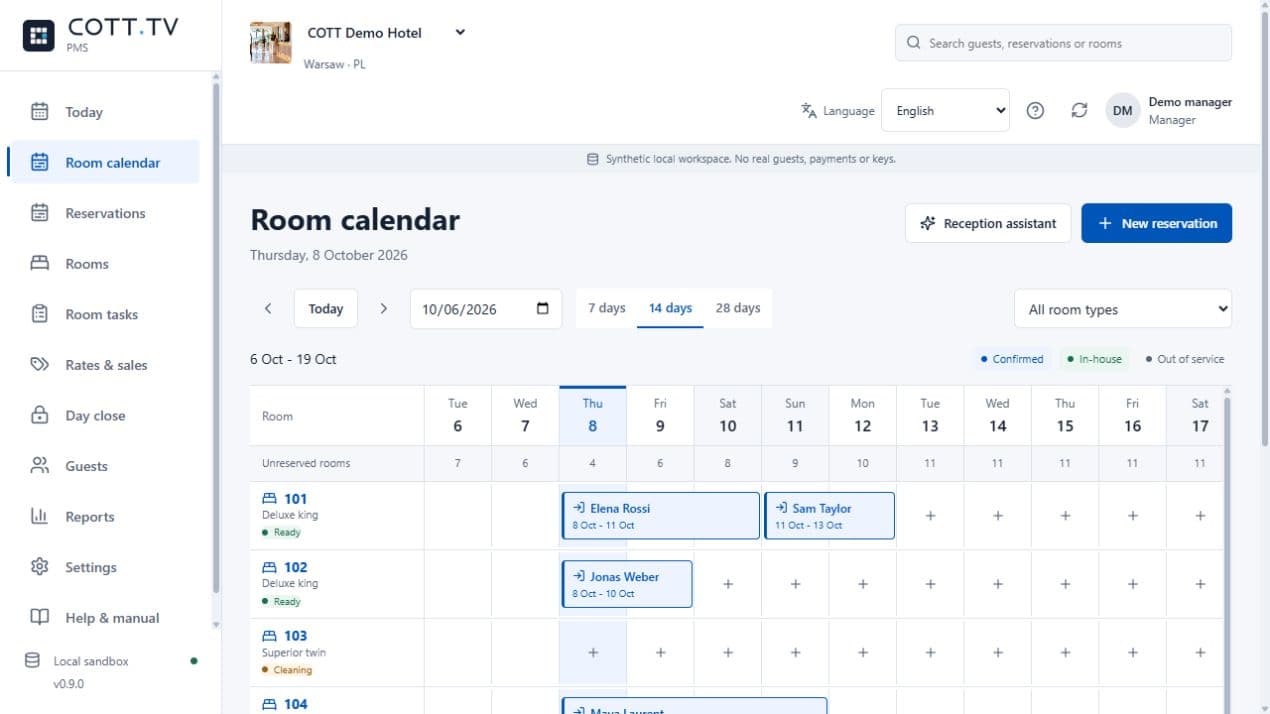
Introducing COTT DESK: Hotel PMS, Built Around the Hotel Day
2026-10-15
COTT DESK brings reservations, reception, housekeeping and guest accounts together. Applications open for a selected 90-day Founding Hotels pilot.